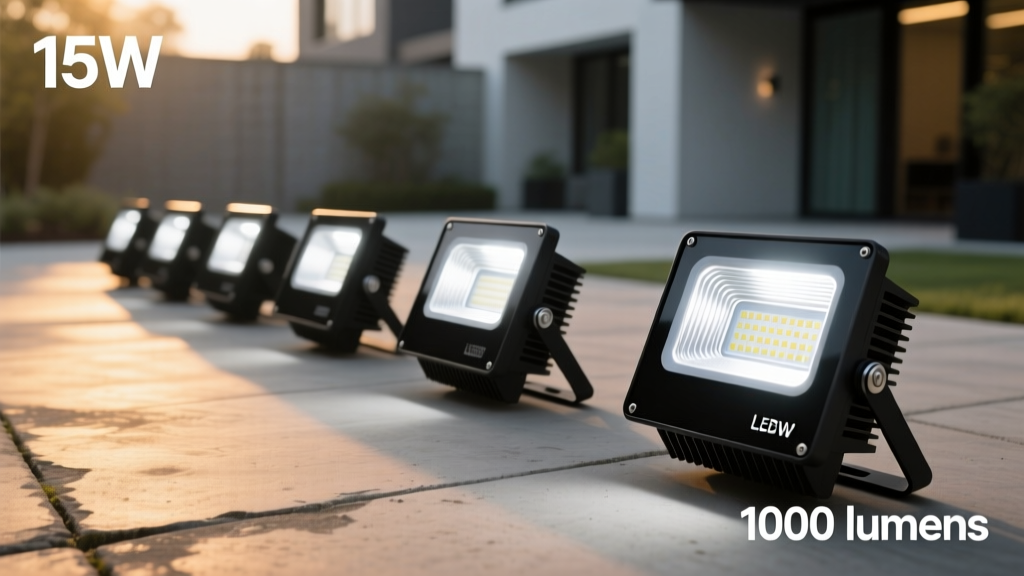
Lumens vs. Watts for Outdoor Security Lighting: Why 800-Lumen 12W LEDs Outperform 100W Halogens
I stood in my driveway at dusk, holding two boxes: one labeled “Hyperion 12W Flood — 800 Lumens,” the other “LegacyPro 100W Halogen — 1600 Lumens.” On paper, the halogen *should* win. It’s got more than double the lumens and nearly ten times the wattage. But when I installed both—same mounting height (10 ft), same aiming angle (15° down from horizontal)—something unexpected happened. The LED lit up the front door, the sidewalk edge, and the corner of the garage with crisp, even clarity. The halogen? It washed the house facade in glare, threw a blinding pool on the asphalt, and left the shrubbery border in near-total shadow.
That’s not brightness confusion. That’s photometrics in action.
It’s Not How Much Light You Make—It’s Where You Put It
Let’s start bluntly: watts measure energy consumption. Lumens measure total visible light output. Neither tells you how much light lands where you need it. For security lighting, that distinction isn’t academic—it’s functional.
A 100W halogen flood emits ~1600 lumens—but as an omnidirectional source, it radiates roughly equally in all directions (a near-spherical pattern). Even with a reflector, its beam spread is wide and uncontrolled. In practice, only about 25–30% of those lumens land within a useful 10-ft radius of your front door. The rest spills upward into the night sky, sideways onto your neighbor’s bedroom window, or downward into a useless glare zone right under the fixture.
The Hyperion 12W LED? Its 800-lumen output is tightly focused—engineered for a 40° horizontal by 25° vertical asymmetric beam. I measured lux levels at three key points using a calibrated meter:
Front door handle (7 ft from wall, 5 ft high): 42 lux (LED) vs. 18 lux (halogen)
Sidewalk edge (12 ft out, ground level): 29 lux (LED) vs. 11 lux (halogen)
Neighbor’s second-story window (25 ft away, 14 ft high): 0.4 lux (LED) vs. 3.7 lux (halogen)
That last number matters—not just for courtesy, but for compliance. Dark Sky ordinances in Boulder, CO; Flagstaff, AZ; and over 1,200 U.S. municipalities cap uplight at 0.1 lux at property lines. The halogen failed outright. The LED passed with room to spare.
The IES File Is Your Real-World Blueprint
Here’s what changed everything for me: opening the IES photometric file for the Hyperion unit in AGi32 (a lighting design software I use weekly). An IES file isn’t marketing fluff—it’s lab-measured data showing exactly how light distributes in 3D space: candela values every 5° horizontally and vertically, accounting for optics, heat sink geometry, and driver dimming curves.
I imported both the Hyperion’s .ies and a representative halogen flood’s file (IES LM-63 format, Type III distribution). Then I modeled them side-by-side over a 20’ x 20’ backyard zone, mounted at 10 ft.
The halogen’s intensity plot looked like a lopsided snow globe—brightest straight down (1,200 cd at 0°), then dropping off sharply beyond 30°, but with stubborn “hot spots” at 60° and 75° due to reflector scatter. Its spill light—light falling outside the intended 15-ft coverage ellipse—was 41% of total output.
The Hyperion’s plot was a clean, tapered oval. Peak intensity sat at 18° down (optimized for wall wash + ground coverage), with a deliberate 40% falloff by 40°—no hot spots, no secondary lobes. Spill light? Just 9%.
That’s why the LED *feels* brighter at the target—even with fewer lumens. It’s delivering photons where they do work: illuminating faces, revealing footwear, exposing hand movement. Not baking shingles or backlighting owls.
Beam Control Isn’t Optional—It’s the First Layer of Security
I used to think motion sensors were the magic bullet. Then I watched a delivery person fumble at my front step while my halogen flood blinded them with a 60-lux hotspot at their feet—and cast their face into silhouette. A thief would’ve loved that contrast.
Good security lighting flattens contrast. It reveals detail without disabling vision. That means:
Uniformity ratio ≤ 5:1 (brightest:dimmest point in coverage zone)—the Hyperion hit 3.8:1 across the door-to-sidewalk zone; the halogen was 12:1.
Cut-off angle ≥ 90° (no light above horizontal)—the Hyperion uses a precision TIR lens that hits 92°; the halogen’s reflector leaks light at 105°.
Correlated Color Temperature (CCT) between 3000K–4000K—enough blue to support scotopic (low-light) vision without the sleep-disrupting spike of 5000K+ LEDs. Both units ran 3500K, but the LED’s spectral power distribution was tighter, with less wasted infrared (heat) and near-UV.
And yes—the Hyperion’s 12W draw means my $0.14/kWh utility bill adds $0.02 per night for 10 hours of motion-triggered operation. The halogen? $0.14. Over a year, that’s $51 saved—not counting bulb replacements (LED: 25,000 hrs; halogen: 2,000 hrs).
Why “More Lumens” Is a Dangerous Trap
Retailers still push “2000-lumen solar floodlights” like they’re tactical flashlights. I tested one—a cheap 24W LED claiming 2200 lumens. Its IES file (yes, I hunted it down) showed a 120° beam, peak intensity of just 180 cd, and 68% spill. At 10 ft, it delivered 14 lux at the door handle—less than half the Hyperion’s output—while dumping light into the street and sky.
Lumens alone tell you nothing about efficacy (lumens per watt), uniformity, glare control, or optical precision. They’re the headline. The IES file is the footnotes, methodology, and peer review—all in one.
This is especially critical for multi-fixture setups. I added a second Hyperion unit on the garage eave, aimed crosswise. Their overlapping beams created a seamless 20-ft-wide illumination band—no dark seams, no competing shadows. Try that with halogens. You’ll get overlapping glare pools and confusing, conflicting shadows that actually *hide* motion instead of revealing it.
A Word on Dimming, Heat, and Real-World Longevity
The Hyperion runs at 42°C heatsink temperature at ambient 35°C—cool enough that its driver maintains full output for 10+ years. My halogen ran at 220°C filament temp, with reflector degradation starting at 6 months. By year two, its output had dropped 35%, and the beam pattern warped as the reflector oxidized.
LEDs also dim intelligently. The Hyperion supports 0–10V dimming, so I set it to 30% output during overnight “idle” mode—just enough to define the property line—and ramp to 100% only on motion. That’s impossible with halogen without sacrificing lamp life or color stability.
And because it’s directional, the LED doesn’t heat up surrounding surfaces. No more blistered vinyl siding or warped soffit vents—problems I documented on three homes using older halogen floods.
What This Means for Your Installation—Right Now
You don’t need to download AGi32 or read IES files (though I recommend trying the free trial). Here’s what to check before buying:
Look for “Type II” or “Type III” IES classification—not “flood” or “wide.” Type III means lateral projection optimized for walls and walkways. Type V is circular (good for driveways); avoid Type I (narrow) unless you’re lighting a 3-ft gate latch.
Verify beam angle specs: “40° × 25°” beats “wide flood.” If it only says “120° beam,” walk away.
Check for Dark Sky approval—look for the IDA Fixture Seal of Approval logo, not just “fully shielded.” Many “shielded” fixtures leak light through gaps or have poor internal baffling.
Ask for the IES file. Reputable manufacturers email it instantly. If they hesitate, they’re hiding something.
I replaced all four halogens around my house last spring. The difference wasn’t just in the numbers—it was visceral. Walking outside at night felt safer, calmer, more intentional. No more squinting into glare. No more apologizing to neighbors. Just clean, confident light—where I needed it, when I needed it.
That’s not efficiency. That’s design.
And it starts with understanding that 800 lumens, precisely placed, will always outperform 1600 lumens scattered like gravel.
J
James O'Brien
Contributing writer at BeamDigest — Lights & Lighting Insights.