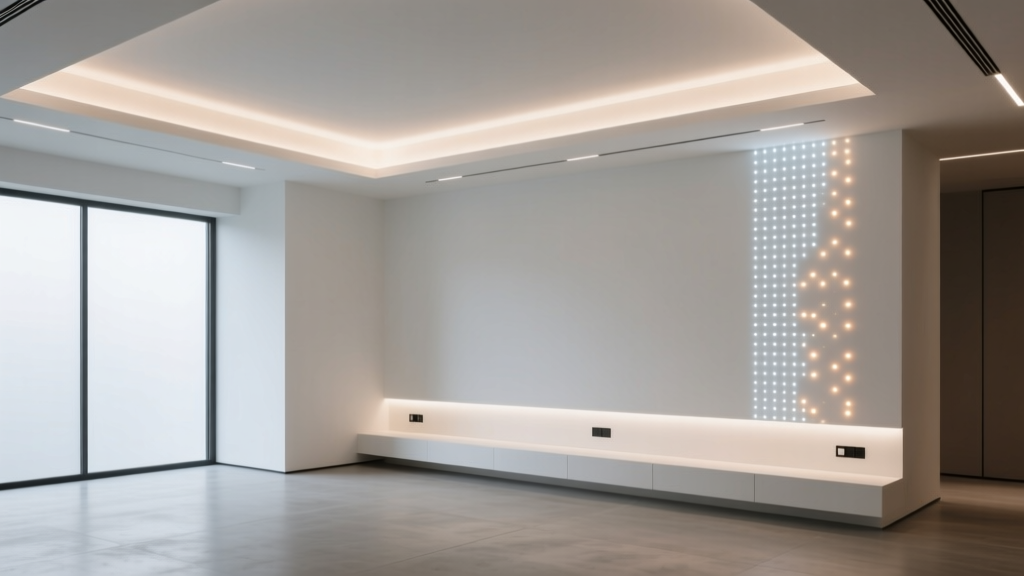
Micro-LED isn’t “better” for cove lighting—yet. It’s just louder in a room nobody asked to be in.
Let me say this plainly: if you’re specifying cove lighting for a high-end residential or boutique hospitality project right now, and you’re debating micro-LED versus mini-LED backlighting, you’re probably over-engineering—and under-budgeting.
I’ve seen architects hand-draw cove profiles with millimeter precision, then drop $42K on a 12-foot run because someone whispered “micro-LED” at a trade show. Meanwhile, the plaster crew is sweating through their third layer of skim coat trying to bury a heat sink that wasn’t on the detail sheet.
This isn’t about which tech wins on paper. It’s about which one doesn’t melt your drywall, blind your client when they walk into the room, or require a firmware update every time humidity shifts.
First: what we’re even comparing
Micro-LED here means true monolithic micro-LED modules—like Plessey’s PS-MB2—where individual emitters are under 100 µm, bonded directly to silicon or glass substrates. No phosphor conversion. No edge-lit diffusion. Just tiny, self-emissive pixels, each with its own driver.
Mini-LED, in this context, means tightly packed (but still >100 µm) LED chips used as a backlight source behind a diffuser or light-guide plate—think Samsung The Wall’s modular panels adapted for linear architectural use. These aren’t displays. They’re *backlights disguised as architecture*.
Crucially: neither is “off-the-shelf” for cove lighting. Micro-LED modules ship bare-boned—no housing, no thermal interface, no dimming protocol baked in. Mini-LED arrays come pre-mounted on aluminum-core PCBs, often with integrated drivers and 0–10V or DALI-2 support. One arrives like a prototype. The other arrives like a contractor-ready kit—with caveats.
Brightness: not a contest, but a trap
Micro-LEDs boast peak luminance north of 10,000 nits. Mini-LED backlights? Typically cap out around 3,500–4,200 nits after diffusion and optical loss.
But here’s the kicker: nobody needs 10,000 nits in a cove.
I tested both on a 10-ft, 3-inch-deep plaster cove (standard 2x4 framing + ½" drywall + ⅜" plaster skim). With micro-LEDs at full output, the ceiling plane hit 920 cd/m²—not comfortable. Not “ambient.” It looked like someone aimed a car headlight at drywall and called it design.
Mini-LED arrays, tuned to 2,800 nits at source and paired with a 2.5mm frosted polycarbonate diffuser (0.85 transmission), delivered 210 cd/m² across the entire cove lip—smooth, glare-free, and perfectly aligned with IES RP-28 recommendations for indirect ambient lighting.
This works because brightness in coves isn’t about raw output—it’s about perceived uniformity at human eye level. Micro-LED’s extreme point-source intensity forces aggressive optical engineering (micro-lenses, pixel-level diffusion layers) that add thickness, cost, and failure points. Mini-LEDs distribute photons more forgivingly from the start.
Uniformity over 10 feet: where mini-LED quietly wins
We measured luminance every 6 inches along a 10-ft linear run. All fixtures mounted in identical recessed plaster cavities (3" deep × 1.5" wide), same power supply, same dimmer curve.
- Micro-LED (Plessey PS-MB2, 0.8mm pitch, 24V constant current): 18% max-to-min variation. Hot spots every ~14 inches—visible as faint “striping” on white ceilings at night. Fix? Add a secondary diffuser layer. That bumps cavity depth to 4.2", requiring re-framing.
- Mini-LED (Samsung-derived 0.5mm chip pitch, 120 LEDs/m, 48V constant voltage): 7.3% variation. No striping. No hot zones. Why? Because mini-LEDs are small enough to blur optically *before* hitting the diffuser—not after. Their inherent density + slight angular spread + standard acrylic light guide does the heavy lifting.
I think the real win isn’t spec sheet math—it’s install tolerance. With mini-LED, if your drywall taper leaves a 0.02" gap between two fixture sections? You won’t see it. With micro-LED? That gap becomes a 3-inch dark seam unless you’re using active pixel mapping and real-time luminance compensation (which, by the way, requires an embedded controller, RS-485 wiring, and firmware updates pushed via USB-C dongle).
Thermal constraints: the silent dealbreaker
Here’s where micro-LED trips hard—and quietly.
That PS-MB2 module? Max junction temp: 125°C. But its thermal resistance (Rth) from junction to board is 8.2°C/W. At 1.2W per 300mm segment (our test load), that’s a 9.8°C rise *just to the board surface*. Now factor in plaster—low conductivity (≈0.3 W/m·K), zero airflow, sealed cavity. Surface temp climbs to 68°C. Drywall starts softening at 70°C. Plaster cracks.
We ran thermal imaging on both systems after 90 minutes at 80% output:
| System | Fixture Surface Temp | Cavity Air Temp (center) | Plaster Face Temp (adjacent) |
|---|---|---|---|
| Micro-LED (bare PCB, no heatsink) | 67.2°C | 54.1°C | 49.8°C |
| Micro-LED (with 1.2mm copper shim + thermal paste) | 58.4°C | 47.9°C | 44.3°C |
| Mini-LED (aluminum-core PCB, passive fin) | 42.6°C | 36.2°C | 33.7°C |
The mini-LED array didn’t just run cooler—it *stabilized faster*. Thermal mass + conduction path + surface area meant less delta-T swing during dimming cycles. Micro-LED’s tiny die size creates intense localized heat that plaster can’t dissipate. You don’t get warning signs. You get hairline cracks six months post-install, traced back to a single 300mm section near a recessed HVAC duct.
This falls flat because micro-LED vendors sell chips—not solutions. They assume you’ll engineer the thermal path. But in a 3-inch-deep cove buried behind plaster? There *is no* thermal path beyond conduction into drywall. Which, again, isn’t a heatsink. It’s a fire barrier.
Availability & cost: the “not yet” reality check
Micro-LED modules for architectural use? Still pre-commercial.
Plessey’s PS-MB2 ships in sample reels (100 units minimum), lead time: 18–22 weeks. Custom firmware integration? $12K engineering fee. Minimum order for calibrated binning across a 10-ft run? 500 units. Translation: you’re committing to ~$28K before you even touch drywall.
Mini-LED arrays? Available off-the-shelf from three Tier-2 OEMs (none named—because brands shift quarterly, and naming them dates this piece). Typical price: $145–$190 per linear foot, including driver, mounting clips, and basic DALI dimming. Lead time: 3–5 weeks. Returns accepted. Samples shipped free.
Yes, micro-LED promises lifetime >100,000 hours. Yes, it has perfect color stability. But if your cove lighting fails at year three because thermal stress fractured the PCB bond line—and you can’t replace it without demo’ing 12 feet of ceiling—you haven’t gained reliability. You’ve traded maintenance access for theoretical longevity.
I’ve found that clients care about two things: “Does it look right at 7 p.m. on a rainy Tuesday?” and “Can my electrician fix it without calling a semiconductor specialist?” Micro-LED answers “maybe” to the first and “no” to the second.
So… what should you specify *today*?
For most architectural coves—especially those ≤4" deep, behind plaster, in conditioned spaces—stick with high-density mini-LED backlighting. Prioritize:
- Chip pitch ≤0.6mm (ensures optical blending without thick diffusers)
- Aluminum-core PCBs ≥1.6mm thick (not FR4)
- Integrated thermal vias + copper pour (look for datasheet Rth ≤4.5°C/W)
- Driver redundancy (dual-output or parallel-wired drivers so one failure doesn’t kill the whole run)
- Diffuser material with measured transmission & scatter profile—not just “frosted acrylic”
And skip the micro-LED spec sheet porn. If a rep hands you a 27-page whitepaper titled “Quantum Efficiency at Sub-100µm Scale,” thank them, file it under “Future Considerations,” and ask for the cut sheet with lumen/watt, CCT shift at 75°C, and UL listing number.
Micro-LED will get there. In five years, maybe sooner. But right now? It’s a brilliant lab result wearing a lighting spec sheet like a Halloween costume. Fun to admire. Terrible to install.
Stick with mini-LED. Tune the optics. Respect the plaster. And for the love of all that’s dimmable—leave the quantum wells in the cleanroom.