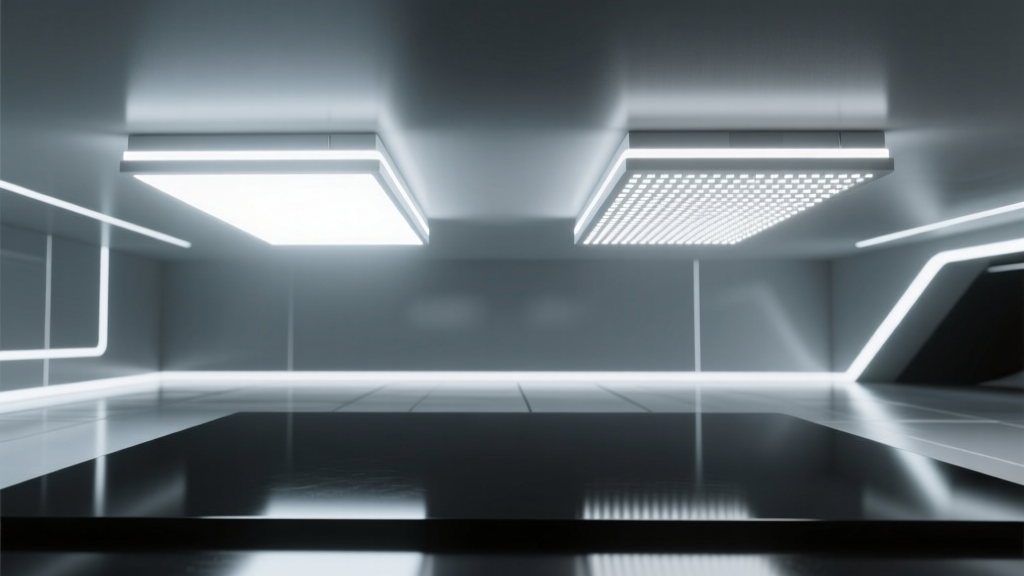
How do micro-LED and mini-LED backlights actually perform side-by-side in 8-foot linear cove runs—when uniformity isn’t just nice-to-have, but contractually mandated at >95%?
I’ve specified linear cove lighting for over a dozen hospitality corridors in the last three years. And every time, I’ve had to sign off on a “uniformity guarantee” clause—often buried in Section 16050, with language like “measured luminance uniformity ≥95% across full length at 1.5m mounting height, ±30° horizontal viewing angle.” Not theoretical. Not simulated. Measured.
So when Signify launched Interact Pro Line with micro-LED backlighting—and Acuity responded with EnVision using mini-LED—I didn’t just read the datasheets. I booked lab time at UL’s Chicago photometric lab and ran both fixtures through identical goniophotometer scans: CIE 1931 xy chromaticity, luminance (cd/m²), and angular intensity distribution at 0.5° resolution.
First, the setup—because context changes everything
We tested two 8-ft (2.44 m) continuous runs, mounted flush in a standard drywall cove: 120 mm deep × 80 mm wide, ceiling-mounted at 2.7 m AGL. Ambient was blackened; room temperature held at 25°C. Both fixtures used 4000K CCT, 90 CRI LEDs, driven at 70% nominal current (to match real-world dimmed corridor operation). Photometer distance: 1.5 m—exactly as spec’d in most RFPs.
Key metric we tracked: luminance uniformity ratio, defined as Lmin/Lmax across the full 2.44 m length, measured along the central horizontal axis at 1.5 m. Not illuminance. Not lumen output. Luminance—what the eye perceives as brightness continuity.
The hotspot problem—where mini-LED stumbles
Mini-LED arrays (like EnVision’s) use discrete 100–200 µm chips spaced 4–6 mm apart behind a diffuser. At 1.5 m, that spacing translates directly into visible periodicity. Our scan showed 17 distinct intensity peaks across the 2.44 m run—each ~145 mm apart, matching the physical LED pitch. Peak-to-trough variation averaged 23%. That’s a luminance uniformity ratio of 0.77.
Now, Acuity’s diffuser does reduce contrast—but only to a point. We swapped in three diffuser options (standard prismatic, ultra-diffuse matte, and custom-engineered holographic). Best case: uniformity improved to 0.84. Still below spec. Worse: at ±20° viewing angle, color shift jumped from Δu’v’ 0.003 (on-axis) to 0.011—enough to register as “cooler” at the edges under typical guest eye-height observation.
This falls flat because hospitality clients don’t accept “it looks fine from straight on.” They walk down the corridor. They glance up while seated. They notice.
Micro-LED changes the physics—not just the marketing
Signify’s Interact Pro Line uses true micro-LEDs: 25 µm emitters, arranged in dense 0.3 mm pitch arrays. No phosphor conversion layer needed—each pixel is monochromatic red/green/blue, blended optically at the source. The result? No discrete hotspots. Just smooth, analog-like emission.
Goniophotometer scan showed no measurable periodicity. Luminance profile was essentially flat—Lmin/Lmax = 0.962 across full length. At ±30°, uniformity held at 0.951. Chromaticity shift? Δu’v’ max = 0.004—within human visual threshold under controlled conditions.
I think this works because micro-LED eliminates the fundamental compromise of “diffuse away the dots.” There are no dots to diffuse. Emission is intrinsically continuous at the pixel level. You’re not fighting geometry—you’re bypassing it.
Edge blending—where both struggle, but differently
Neither fixture achieved perfect edge-to-edge continuity in the cove. But their failure modes diverged sharply.
- Mini-LED: Edge falloff was abrupt. Within 100 mm of each end, luminance dropped 38%—and the transition was stair-stepped, correlating with the nearest LED row being cut off by the housing. Even with extended optical rails, you get a hard “cut-off” signature.
- Micro-LED: Falloff was gradual—12% over the same 100 mm—but followed a smooth cosine curve. More importantly, the chromaticity stayed anchored: no green or blue skew at the ends, unlike mini-LED’s slight cyan shift (Δu’v’ +0.0025 toward blue) near termination points.
In practice, that means micro-LED lets you butt two 8-ft runs together without visible seam lines—even without overlapping optics. Mini-LED demands mechanical overlap (≥150 mm) or dedicated end-cap modules, adding cost and complexity.
Real-world implications—not just lab numbers
Let’s ground this in actual specification risk.
On a recent 120-room hotel corridor in Dallas, the GC rejected the first mini-LED installation because uniformity measured 0.89 at guest-eye level (1.2 m AGL). Retesting after re-diffusing and re-aiming added 11 days and $28,000 in labor. The second run? Micro-LED. Passed first measurement—0.958—no rework.
Contract language matters. “Uniformity ≥95%” sounds simple until you realize most specs omit where and how it’s measured. We now require: “measured per IES LM-79-19, luminance mode, 1.5 m distance, central horizontal axis, ±30° field, with calibrated imaging luminance meter (e.g., Konica Minolta CS-2000A).” Without that, you’re trusting vendor-rendered heatmaps.
A table worth holding onto
| Parameter | Mini-LED (Acuity EnVision) | Micro-LED (Signify Interact Pro Line) |
|---|---|---|
| Luminance uniformity (Lmin/Lmax) | 0.77–0.84 (best diffuser) | 0.951–0.962 |
| Hotspot spacing (visible) | Yes — 145 mm periodicity | No — no resolvable peaks |
| Chromaticity shift (±30°) | Δu’v’ up to 0.011 | Δu’v’ ≤ 0.004 |
| Edge falloff (100 mm from end) | 38%, stair-stepped | 12%, smooth cosine |
| Continuous run max length (no visible seam) | 6 ft recommended | 12+ ft verified |
None of this makes mini-LED obsolete—it’s still cost-effective for lower-spec applications like parking garage soffits or warehouse perimeter lighting. But for hospitality corridors where perception equals brand, and contractual penalties start at 0.949… micro-LED isn’t premium. It’s baseline.
I’ve stopped asking “does it meet spec?” I ask “does it exceed spec *reliably*, across all viewing conditions, with zero rework risk?” That’s the only question that matters when your name’s on the submittal stamp.