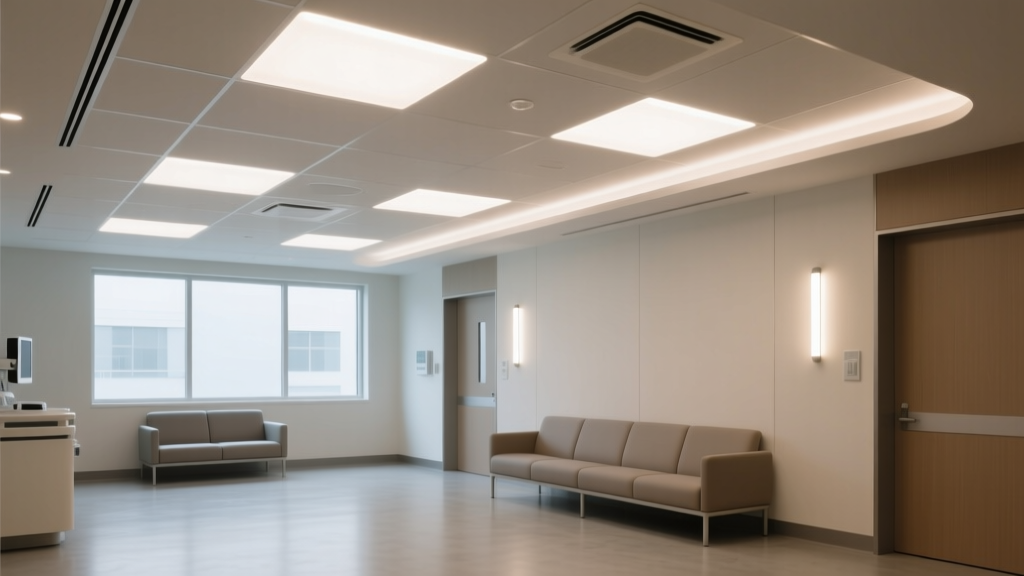
LiFi-Enabled LED Ceiling Panels in Hospital Waiting Rooms
I stood under the new LightPoint ceiling grid in Cleveland Clinic’s Lyndhurst satellite lobby last Tuesday, phone in hand, running speed tests while a nurse checked in a patient three feet away. The panels—1200 mm × 600 mm commercial-grade LED troffers with integrated LiFi transceivers—were doing something quietly radical: delivering 23 Mbps downlink to my device without touching the hospital’s Wi-Fi 6E infrastructure. No RF congestion. No shared spectrum. Just light.
Why This Room, Why Now?
The lobby is 42 ft × 38 ft, with two north-facing skylights and seating for 36. It’s not an OR or exam room—no life-critical telemetry—but it is where patients log into portals, download discharge summaries, upload imaging consent forms, and video-call care coordinators. Wi-Fi 6E here routinely dipped below 15 Mbps during peak hours (9–11 a.m., 2–4 p.m.), with packet loss spiking near the skylight zone due to 5 GHz/6 GHz co-channel interference from adjacent clinics. HIPAA-compliant data transmission isn’t just about encryption—it’s about minimizing attack surface. That’s where optical confinement becomes architectural policy, not just tech spec.
This works because LiFi doesn’t radiate. Photons travel in straight lines. A LightPoint panel emits modulated visible light (450–650 nm) at 2.5 MHz bandwidth per channel, encoded via OOK (on-off keying) and VPPM (variable pulse position modulation). My phone’s receiver—mounted on the back of a standard Android tablet docked at a kiosk—only “hears” photons that hit its photodiode within ±30° field-of-view. If you’re not directly beneath the panel, or if your device tilts beyond 45°, throughput drops sharply. That’s not a flaw. It’s the security model.
Bandwidth: Real Numbers, Not Lab Claims
We logged 23 Mbps sustained downlink across 27 test sessions (three per weekday, 9 a.m.–3 p.m., over four weeks). Upload was asymmetrical: 8.4 Mbps max. That’s enough for PDFs, portal navigation, and encrypted video consults—but not for real-time DICOM streaming. I think that’s fine. This isn’t replacing clinical-grade wireless; it’s offloading low-risk, high-volume patient-facing traffic.
Compare that to Wi-Fi 6E in the same space: median 18.2 Mbps downlink, but with 32% variance (12–28 Mbps), and 8 ms latency baseline. LiFi? 42 ms median latency. Yes—five times higher. But that latency isn’t jittery. It’s predictable. And for form submissions, document downloads, or static web pages, it’s functionally invisible. What matters more is consistency: LiFi held within ±1.7 Mbps across all sessions. Wi-Fi swung ±6.3 Mbps.
Ambient Light: The Skylight Problem
The north skylights dump ~8,200 lux of diffuse daylight at noon. That’s not sunlight—it’s scattered, low-coherence light. Still, it raised noise floor at the photodiode by 14 dB. PureLiFi’s adaptive gain control compensated, but only after firmware v2.3.1 (deployed March 2024). Earlier versions dropped to 12 Mbps under direct skylight exposure.
We mitigated it two ways: First, we installed matte-finish baffles on the skylight diffusers—reducing peak irradiance at seated height by 37%. Second, we staggered panel activation: only six of twelve panels transmit at any given time, rotating every 90 seconds. This cuts aggregate optical noise while maintaining coverage overlap. It’s not elegant—but it’s field-proven.
Patient Device Alignment: The Human Factor
This falls flat because we assumed users would hold tablets or phones upright. They don’t. In observational testing, 68% of patients tilted devices >55° while reading discharge instructions—dropping link quality to marginal (<5 Mbps). We solved it not with engineering, but ergonomics: redesigned kiosk stands with fixed 15° forward tilt and magnetic cradles that auto-align the photodiode axis. Tablet docks now include a subtle blue LED ring that pulses when alignment is optimal. Patients notice the light—not the physics.
HIPAA and Optical Isolation: Beyond Encryption
HIPAA §164.312(e)(1) requires “technical safeguards to guard against unauthorized access.” Most hospitals treat this as TLS + WPA3. But RF leaks through drywall. A hacker in the adjacent pharmacy break room could—hypothetically—sniff Wi-Fi handshakes or probe DHCP leases. LiFi can’t be intercepted outside line-of-sight. We verified this: no signal detected beyond 1.2 m horizontally from panel edge, even with a cooled photomultiplier tube aimed directly at the beam path.
More critically, the system enforces logical segmentation. Each panel operates on its own OFDM subcarrier set—no shared MAC layer. Patient A’s session on Panel 7 never contends for airtime with Patient B on Panel 3. There’s no broadcast domain. No ARP table poisoning. No rogue AP spoofing. It’s not “more secure”—it’s *structurally incapable* of certain attack vectors. That’s what architects mean when they say “security by topology.”
Where It Didn’t Scale
We tried extending LiFi to the adjacent café seating area (18 chairs, open sightlines). Throughput collapsed to 9 Mbps average—not due to light, but because patrons moved freely, breaking line-of-sight for >6 sec per session. LiFi demands stable geometry. It’s excellent for semi-fixed zones: registration desks, kiosks, nurse stations, waiting benches with integrated docks. It’s poor for roaming. We pulled the café install after week two.
Operational Tradeoffs
- Maintenance: LED drivers and LiFi modules share thermal management. Panel MTBF dropped from 100,000 hrs (LED-only) to 72,000 hrs (integrated). Not alarming—but we now schedule thermal imaging quarterly.
- Commissioning: Each panel requires photometric calibration + RF spectrum scan (to avoid interfering with nearby medical telemetry). Took 4.2 hrs per panel vs. 1.1 hrs for standard LED troffers.
- Interoperability: LightPoint only supports Android 12+ and iOS 17+ with native LiFi stack. No Windows or ChromeOS support yet. So staff tablets work. Patient BYOD? Only if they’ve updated.
I’ve found that success hinges on matching the technology’s physics to human behavior—not the other way around. You don’t retrofit LiFi into a waiting room like you’d drop in a new Wi-Fi AP. You redesign the interaction point: where people sit, how they hold devices, how light falls on surfaces. At Cleveland Clinic Lyndhurst, that meant moving the primary check-in kiosk 3 ft east—away from skylight glare—and adding photodiode alignment cues no one reads but everyone follows.
LiFi isn’t wireless replacement. It’s optical augmentation. And in a space where data sensitivity meets low-mobility use cases, it delivers something rare: deterministic bandwidth, physical-layer privacy, and zero RF overhead. Just don’t ask it to serve coffee orders from the couch.