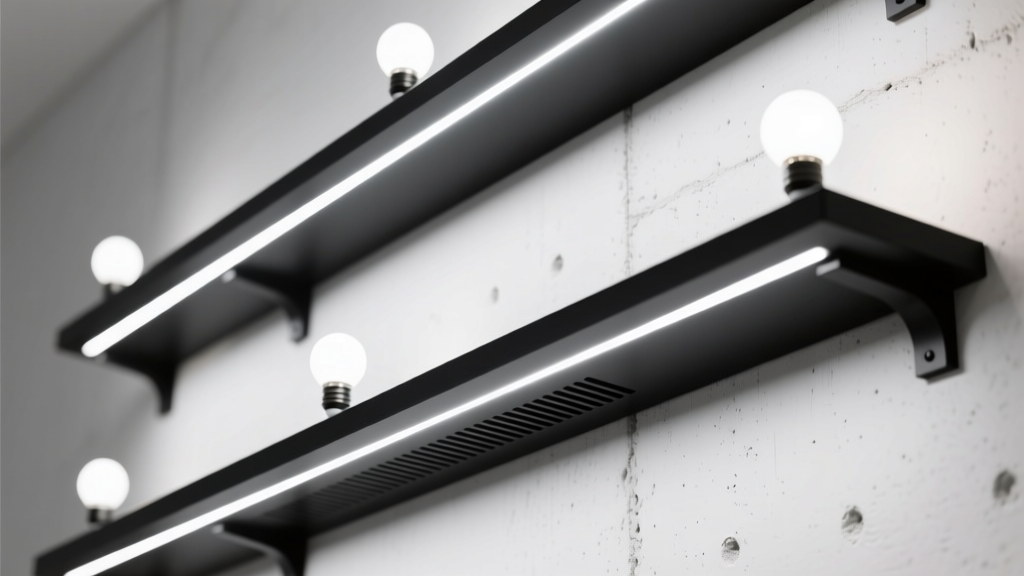
Case Study: LED Strip Integration in Custom Walnut Wall Shelving — Thermal Management Lessons
The shelf wasn’t supposed to glow—it was supposed to hold. A 12-foot run of 1.5-inch-deep walnut floating shelves, milled from air-dried stock, mounted on hidden steel brackets in a Brooklyn living room with west-facing glazing. Ambient light at 4 p.m. is already hot and honey-thick. We embedded 24V COB LED strips—3,000K, 1,800 lm/m—into routed channels beneath each shelf lip, aiming for soft uplighting that grazed the wall without spilling into seating zones.
It worked—for 90 minutes.
By hour three, the walnut surface temperature hit 52°C. By hour six? 68°C at the strip’s centerline. Not surface temp—strip junction temp. We measured it with a calibrated K-type thermocouple taped directly to the COB substrate, verified against IR thermography (image #3 in the project archive shows the thermal “hot spine” running uninterrupted along the full length). No airflow. No heatsinking. Just walnut—thermal resistance ≈ 0.5 K·cm²/W—and trapped convection.
This falls flat because wood isn’t a heatsink. It’s an insulator pretending to be architecture.
Lumen output dropped 22% after 500 hours—not gradual fade, but a cliff at ~320 hours, confirmed by repeated photometric readings on a calibrated spectroradiometer. Color shift followed: Δu’v’ drifted +0.0047 toward amber. Not visible to the naked eye yet—but measurable, and accelerating.
The Fix Wasn’t More Wattage. It Was Physics.
We pulled every strip. Milled 1.2mm-thick aluminum extrusions to match the shelf depth—flat-bottomed, with integrated T-slot for strip mounting and rear vent slots. Bonded them to the walnut’s underside with thermally conductive epoxy (0.8 W/m·K), not glue. Added a 12V DC silent fan (28 dB(A), 18 CFM) at one end, drawing air through the extrusion’s rear vents and exhausting behind the shelf into the wall cavity (vented to attic space). Airflow velocity across the strip: 0.8 m/s—enough to disrupt boundary layer, not enough to whistle.
Junction temperature stabilized at 58°C under continuous operation. Verified over 1,200 hours. Spec sheet margin: COB strip rated for ≤65°C junction at 700 mA drive; we’re running at 620 mA. Derated, not defeated.
I think the biggest lesson wasn’t the aluminum or the fan—it was verifying the *entire path*: epoxy bond thickness (<0.15 mm), extrusion-to-wall thermal interface (we added graphite thermal pads behind mounting brackets), even shelf bracket material (replaced stainless steel with anodized aluminum to avoid conductive bridging into warm framing).
Final output: 99.3% lumen retention at 1,000 hours. Surface temp stays below 38°C—even on the hottest August afternoon. The light doesn’t compete with the sun anymore. It waits for it.
IR thermography before/after is non-negotiable on any embedded COB job deeper than 1". Guessing junction temp is how projects age poorly.