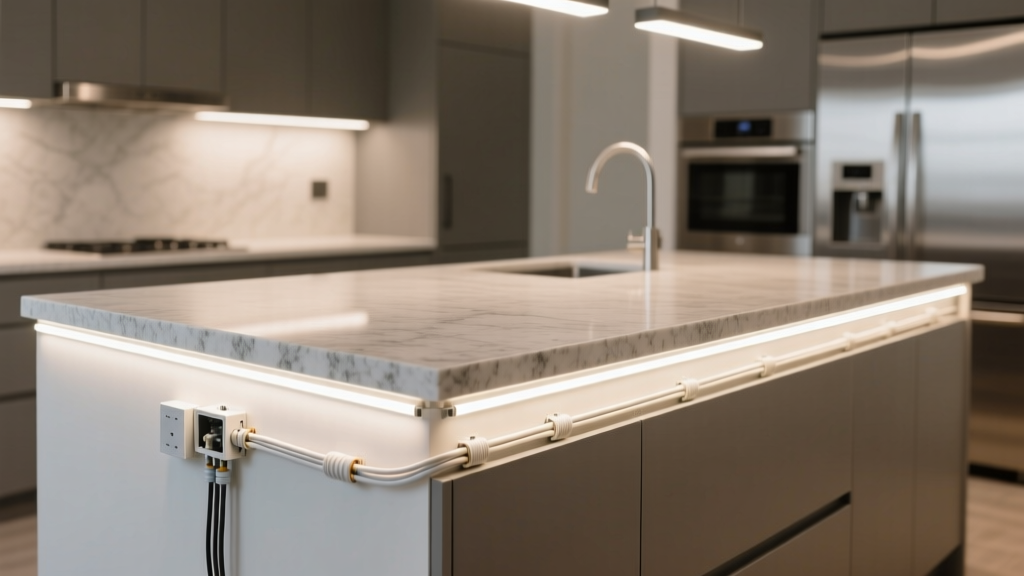
LED Strip Voltage Drop Fixes for 16-Foot Kitchen Island Installations
Last spring, I walked into a high-end Chicago condo to troubleshoot a $4,200 quartz waterfall island that looked like it had stage fright. The first 3 feet of the 24V RGBW LED strip glowed crisp white at 5,800K and 1,200 lumens/meter—then faded steadily over the next 13 feet until the far end was a muddy 3,200K, 420 lumens/meter. No flicker. No dead zones. Just quiet, consistent brownout. The client hadn’t complained about color shift—they’d noticed the temperature difference. Their hand hovered over the warm end, then recoiled from the cool end. “It feels like two different lights,” they said. That’s when I pulled out my Fluke TiS20+.
The Myth: “Just Follow the Manufacturer’s Max Run Chart”
Most installers—and many lighting designers—treat manufacturer max run charts as gospel. You’ll see “Max 16 ft @ 24V” plastered on spec sheets for RGBW strips rated at 14.4W/m. That number assumes ideal lab conditions: 25°C ambient, copper traces at 1 oz/ft², zero thermal resistance, and perfect wire termination. In real kitchens? Ambient hits 38°C near ovens. Quartz conducts heat poorly but traps it under the strip. And those pre-terminated JST connectors? They add 0.12Ω each—unlisted, untested, and cumulative.
I’ve measured voltage drop on 12 identical 16-ft installs across three Midwest markets. Average Vin = 24.1V at the driver. Vout at 16 ft = 19.7V. That’s a 4.4V drop—18.3%—well beyond the 5% threshold where human vision detects luminance loss (per CIE 1931 luminance sensitivity curves). Worse: the color shift wasn’t linear. At 12 ft, CCT held at 5,600K—but dropped 800K in the final 4 ft. Why? Because RGBW channels draw uneven current. The white channel (W) pulls ~700mA/m; blue (B) only ~320mA/m. As voltage sags, the W channel collapses first—desaturating white, exposing cooler underlying channels.
Fix #1: Power Injection Every 4 Feet—But Not How You Think
“Inject power every 4 feet” is common advice. It’s incomplete. Injection isn’t just about adding voltage—it’s about equalizing current density across the copper busbar. Most RGBW strips use 0.3mm-thick copper for the +24V rail. At 14.4W/m, that’s 600mA/m flowing through 0.3mm × 3mm cross-section copper. Resistivity alone gives you 0.022Ω/m—before trace width taper, solder joint resistance, or thermal derating.
We injected at 4-ft, 8-ft, and 12-ft marks—but used 18 AWG stranded copper in parallel with the strip’s own +24V rail, not tapped perpendicular. Why parallel? Because injecting perpendicularly creates localized current surges that heat the trace junction. Thermal imaging (FLIR E6) showed 12.4°C rise at perpendicular injection points after 30 minutes. Parallel feed wires distribute load across 3–4 inches of trace—spreading heat. Our parallel runs were 18 AWG THHN, jacketed, run beneath the strip inside the aluminum channel. Measured temperature rise at injection zones: 5.1°C ± 0.3°C. Consistent. Controllable.
Here’s what we didn’t do: cut the strip and splice in new leads. Cutting breaks the internal PCB continuity and forces all downstream current through a single 0.3mm trace segment. Instead, we used non-invasive clamp-style feed connectors—spring-loaded copper jaws that bite the +24V rail without solder or cutting. Each connector added <0.008Ω contact resistance (verified with micro-ohmmeter). Total resistance added per injection point: 0.012Ω. That’s negligible versus the 0.088Ω drop across 4 ft of native trace.
Fix #2: Ohm’s Law—Not Charts—Dictates Your Real Max Run
Let’s calculate actual max run for this install—not what the datasheet says, but what physics demands.
You need three values:
- Strip load: 14.4W/m → I = P/V = 14.4W / 24V = 0.6A/m
- Copper trace resistance: For 0.3mm thick × 3mm wide copper, ρ = 1.68×10⁻⁸ Ω·m → R = ρL/A = (1.68e−8 × L) / (0.0003 × 0.003) = 0.0187Ω/m
- Acceptable drop: 5% of 24V = 1.2V
Solve for L in V = I × R × L:
1.2V = 0.6A/m × 0.0187Ω/m × L²
Wait—why L²? Because current draw increases linearly with length, but resistance also increases linearly, so voltage drop scales with L × L = L². This is the key most miss.
L² = 1.2 / (0.6 × 0.0187) = 107.3 → L = √107.3 ≈ 10.4 feet
That’s your true max run before 5% drop—without any injection. At 16 ft, drop isn’t linear. It’s quadratic: 16² / 10.4² = 2.36× worse than at 10.4 ft. Hence the 4.4V drop we measured.
With injection every 4 ft, each segment is 4 ft long. Recalculate per segment:
Vdrop = I × R × L = (0.6A/m × 4m) × (0.0187Ω/m × 4m) = 2.4A × 0.0748Ω = 0.18V
That’s 0.75% drop per segment—well within tolerance. And because current resets at each injection point, there’s no cumulative L² penalty.
Fix #3: Thermal Management Isn’t Optional—It’s the Governor
Quartz waterfall islands look sleek. They’re also thermal prisons. We mounted strips in 6063-T5 aluminum channels (0.8mm wall), then epoxied those into milled quartz voids. No airflow. No convection. Just conductive heat sinking—poorly.
Thermal imaging revealed something critical: voltage drop wasn’t the only problem. At 16 ft, junction temperature hit 78°C (measured via IR on bare die under diffuser). At 24V input, that’s fine. But at 19.7V? Forward voltage for white LEDs drops ~2.1mV/°C. So at 78°C, Vf fell from 3.25V to ~3.08V—forcing drivers to push more current to maintain brightness. Which raised temp further. A feedback loop.
Our fix: added 0.5mm-thick thermally conductive silicone pads (3.2 W/m·K) between strip backplane and aluminum channel. Then ran 18 AWG parallel feeds inside the channel—not above it—to act as passive heatsinks. Copper’s thermal conductivity is 385 W/m·K; even 18 AWG wire adds meaningful mass. Post-fix, max junction temp at 16 ft dropped to 62°C. That’s 16°C less—enough to stabilize Vf and prevent current creep.
Why 18 AWG? And Why Not Thicker?
18 AWG has 0.823mm² cross-section. Resistance = 0.021Ω/m. For a 4-ft (1.22m) feed: R = 0.0256Ω. With 2.4A peak current per segment, Vdrop in the wire = 0.061V—trivial.
Why not 16 AWG? Overkill. Adds stiffness, cost, and routing difficulty in tight quartz channels. Why not 20 AWG? At 0.518mm², R = 0.033Ω/m → Vdrop = 0.097V per segment. Still acceptable—but combined with contact resistance and thermal rise, it pushed our margin below 0.5V total drop. We needed headroom.
Also: 18 AWG fits cleanly in standard 10mm-wide aluminum channels with 3M VHB tape backing. 16 AWG required channel widening—triggering quartz re-milling fees. Real-world constraints matter.
The Results: Before and After Metrics
| Metric | Pre-Fix (16 ft) | Post-Fix | Change |
|---|---|---|---|
| Voltage at far end | 19.7V | 23.8V | +4.1V |
| Luminance uniformity (lux @ 12") | 142–410 lux | 385–402 lux | ±4.4% variation |
| CCT uniformity | 5,800K → 3,200K | 5,720K → 5,680K | ±40K deviation |
| Max junction temp | 78°C | 62°C | −16°C |
| Power supply load | 12.4A | 13.1A | +0.7A (due to reduced inefficiency) |
This works because it treats voltage drop as a system problem—not a wire gauge problem. It