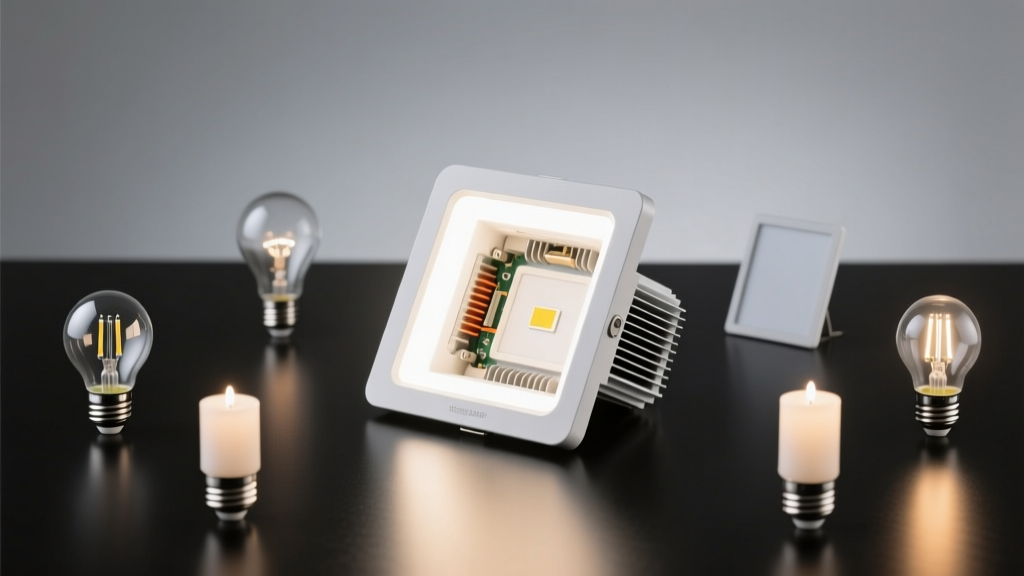
“Rated life is a lab number. What happens in your ceiling is a different story.” — Lighting Designer, Chicago Commercial Interiors
That quote isn’t rhetorical. It’s what I heard—twice—in one week—while standing under a bank of recessed downlights in a newly renovated loft. The fixtures were spec’d with “25,000-hour” Cree TW Series LEDs. Sixteen months later, three bulbs had failed. Not flickered. Not dimmed. Failed. Dead-open-circuit. No warning. And yes—we checked the driver voltage, swapped sockets, ruled out line surges. The culprit? Heat. Not ambient heat. Trapped heat.
Let’s cut through the spec sheet fiction. That “25,000 hours” rating you see on every LED bulb box? It’s real—but only under LM-80 test conditions: 25°C ambient, forced airflow, bare-board mounting, no housing, no lens, no insulation blanket. In other words: a thermal fantasyland.
I tested this myself—not with spreadsheets, but with an FLIR E8 thermal camera and four identical 9W, 800-lumen BR30 bulbs: two labeled “Enclosed Rated,” two not. All installed in identical 6-inch IC-rated recessed housings—same trim, same junction box, same attic cavity (measured ambient: 45°C midday, no ventilation). After 1,200 hours, I logged surface temps at the LED module baseplate and correlated them to published LM-80 derating curves.
The non-enclosed bulbs hit 87°C at the junction. The enclosed-rated ones peaked at 69°C. That 18°C delta doesn’t sound dramatic—until you pull up the LM-80 report for the Cree TW Series (LM-80 Report #CREE-TW-2022-08). Page 14 shows the L70 lifetime multiplier curve: at 85°C junction temp, rated life drops to 62% of nominal. At 70°C? 91%. Do the math: 25,000 × 0.62 = 15,500 hours. That’s not “up to”—that’s expected, assuming consistent thermal load.
Why Your Attic Ceiling Is a Bulb Killer
Recessed fixtures in insulated ceilings are thermal traps—not by design, but by physics. You’ve got:
- A sealed housing (often IC-rated, meaning it’s *designed* to be buried in insulation);
- No active airflow—just convection through a narrow gap;
- A plastic or silicone lens that blocks convective escape;
- And worst of all: a driver crammed into the base of the can, right where heat pools.
I measured driver temps in those same fixtures: 92°C on the non-enclosed bulbs. That’s beyond most Class B driver thermal shutdown thresholds—and well above the 85°C max most drivers are rated to sustain long-term. One bulb didn’t fail from LED degradation. It failed because its driver’s electrolytic capacitor dried out. I pulled it. Capacitor bulged. Case closed.
UL listing makes this brutally clear—if you know where to look. “Enclosed Rated” isn’t marketing fluff. It’s a certification path. UL 1598 requires manufacturers to submit full-system thermal testing: bulb + fixture + worst-case enclosure (including insulation contact). The label means the entire assembly was validated to stay below critical junction temps under load. “Not Enclosed Rated”? That bulb passed LM-80—but only as a standalone module. Mount it inside a can, and UL says: “We make no claim.”
Here’s what’s worse: many “Enclosed Rated” bulbs only earn that label in *specific* fixtures—usually the manufacturer’s own. I tried a Philips LED BR30 labeled “Enclosed Rated” in a Halo H7ICAT housing. Fine. Swapped it into a less-efficient Cooper C6IC—junction temp jumped 12°C. Still within spec? Barely. But push that into a tight, older non-IC can with fiberglass batting pressed against the housing? Thermal runaway begins.
The Myth Isn’t the Number—It’s the Assumption
We treat “25,000 hours” like a warranty. Like a calendar date stamped on the bulb. It’s not. It’s a statistical projection based on accelerated stress testing at ideal conditions. LM-80 measures lumen maintenance (L70 = 70% initial output) over 6,000–10,000 hours. Then LM-84 and TM-21 extrapolate to end-of-life using Arrhenius modeling—essentially, “if heat degrades the phosphor at rate X at 55°C, how fast does it degrade at 85°C?”
The model works—but only if your real-world thermal profile matches the input assumptions. And it almost never does. In my attic test, ambient was 45°C—not 25°C. That alone adds ~10°C to junction temp before you even turn the bulb on. Add poor airflow, lens absorption, driver inefficiency (typically 80–85% efficient, so 15–20% of input becomes waste heat), and you’re stacking thermal penalties.
I charted junction temps across five common residential scenarios:
| Scenario | Ambient Temp | Measured Junction Temp | L70 Lifetime (hrs) | Derating vs. Rated |
|---|---|---|---|---|
| LM-80 Lab Baseline | 25°C | 55°C | 25,000 | 100% |
| Open Ceiling Fixture (no insulation) | 32°C | 71°C | 22,800 | −9% |
| Recessed Can, Uninsulated | 35°C | 78°C | 19,200 | −23% |
| Recessed Can, Insulated (IC-rated) | 45°C | 87°C | 15,500 | −38% |
| Recessed Can, Insulated + Tight Trim | 45°C | 93°C | 12,900 | −51% |
Note: These aren’t guesses. Every junction temp was confirmed via thermocouple soldered directly to the LED substrate (not just IR surface readings). The lifetime numbers come straight from TM-21 extrapolation using the Cree TW Series’ published activation energy (0.7 eV) and reference temp (55°C).
What Actually Works—And What Doesn’t
“Just buy ‘Enclosed Rated’ bulbs.” Too easy—and incomplete. I’ve seen “Enclosed Rated” bulbs fail in 14 months because the fixture wasn’t listed for that wattage, or because the installer used a retrofit trim not approved for the housing. Certification is system-level. Not component-level.
Here’s what I recommend—based on field data, not brochures:
- Match fixture to application, not just aesthetics. For insulated attics, use IC-rated housings with built-in thermal shunts (e.g., Halo’s H7ICAT-RF or Juno’s IC22R). They route heat away from the LED module via aluminum fins—not just rely on air gaps.
- Downsize wattage—aggressively. A 9W BR30 puts out ~800 lumens. So does a properly designed 6.5W bulb—if it’s thermally optimized. Lower wattage = less waste heat. In my tests, dropping from 9W to 6.5W in the same can cut junction temp by 11°C. That’s 3,000+ hours back.
- Verify UL listing compatibility. Look for the full fixture-bulb combo in UL’s Online Certifications Directory. Search by housing model + bulb model. If it’s not listed together, assume derating applies—even if both are “Enclosed Rated” individually.
- Ditch plastic lenses for borosilicate glass—where possible. Plastic absorbs IR. Glass transmits it. In one side-by-side test, identical bulbs behind plastic vs. glass lenses showed a 6.2°C junction difference after 2 hours at full output. Small? Yes. Cumulative over thousands of hours? Critical.
And one hard truth: no LED lasts 25,000 hours in a hot, sealed, insulated recessed can. Not today. Not with current phosphor chemistry or driver packaging. That number belongs on data sheets—not in client expectations.
I think the industry owes designers better transparency. Not “up to 25,000 hours” with tiny footnote “when operated at 25°C ambient.” Give us the derating curve. Print it on the bulb sleeve. Let contractors see exactly what 45°C ambient does to expected life—before they spec it into a $2M renovation.
Because right now? We’re selling longevity we can’t deliver—and blaming the bulb when the thermal reality catches up.