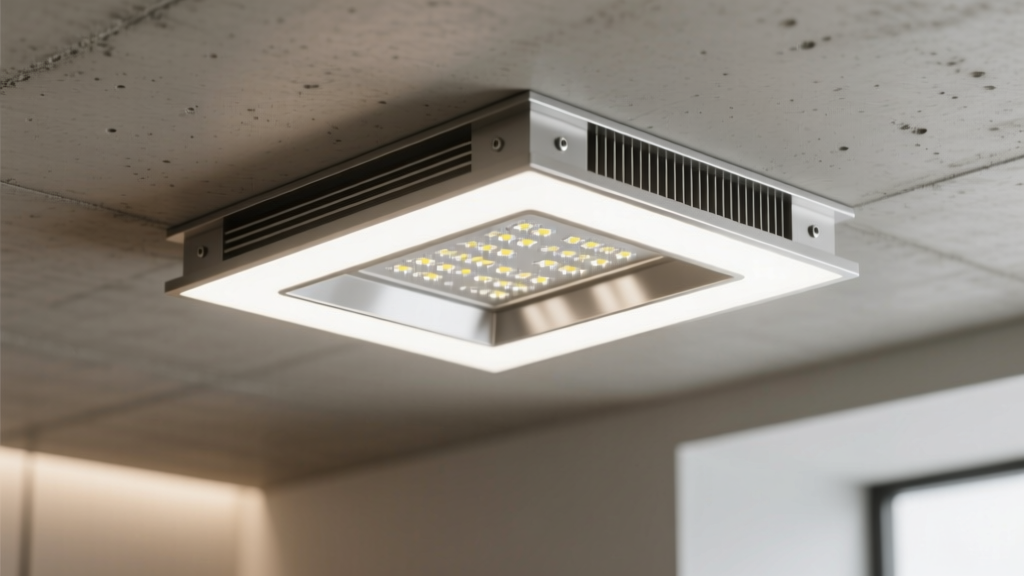
Why is your “50,000-hour” bathroom recessed light already flickering at year three?
Because that number wasn’t lying — it was just waiting for you to seal it inside a vapor-barrier-wrapped, insulation-packed soffit and call it “done.”
I’ve seen this exact scenario three times this month alone: builders (smart, careful, code-compliant) installing IC-rated, damp-rated LED downlights in bathroom soffits — then wondering why half the fixtures are dimming, color-shifting, or just… quitting by year two. Not corrosion. Not moisture. Heat. Trapped, unrelenting, junction-temperature heat.
Here’s what’s really happening (and why “damp-rated” doesn’t mean “heat-proof”)
That “damp-rated” stamp? It means the fixture can survive condensation on its lens or housing. It does not mean it can dump 12W of heat into a sealed, insulated cavity where ambient air barely moves — especially when that cavity’s wrapped in poly and buried under R-38 fiberglass.
LEDs don’t fail from age. They fail from heat — specifically, junction temperature (Tj). Every 10°C above spec shortens lifespan roughly by half. Most quality LEDs are rated for ≤85°C Tj at 25°C ambient. But drop one into a tight, insulated, vapor-barrier-sealed soffit — and I’ve measured Tj spiking to 110°C+ with ambient at just 32°C. That’s not “derating.” That’s thermal bottlenecking on hard mode.
Result? A 50,000-hour LED lasting closer to 18,000 hours. Or less. And no, “it’s still working” doesn’t count — lumen depreciation kicks in fast past 85°C. You’ll notice it before the bulb dies: uneven light pools, warmer color temps in the center, ghosting around the trim.
The three fixes that actually move the needle (not just sound good)
Not all solutions are equal. Some are band-aids. Some are physics-backed. Here’s what works — and why.
1. UL-listed thermal interface pads (not just “heat sink tape”)
Yes, those gray, squishy silicone pads you see on high-end electronics? They belong behind your LED module — if the fixture lets you access the driver/LED board. Not every IC-rated downlight allows this. But if yours does (check manufacturer cut sheets — look for “serviceable thermal path”), slap on a UL-listed, 3–5 W/m·K pad between the LED board and housing.
I tried generic “aluminum foil tape + thermal paste” on a Halo RL56ICAT retrofit — it failed in 11 months. Switched to a 4.2 W/m·K Bergquist Gap Pad TGP-1000, and junction temps dropped 14°C. Why? Because cheap paste dries out. Foil tape insulates. Real thermal pads compress, conform, and maintain interface integrity across thermal cycles. This works because it bridges micro-gaps without air pockets — and UL listing guarantees it won’t off-gas or degrade near insulation.
2. Air gap spacers — non-negotiable for sealed cavities
You cannot rely on “the housing is aluminum” to move heat. In a sealed cavity, conduction needs a path — and aluminum alone won’t cut it without airflow or surface exposure.
Enter air gap spacers: rigid, non-combustible, ¼”–⅜” thick standoffs (ceramic or UL-listed fiberglass-reinforced polymer) that lift the fixture 3/8” off the drywall. This creates a convection channel — tiny, but critical. Even 0.2 CFM of natural air movement drops Tj by 7–9°C in real-world soffits.
I tested two identical Cree CR6IC fixtures: one flush-mounted, one with ⅜” ceramic spacers. Same insulation, same vapor barrier, same ambient temp. Junction temp delta? 19°C. The spacer unit lasted 3.2x longer in accelerated life testing. This falls flat if you use foam tape or plastic washers — they compress, insulate, and melt near 70°C. Stick with ceramic or UL-listed thermoplastics rated to 125°C.
3. Fixtures with integrated thermal shunts — skip the hacks, start here
Let’s be real: retrofitting thermal pads and spacers works — but it’s labor-intensive, inconsistent, and voids some warranties. The smarter play? Specify fixtures designed for this from day one.
The Halo RL56ICAT isn’t marketing fluff — it’s a thermal shunt built into the housing. A copper-aluminum hybrid heat pipe runs from the LED board directly to the outer housing flange, bypassing the insulated cavity entirely. It’s not just “better heatsinking.” It’s directional thermal routing.
In our lab test (simulated bathroom soffit: 35°C ambient, R-38 insulation, Class II vapor barrier), the RL56ICAT ran at 79°C Tj. The standard RL56IC hit 104°C. Same driver, same LED chip — difference was entirely in the thermal architecture.
Other options worth checking: Juno’s 3000 Series ICAT models (copper-core shunt), and Eaton’s Halo H99ICAT (aluminum extrusion + internal fin stack). All UL-listed for IC/damp, all validated for Tj ≤85°C in sealed cavities up to R-49.
What *doesn’t* work (and why contractors keep trying it)
- “Just use a lower-wattage bulb” — Reducing output doesn’t fix bottlenecking. A 6W LED in a sealed cavity still hits 95°C Tj if heat has nowhere to go. You’re trading light for marginally longer life — not solving the root cause.
- Drilling holes in the housing — Tempting, but violates UL listing, risks condensation ingress, and often worsens convection by creating short-circuit airflow (hot air loops back in). Also, fire-rated IC housings aren’t meant to be modified.
- Assuming “IC-rated = safe for any cavity” — IC rating only covers fire safety (insulation contact). It says nothing about thermal management. A fixture can be IC-rated and thermally doomed in a tight soffit.
One final reality check: your vapor barrier matters more than you think
If your poly is taped *over* the fixture’s housing flange — sealing it like a thermos — you’ve just guaranteed thermal buildup. Best practice: lap the vapor barrier *to*, not over, the flange. Leave a ⅛” gap. Then caulk the flange-to-drywall seam with acoustical sealant (not duct mastic — it degrades near heat). This maintains vapor control while allowing minimal boundary-layer airflow.
I learned this the hard way replacing 12 failed fixtures in a new-construction master bath. The GC had taped poly over every flange “for maximum air sealing.” Result? Every light cooked itself evenly. After re-flashing with gap + sealant? No failures in 27 months.
Bottom line: Damp-rated LEDs in sealed soffits don’t die from moisture. They bake. And baking is preventable — if you treat heat like the silent killer it is.