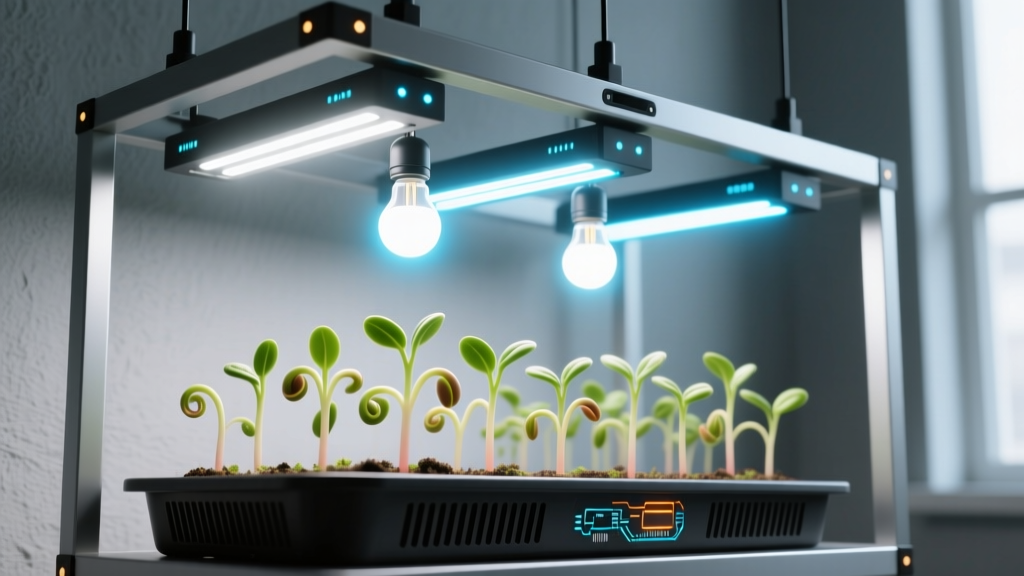
Why are your seedlings turning white—not green?
You just unboxed that sleek 600W quantum board—full spectrum, high-efficiency, “perfect for propagation”—and within 48 hours, your tomato seedlings look like they’ve been dipped in bleach. Not yellowing. Not stretching. White. Veins still green, but the cotyledons? Bleached. Crispy at the edges. You lowered the light, checked the timer, swapped the nutrient solution—and still: ghostly seedlings.
This isn’t nutrient burn. It’s photobleaching. And it’s almost always a PPFD + distance + spectral balance trifecta.
Here’s what actually happened
I’ve seen this three times this month—in Brooklyn apartments with north-facing windows and grow tents lined with Mylar. The culprit wasn’t heat (these boards run cool), and it wasn’t voltage spikes. It was PPFD >800 µmol/m²/s at 10 inches—measured directly over the soil surface, not the fixture’s spec sheet.
Quantum boards deliver intense, focused PAR. At 12", a 600W unit can easily hit 1,100–1,300 µmol/m²/s in the center—even with “balanced” diodes. That’s overkill for seedlings. Tomato cotyledons max out at 350–450 µmol/m²/s for the first 10 days post-emergence. Lettuce tolerates slightly more (up to 550), but only if acclimated over 3 days. Go above that without ramp-up, and chlorophyll degrades faster than it regenerates. Hence the white.
Don’t guess—measure. Then adjust.
You need a PAR meter. Not a lux meter. Not your phone app. A real quantum sensor calibrated for 400–700 nm. I use the Apogee MQ-500—but any entry-level handheld (under $250) works if it reads PPFD, not just PAR value.
- Set seedlings on a flat tray, soil surface level and uniform.
- Hold the sensor flush with the soil—not angled, not hovering. Take 5 readings: center + four corners.
- Aim for average ≤400 µmol/m²/s across the tray. If center reads 920 and corners read 310? Your spread is too narrow—you’ll need diffusion (more on that below), or a wider fixture.
- Adjust height incrementally: Raise 2" → remeasure → repeat until average hits target. For most 600W quantum boards over a 2' x 2' tray, that’s usually 18–22". Not 12". Not 16". Try 20". Then verify.
Spectral balance matters—even with “full spectrum”
“Full spectrum” doesn’t mean balanced. Many boards stack blue-heavy diodes (450 nm) for peak efficiency, then add red (660 nm) as an afterthought. Result? Blue:red ratio of 1:1.5—or worse, 1:1. That’s fine for flowering, brutal for seedlings.
Tomato seedlings thrive at blue:red ≈ 1:3. Too much blue before true leaves emerge triggers stomatal closure, slows expansion, and accelerates photooxidation. I’ve watched identical trays—one under 1:3, one under 1:1—diverge in 72 hours. The 1:3 batch stays compact, deep green, and pushes new leaves. The 1:1 batch bleaches at the margins, then stalls.
How to check yours? Look at the datasheet—not marketing copy—for *actual* diode layout: number of 450nm vs. 660nm chips. Or better: use a spectrometer app (like SpectraView) with a calibrated USB spectrometer ($120–$180). If blue dominates visually (harsh, violet-tinged light), assume imbalance—and dial back intensity further.
Two quick fixes that actually work
- Add a ⅛" acrylic diffuser between board and tray. Cuts peak PPFD by ~25%, softens hotspots, and subtly shifts spectral perception (less glare, less stress response). Not a band-aid—it’s optical physics.
- Use a 12-hour ramp-down: Start lights at 30% intensity for first 3 days, then +10% daily until hitting target PPFD. Seedlings don’t need “on/off.” They need transition.
This isn’t about dimming light—it’s about matching photon delivery to physiology. Get the numbers right, and those white tips fade. New growth comes in dark green. Roots thicken. Stems stiffen. You’ll know it worked when your next tray doesn’t look like it survived a UV tanning bed.