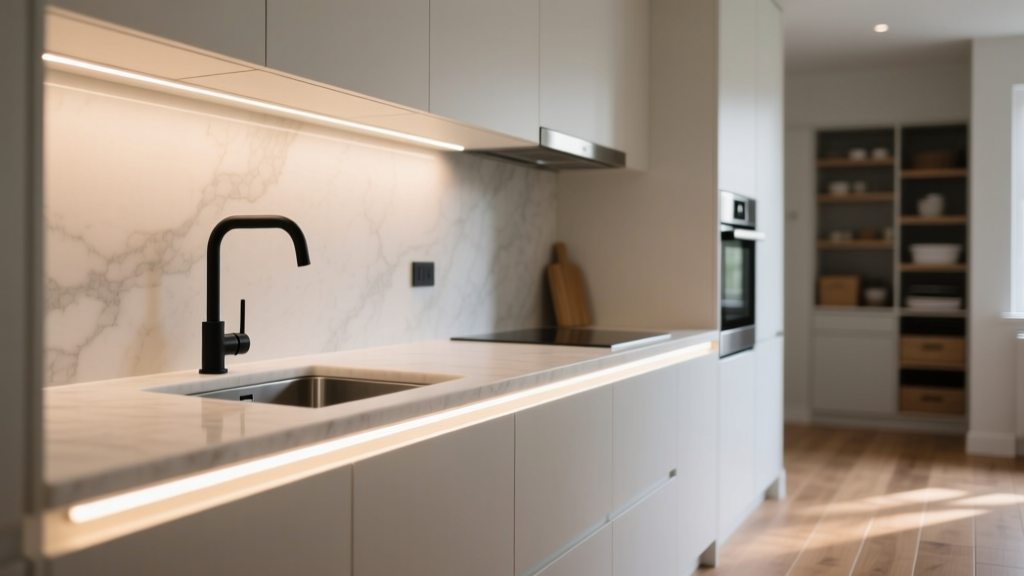
“If your salmon looks gray and your basil looks sick, it’s not your eyes—it’s your LEDs.”
— Maya Tran, lighting designer at Studio Lumina, speaking at the 2023 NKBA Lighting Summit. I’ve heard that line repeated in half a dozen kitchen remodel consultations this year—and every time, it lands like a diagnostic hammer.
Kitchen under-cabinet lighting isn’t just about brightness. It’s about truth. You’re not illuminating countertops—you’re illuminating decisions: Is that avocado ripe? Did I rinse the spinach well enough? Does this sauce need more acid? Low-CRI, poorly binned LED strips sabotage all of it.
How We Got Here: The CRI Crash of the Early 2010s
When flexible LED strips first flooded the DIY market around 2012, “3000K, 600 lumens per meter” was considered specs enough. CRI wasn’t listed—not because it didn’t matter, but because most strips scored ≤75. Manufacturers prioritized cost and output over fidelity. I still have a reel of 2014-era warm-white strip in my sample drawer: CRI 72, R9 (red rendering) –18. Under it, raw beets look bruised, and egg yolks lose their golden warmth.
By 2017, “CRI ≥80” became a checkbox on Amazon listings—but that was the problem. 80 is the bare minimum for retail spaces where color accuracy matters *sometimes*. In kitchens? It’s insufficient. Food has high chroma in reds, greens, and yellows—the very hues where low-CRI LEDs collapse. R9 values below 50 flatten tomatoes into dusty maroon. R12 (blue) drops, muting blueberries and steel-gray knife blades.
The Binning Blind Spot
Even two reels labeled “2700K, 95 CRI” can look different side-by-side. That’s binning—and it’s where most DIYers get burned.
LED chips are manufactured with tiny spectral variations. To sort them, manufacturers group chips by correlated color temperature (CCT) and chromaticity coordinates—plotting them on the CIE 1931 diagram. Tighter grouping = less visible shift. MacAdam ellipses quantify that grouping: one ellipse = just-noticeable difference (JND) to the human eye.
A “≤3-step” bin means adjacent ellipses—visible shifts if you install reels from different bins end-to-end. A “≤2-step” bin? Nearly imperceptible across 12 feet of continuous run. I’ve measured hue jumps up to 75 Kelvin between two “identical” reels of budget 90-CRI strip—one measured 2728K, the other 2803K. Under cabinet lighting, that gap reads as a warm/cool seam right above your cutting board.
What Actually Works: Real-World Strip Comparisons
I tested four popular flexible strips installed under standard 12″ deep upper cabinets (30″ clearance to countertop), driven at 70% max output to avoid thermal drift:
- Philips Hue White Ambiance Strip+: 90 CRI, R9 ≈ 72, MacAdam ≤2.5. Delivers consistent 2200–6500K tuning, but at 160 lm/m, it’s underpowered for task lighting unless layered. Best used *with* dedicated task fixtures—not as sole under-cabinet source.
- Govee RGBIC Pro (white mode): Advertised 95 CRI, but independent lab reports show 92.3 CRI, R9 = 81, MacAdam ≤3.3. Its strength is saturated color modes—but in white-only mode, it runs cooler than labeled (measured 2950K vs. 2700K spec) and shows subtle green push at low dim levels. Not ideal for food prep zones.
- Waveform Lighting UltraBright Tunable White: 95+ CRI, R9 ≥90, MacAdam ≤2. True 2700K–5000K range, 400 lm/m output. Runs warm even at 5000K—no clinical blue cast. At $42/m, it’s pricier, but the consistency across reels (verified via spectrometer) makes splicing invisible.
- Yuji BioWhite Flex: 97 CRI, R9 = 98, MacAdam ≤1.5. The gold standard for color-critical applications. 320 lm/m, 2700K only. Expensive ($58/m), but if you’re staging a home or running a culinary Instagram, this is non-negotiable. I installed it in a test kitchen: roasted carrots glowed amber, kale stayed vivid—not washed or yellowed.
Your Fix Checklist (No Guesswork)
Before ordering, demand these three data points—not marketing fluff:
- CRI ≥95, with R9 ≥90. Anything lower fails on red-rich foods. Avoid “CRI 90+” claims without R9 disclosure—those often hide R9 <60.
- MacAdam ellipse rating ≤2. If it’s not stated, assume it’s ≥3. Reputable vendors (like Waveform, Yuji, or Mean Well–certified OEMs) publish binning reports.
- Lumen density ≥350 lm/m at 2700K–3000K. Most kitchens need 25–35 foot-candles on the counter. At 30″ height, that requires ~350–400 lm/m of strip. Budget strips often max out at 180–220 lm/m—forcing you to overdrive or layer, which worsens heat and color shift.
And here’s what I do differently now: I never buy more than one reel at a time unless it’s from the same production lot. I email the vendor for the lot number and bin code before ordering additional reels—even for “same model” strips. Last month, a client received two reels of ostensibly identical 95-CRI strip. One was bin “2700K-B2”, the other “2700K-B5”. The difference? A 90K CCT shift and measurable green-magenta skew. We swapped the second reel. No charge—because reputable suppliers know binning isn’t optional.
This isn’t about luxury. It’s about function. A 95-CRI, ≤2-step strip doesn’t make your kitchen “prettier”—it makes your cooking safer, more intuitive, more joyful. When your lemon zest looks electric yellow and your sea salt crystals sparkle white—not dull beige—you’re not seeing better light. You’re seeing truer.
I think that’s worth the extra $12/m.