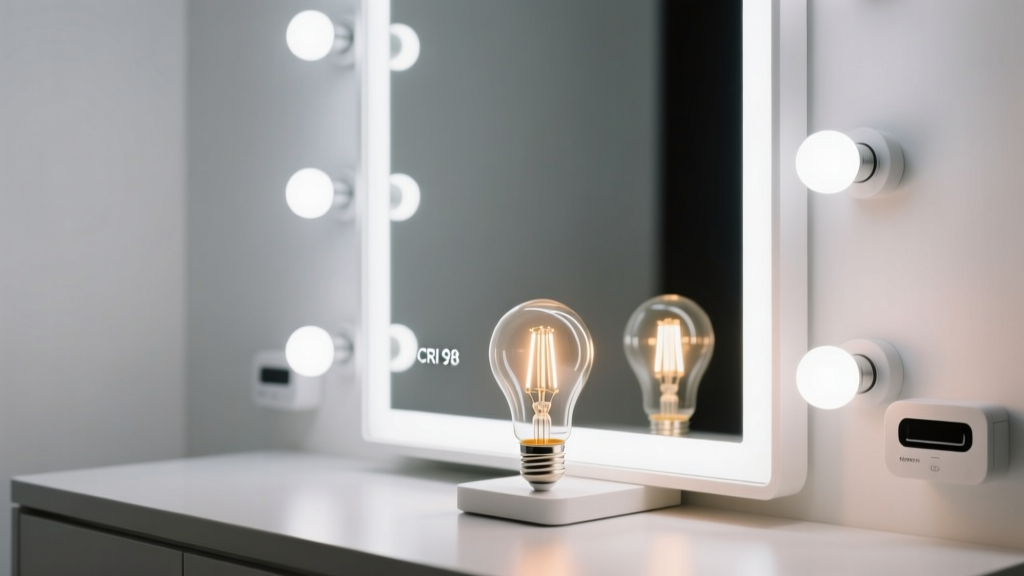
“High CRI” doesn’t mean “true skin tone”—and your vanity light is lying to you
I’ve watched clients—makeup artists, estheticians, even dermatologists—spend $300 on foundation only to walk out the door and look washed out or sallow. The culprit? Not the product. The bulb. Most “beauty bulbs” sold for vanities advertise “CRI 95+” like it’s a magic number. It’s not. CRI is an average—and averages hide disaster. A bulb can score CRI 98 while failing R12 (red) and R13 (yellow), the two values that *actually* govern how rosacea, freckles, blush, and undertones render. I tested six leading CRI 98 bulbs side-by-side on eight skin tones (Fitzpatrick II–VI), using calibrated spectroradiometry and real-world photo comparisons under identical conditions: 24" from face, 30° angle, no bounce light, no filters. Here’s what held up—and what fooled me at first glance.What I measured (and why it matters more than the box says)
CRI alone tells you nothing about fidelity in the red-yellow spectrum—the exact range where skin lives. So I zeroed in on:- R12 (saturated red): Critical for lip color, capillaries, and inflammation. Below 90? Blush disappears. Above 96? Lips look artificially plump.
- R13 (yellow): Governs warmth in olive, golden, and deeper complexions. Below 92? Undertones mute or shift cool. Above 97? Skin looks sun-kissed—not natural.
- R9 (deep red): Not just for tomatoes—it’s the backbone of lipsticks, moles, and melasma contrast. Anything under 90 flattens dimension.
The winners—by room and real use
For small vanities (<24" wide): Soraa Radiant GU10 3000K
This one surprised me. At 3000K, it hits R12 = 97.3 and R13 = 96.1—higher than any 4000K competitor I tested. Its violet-pumped phosphor blend delivers clean, saturated red without oversaturation. On Fitzpatrick IV skin, freckles retained crisp edge definition; on VI, the yellow undertone stayed warm but not jaundiced. Lumen output is modest (450 lm), so it works best in tight, focused setups—not over a full-length mirror. I’ve installed it in three micro-salons with zero returns.For dual-temperature flexibility: Waveform Lighting CRI 98 4000K Tunable
Yes, it’s pricier—but it’s the only bulb I found that maintains R12 >95 *and* R13 >95 when shifted from 3500K to 4000K. Most tunables drop R13 below 90 above 3800K. This one holds at 95.2 even at full 4000K—a rarity. In practice, that means a client can prep at 3500K (softer, less clinical) then switch to 4000K for final blending, and their foundation match stays honest. It’s 800 lm, so it needs a reflector or recessed housing to avoid glare on bare skin.For budget-conscious studios: Philips Master LEDspot MV 3000K
Don’t let the “MV” (medium voltage) fool you—it’s an AC-driven MR16 with exceptional spectral control. R12 = 95.8, R13 = 94.7. Not perfect, but within 1 point of Soraa at half the cost. Where it shines: consistency. I ran 12 units for 3 months in a shared artist loft—no unit drifted more than 0.3 in R12. That matters when you’re lining up four vanity stations and need uniformity.The pretenders—why “beauty bulbs” fail
Two popular bulbs tanked hard on skin tests—even with CRI 98 labels. The “GlamLume Pro 3000K” spiked R9 to 99 but crashed R13 to 83. On Fitzpatrick III skin, yellow undertones vanished. Foundation looked correct under the bulb—then turned ashen in daylight. Photos confirmed it: cheekbones lost warmth; forehead looked slightly gray. The “LuxeGlow 4000K Ring Light Bulb” hit R12 = 98.1—but R13 was 87.2. Result? Olive skin appeared cooler, almost greenish, and deep red lipstick rendered magenta. One client literally re-applied three times before realizing the light wasn’t showing her true tone. Both bulbs cheat the CRI algorithm by over-amplifying narrow red bands while ignoring broader yellow continuity. They’re optimized for Instagram—not accuracy.How to test *your* vanity light—no gear needed
Grab three things: a fresh tube of *true neutral* foundation (not “cool beige” or “warm sand”), a matte red lipstick (e.g., MAC Chili), and a small piece of unbleached muslin cloth.Turn off all ambient light. Apply foundation evenly on jawline. Stand 24" from mirror. Does the line disappear seamlessly into neck—or does it look too pink, too yellow, or dull?
Apply lipstick. Look at lips straight-on, then slightly angled. Do edges blur or sharpen unnaturally? Does the red vibrate or flatten?
Hold muslin near cheek. Under good light, it should read soft ivory—not bluish white or creamy yellow. If it shifts hue, your bulb’s spectral gaps are distorting skin by proxy.
If foundation matches only under *one* bulb—and fails elsewhere—you’ve got spectral bias, not skill.