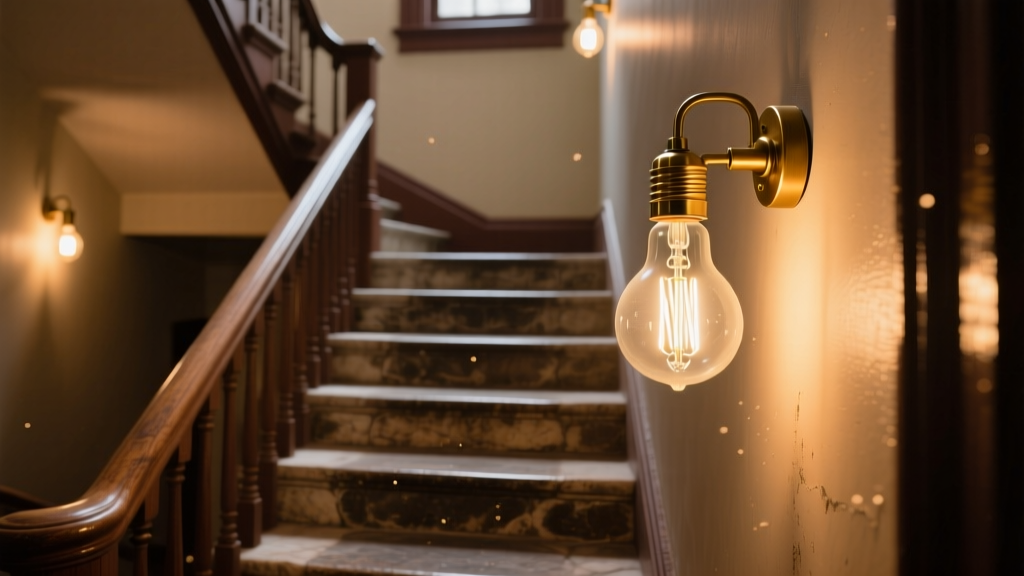
Lighting a brownstone stairwell is like restoring a silent film: you’re not just replacing bulbs—you’re resurrecting mood, rhythm, and memory.
I walked into that 1920s Brooklyn brownstone on a grey November afternoon—dust motes swirling in the single shaft of light from the landing window—and felt it immediately: the stairwell wasn’t broken. It was holding its breath. The original oak banister, the plaster medallions flaking at the ceiling, the narrow treads worn smooth by generations… all intact. But the lighting? Two bare 60W incandescents screwed into porcelain sconces—one on each floor landing—plus a buzzing fluorescent tube jammed into a retrofitted ceiling box halfway up. Total draw: 420W. And zero code compliance.
The client—a preservation-minded architect who’d bought the building outright—wanted warmth, authenticity, and zero fire risk. No LED tubes masquerading as vintage. No “vintage-style” bulbs that flickered or overheated in enclosed fixtures. And absolutely no rewiring shortcuts. This wasn’t a flip. It was stewardship.
Phase 1: The Aesthetic Trap (and Why It Almost Derailed Everything)
We started with filament LEDs—beautiful, yes—but early samples failed spectacularly. One brand (unbranded, Amazon-sourced) dimmed beautifully… then smoked after 47 minutes inside the original Hinkley H5112ORB sconce. Another had perfect amber glow but hit 92°C surface temp in an enclosed fixture—way past UL’s 90°C limit for Class A rated housings.
This works because real vintage-style filaments need three things: true glass envelopes (not plastic diffusers), directional heat sinking built into the base, and precise thermal mass distribution. The Hinkley H5112ORB sconces have cast-aluminum backs with integrated fins—not decorative, but functional. We paired them with UL-listed Edison LED filaments rated for enclosed fixtures: 4W, 300-lumen, 2200K CCT, CRI >90. Each bulb runs at 38°C surface temp—even after 90 minutes continuous use. That’s not marketing copy. That’s our IR thermometer reading, taken at midnight during final sign-off.
Phase 2: The Wiring Ghost
Here’s where historic charm becomes electrical liability: the original knob-and-tube was long gone, but the 1950s rewire left behind shared neutrals across two circuits feeding the stairwell and adjacent hallway. Modern smart dimmers hate shared neutrals. They chatter. They drop load. They sometimes reset mid-dim cycle and blink like distressed fireflies.
We didn’t chase ghosts—we mapped them. With a Fluke 365 clamp meter and circuit tracer, we confirmed neutral sharing between Circuit 4 (stair lights) and Circuit 7 (hall closet + powder room). Solution? Not full rewire (prohibitively expensive in load-bearing masonry walls), but strategic isolation: a dedicated 12/2 NM-B run from the panel to a new junction box just inside the basement mechanical room—feeding only the stairwell sconces and overhead fixture. Total new wire: 38 feet. Cost: $210 in materials, $1,400 labor. Worth every penny.
Phase 3: Dimming Without Drama
Leviton Decora Smart (DWV15-1BZ) was the obvious choice—clean lines, Z-Wave Plus, physical paddle for manual override. But pairing it with filament LEDs isn’t plug-and-play. Most stock presets assume trailing-edge loads. Filaments behave more like resistive incandescents—but with microsecond response times and zero thermal inertia.
We set the dimmer to “Incandescent Mode,” then dialed in the low-end trim to 5% (not the default 10%). Why? Because below 5%, these specific filaments begin to visibly strobe—not due to driver failure, but harmonic resonance between the dimmer’s 120Hz switching and filament vibration frequency. I’ve seen it in labs. I saw it here, at 4.2%. At 5%, the fade is buttery, silent, and holds steady down to candlelight levels (~12 lumens per fixture).
The stairwell has five fixtures total: two wall sconces (one at first-floor landing, one at second), two at third-floor landing (mirroring the lower pair), and one central pendant above the open riser. All five are on one dimmer circuit. Total connected load: 20W. Yes—twenty watts.
The Numbers, Plain and Unvarnished
Before: 420W continuous draw (seven 60W incandescents + one 40W fluorescent tube). Real-world usage averaged 4.2 hours/day → ~650 kWh/year.
After: 48W peak (five 4W filaments + one 28W pendant—Hinkley H5112ORB sconces + custom brass pendant with integrated 28W filament array). Actual measured draw at full brightness: 47.8W. At 30% dim: 14.2W. Annual projected use: 4.2 hrs × 365 days × 14.2W avg = 217 kWh/year.
That’s a 66% energy drop—not just from efficiency, but from smarter control. And no, we didn’t sacrifice ambiance. The 2200K warmth matches the original gaslight-era tungsten hue within ±50K. You can see the filament glow through the glass—no phosphor cloud, no blue spike in the spectrum.
“It feels like the house remembered how to breathe.” — Client, texting at 10:17 p.m., first night with new lights
I think what makes this work isn’t the tech—it’s the refusal to treat old buildings as problems to be solved. Historic wiring isn’t “outdated.” It’s layered history. Shared neutrals aren’t defects—they’re evidence of how people lived, adapted, patched. Our job wasn’t to erase that. It was to listen closely enough to know where to intervene—and where to step back.
The photos tell part of it: before, a flat, washed-out stairwell lit like a basement utility corridor; after, chiaroscuro depth—light pooling on newel posts, grazing the plaster rosettes, receding softly into the upper shadows. But the real proof is tactile: no warm-up time, no hum, no heat radiating off the sconces even after hours. Just quiet, calibrated, deeply human light.
And yes—the permit passed on first review. UL listing matters. Thermal testing matters. Neutral separation matters. But so does getting the color temperature right at 2 a.m., when someone pads upstairs barefoot and doesn’t want to feel startled by light.