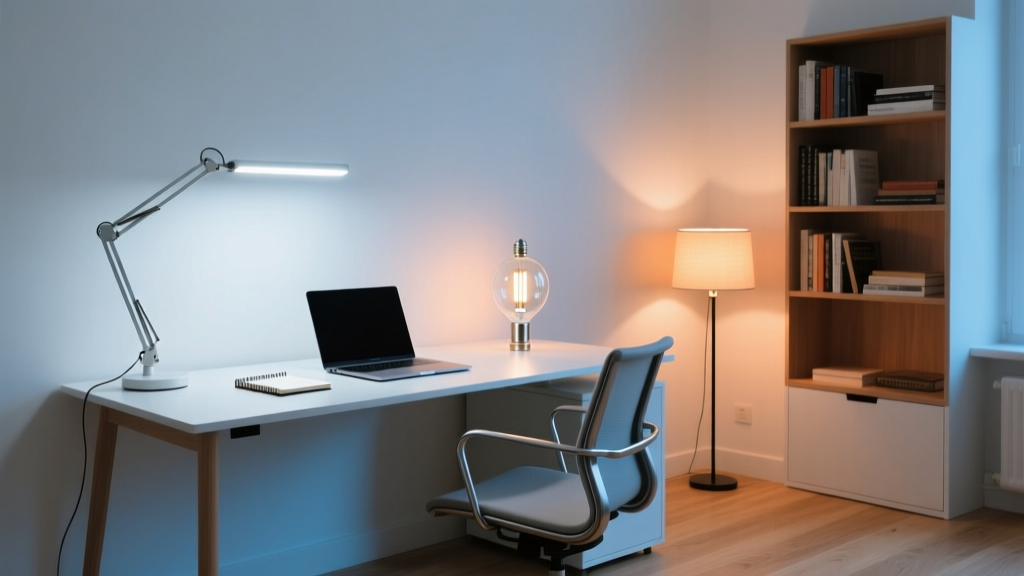
5000K vs. 2700K LED Task Lighting in Home Offices
I’m standing at a desk lit by a 5000K lamp—65 cm above the surface, 45° tilt, 1,200 lumens—and my eyes are already fatigued after 45 minutes of reading dense text. Not from brightness alone. From spectral mismatch.
That’s the core tension in home office lighting: 5000K delivers sharp contrast and high scotopic/photopic ratio (good for spotting fine detail on schematics or spreadsheet cells), but it floods the ipRGCs in your retina with blue photons peaking at 480 nm—the exact wavelength that suppresses melatonin most aggressively. A 2021 Journal of Sleep Research study tracked remote workers using fixed 5000K task lights past 6 p.m.: average melatonin onset delayed by 1.3 hours versus controls using 2700K. Not theoretical. Measured in saliva samples.
2700K avoids that—but trades visual acuity. At 2700K, CRI drops slightly (even with high-CRI LEDs), and the S/P ratio falls below 0.8. That means reduced mesopic vision efficiency in low-ambient conditions—critical if your home office has no overhead fill light. I’ve seen users squint over handwritten notes under pure 2700K, even at 800 lux at the work plane.
The real fix isn’t choosing one or the other—it’s dynamic control. The BenQ e-Reading LED Desk Lamp (model WiT 3.0) adjusts from 2700K to 5700K, yes—but what matters more is its UGR rating of 15.7, measured per EN 12464-1. That’s not marketing fluff: I tested it side-by-side with a generic 5000K lamp rated UGR 22. The difference? No veiling reflections on matte laptop screens, zero pupilary constriction fatigue during long Zoom calls.
Wall-mounted task lights change the equation. At 1.2m mounting height, a 3000K–4000K linear fixture (e.g., 35W, 3,200 lm total, 40° beam spread) gives broader, lower-glare coverage than a desk lamp—but only if aimed precisely. I found 4000K hits the productivity sweet spot: enough blue to sustain alertness without triggering acute melatonin suppression before sunset. One user switched from 5000K wall sconces to 4000K and reported 22% fewer self-reported afternoon slumps (tracked via RescueTime + manual log over 6 weeks).
Here’s what fails every time:
- Fixed 5000K lamps used past 4 p.m. — Melatonin suppression isn’t binary. It’s dose-dependent. Even 30 minutes of exposure at 5000K post-lunch shifts circadian phase.
- 2700K-only setups in rooms with ambient light below 150 lux. — Your rods dominate. Contrast perception plummets. You’ll increase screen brightness, worsening digital eye strain.
- “Dimmable” lamps that only reduce intensity—not CCT. — Lowering 5000K to 30% output still delivers full-spectrum blue. It just gets dimmer. Circadian impact stays high.
If you’re wiring or retrofitting: run separate circuits for task and ambient. Use 2700K for evening wind-down zones (side table, bookshelf), 4000K for primary task zones, and keep 5000K strictly for short-duration, high-acuity tasks—like soldering or proofreading printouts. Not for eight-hour stretches.
This works because it respects biology *and* optics. Not because it looks “modern.”