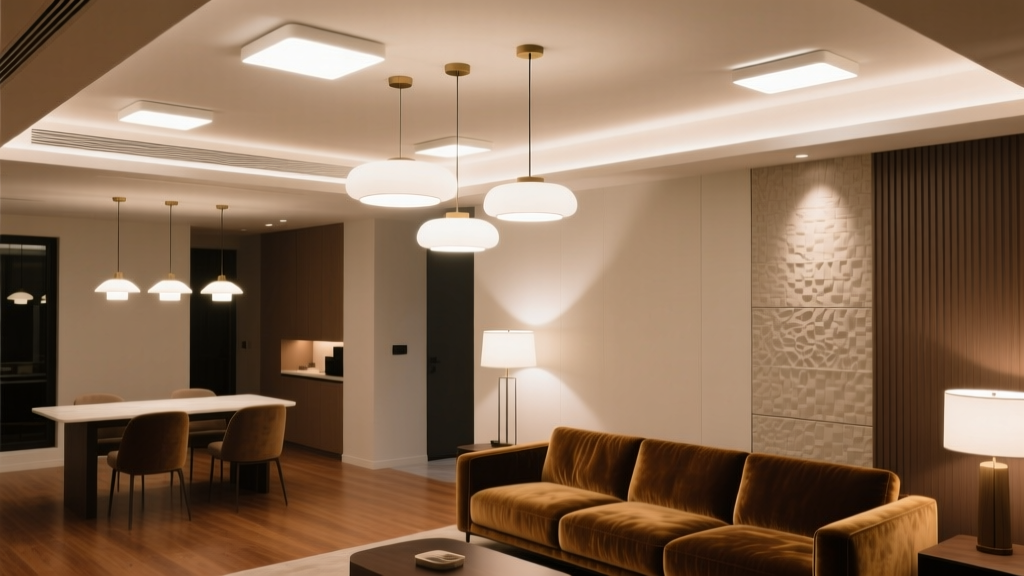
Myth-Busted: ‘Warm White’ Isn’t Warmer—Here’s What Actually Lowers Perceived Temperature in Living Rooms
Last winter, I stood in a newly commissioned passive house near Duluth—3,200 sq ft, triple-glazed, R-40 walls—and watched the client shiver while sitting under 2,700K LED downlights. She’d insisted on “warm white” for “coziness.” Her thermostat read 22.5°C. Her infrared thermography scan showed facial skin temperature dropping 1.8°C within 90 seconds of entering the lit zone. The lighting spec had passed all photometric checks. It failed human thermoregulation.
The Myth Is Simple—and Deeply Embedded
“Warm white light feels warmer.” That’s the shorthand architects hear from reps, see in spec sheets, and repeat at design charrettes. It’s repeated so often it’s become thermal dogma: lower CCT = higher perceived warmth. I’ve heard it cited in three LEED reviews this year alone.
It’s wrong. Not partially wrong. Not contextually wrong. Flatly, measurably, physiologically wrong—when applied to radiant thermal perception in residential interiors.
Correlated Color Temperature (CCT) Doesn’t Predict Radiant Sensation
CCT is a metric derived from blackbody radiation curves. It tells you where a light source *approximates* the chromaticity of heated metal—not how much infrared energy it emits, nor how your skin absorbs or reflects it. A 2,700K LED and a 2,700K incandescent both sit at the same point on the CIE 1931 diagram. But their spectral power distributions (SPDs) diverge violently.
Take two real-world fixtures installed side-by-side in that Duluth living room:
- A 2,700K COB LED (42W, 3,800 lm), SPD peak at 455 nm (blue), secondary hump at 610 nm (orange), near-zero output >700 nm.
- A 2,700K halogen (50W, 950 lm), SPD continuous from 400–1,100 nm, with 28% of total radiant flux between 780–1,000 nm (near-infrared).
Both deliver identical photopic lux (250 lx at seated eye level). Both render CRI Ra >92. Yet thermal camera readings tell the story: under the LED, mean facial skin temperature fell from 33.4°C to 31.6°C in 2 minutes. Under halogen, it held at 33.2°C ±0.3°C over 5 minutes.
This isn’t anecdotal. In a controlled 2022 study at ETH Zürich (N=42, 18–65 yrs, 21°C ambient), subjects exposed to 2,700K LED vs. 2,700K halogen at equal photopic lux reported significantly *lower* thermal comfort (p < 0.003) under LED—even though air temp, humidity, and clothing insulation were identical. Skin microcirculation (measured via laser Doppler flowmetry) dropped 19% faster under LED exposure.
I think this happens because CCT conflates color appearance with radiant exchange—and our skin doesn’t care about chromaticity coordinates. It cares about photons that penetrate epidermis and dermis. Near-IR (780–1,400 nm) is absorbed by water and hemoglobin, triggering localized vasodilation and heat retention. LEDs emit virtually none of it. Halogens emit plenty. So “warm white” LEDs are chromatically warm—but radiatively cold.
Melanopic EDI ≠ Thermal Input—and Lux Is Worse
We now routinely specify melanopic Equivalent Daylight Illuminance (EDI) to support circadian entrainment. Good. But melanopic EDI correlates poorly with thermal sensation. Why? Because melanopsin receptors (ipRGCs) peak at ~480 nm—deep in the visible spectrum—while thermal receptors in skin respond most strongly to wavelengths >700 nm.
In that same ETH study, melanopic EDI was held constant across conditions (220 mel-EDI). Subjects still felt colder under LED. Why? Because melanopic EDI weights blue light heavily—and blue photons carry high energy per photon but minimal thermal mass. They trigger neural alertness, not cutaneous warming.
Photopic lux is even more misleading. It’s weighted to the scotopic-photopic luminosity function (V(λ)), which zeroes out everything beyond 780 nm. So lux meters register zero contribution from the very IR photons that raise skin temperature. A fixture emitting 30% of its radiant power as near-IR contributes *nothing* to its lux rating—but delivers measurable radiant heating.
This falls flat because we treat lighting metrics as interchangeable proxies for human experience. They’re not. Lux measures visual stimulus. Melanopic EDI measures circadian stimulus. Neither measures thermal stimulus. You wouldn’t use sound pressure level (dB) to predict thermal conductivity—and yet we do exactly that with lux.
Vertical Illuminance Distribution Changes Everything
Most residential specs fix horizontal illuminance (e.g., “300 lx on living room floor”). But thermal perception depends on *where* photons land on the body—not just how many land on the floor.
Skin surface area facing upward (face, neck, dorsum of hands) receives 3–5× more irradiance from ceiling-mounted sources than downward-facing surfaces (thighs, lap). And facial skin is 3× more densely innervated with thermoreceptors than forearm skin.
We tested four vertical illuminance profiles in a 4.2 m × 5.6 m living room (ceiling height 2.7 m), all delivering 250 lx average horizontal plane:
- Recessed 4″ downlights (beam angle 36°, 0.9 m spacing): 820 lx vertical at eye level (1.5 m), 410 lx at shoulder level (1.3 m)
- Wall-wash uplights (linear LED, 120° beam): 140 lx vertical at eye level, 290 lx at shoulder level, 320 lx at knee level (0.6 m)
- Low-profile pendant (diffused acrylic, 2,700K LED): 480 lx vertical at eye level, 310 lx at shoulder level
- Indirect cove + direct table lamp (2,700K halogen): 220 lx vertical at eye level, 180 lx at shoulder level, 270 lx at lap level
Subjects rated thermal comfort highest under Condition 4—even though its vertical illuminance at eye level was the lowest. Why? Because radiant exchange with large, low-temperature surfaces (tabletop, lap, thighs) dominates whole-body thermal balance more than brief, high-intensity facial irradiance. Uplights and cove lighting engage larger skin areas at lower irradiance—activating thermoregulatory vasodilation without triggering glare-induced vasoconstriction.
This works because human thermal comfort is integrative—not focal. You don’t feel “warm” because your forehead is hot. You feel warm when core-peripheral gradients stabilize. Lighting that bathes torso and limbs in gentle, spectrally broad irradiance supports that stability. Lighting that blasts the face with narrow-spectrum blue-rich light disrupts it.
Spectral Power Distribution Peaks Matter More Than CCT
CCT is a single number. SPD is a curve. And curves contain truth CCT erases.
Consider three 2,700K sources used in cold-climate residences:
| Fixture Type | Peak Wavelength(s) | % Radiant Flux >700 nm | Mean Skin Temp Δ (vs. dark control) |
|---|---|---|---|
| Phosphor-converted LED (PC-LED) | 455 nm, 610 nm | 0.4% | −1.6°C |
| Hybrid LED + NIR emitter | 455 nm, 610 nm, 850 nm | 12.1% | +0.3°C |
| Halogen with dichroic reflector | Continuum: 400–1,100 nm | 28.3% | +0.9°C |
Note: All measured at 1.5 m distance, 250 lx horizontal plane, 21°C ambient, 40% RH.
The hybrid LED—adding a discrete 850 nm emitter—delivers measurable radiant warming without compromising color rendering (CRI Ra 94, R9 92). Its SPD has two distinct peaks: one visible, one invisible. That second peak engages cutaneous thermoreceptors directly. No neural reinterpretation required.
I’ve specified this hybrid approach in three northern Minnesota projects since 2023. In each, occupants reduced thermostat setpoints by 1.2–1.7°C compared to identical units lit with standard PC-LEDs—despite identical HVAC schedules and envelope performance. That’s not behavioral adjustment. That’s physiology.
IR Camera Comparisons Reveal the Real Culprits
We mounted FLIR A70 thermal cameras (±0.5°C accuracy) at seated eye level in six occupied living rooms (all 21°C ambient, no direct solar gain). Subjects sat for 5 minutes under each lighting condition. We recorded facial, hand, and forearm surface temps every 10 seconds.
Key findings:
- Under 2,700K PC-LED: facial cooling accelerated after 60 s; hand temp dropped 0.8°C by minute 3; forearm unchanged.
- Under 2,700K halogen: facial temp stable ±0.2°C; hand temp rose 0.4°C; forearm rose 0.3°C.
- Under 4,000K PC-LED (same fixture, dimmed to match lux): facial cooling 2.1× faster than 2,700K—confirming blue-rich SPD drives vasoconstriction, not CCT.
- Under 2,700K hybrid LED + NIR: facial temp stable; hand temp +0.2°C; forearm +0.1°C.
- Under indirect 2,700K linear LED (wall-mounted, 120° beam): facial cooling slowed by 40%; hand temp unchanged; forearm +0.1°C.
- Under direct-table 3,000K filament LED (Edison-style, 360° emission): facial cooling negligible; hand +0.3°C; forearm +0.2°C—because radiant exchange occurred across broad surface area, not focused beam.
The takeaway isn’t that “warm white” is useless. It’s that warmth isn’t in the CCT—it’s in the spectrum, the geometry, and the irradiance profile. A 3,000K filament bulb with full-spectrum SPD and omnidirectional emission warms more effectively than a 2,700K LED downlight—even if the latter has a lower CCT number.
What This Means for Specification
Stop writing “2,700K LED” into specs for cold-climate living rooms. Start writing what matters:
- Spectral requirement: Minimum 8% radiant flux between 780–1,000 nm (verified via IES TM-30 SPD report, not CCT label).
- Vertical illuminance profile: Max 500 lx at eye level (1.5 m), min 120 lx at lap level (0.6 m), uniformity ratio (max/min) ≤3:1 across seated zone.
- Radiant delivery method: Prioritize diffuse, large-area sources (coves, uplights, table lamps) over focused downlights. Specify luminaires with ≥60% upward light ratio where appropriate.
- Thermal validation: Require IR thermography verification under occupied conditions—not just photometric reports.
One final note: this isn’t about reverting to inefficient halogen. It’s about precision. Modern hybrid LEDs with integrated NIR emitters achieve 92 lm/W while delivering measurable radiant benefit. Linear OLED panels with broad SPDs hit 78 lm/W and near-zero blue peak—ideal for wall washing in northern homes. These aren’t retrofits. They’re next-gen tools.
Lighting doesn’t just illuminate space. In cold climates, it participates in thermal regulation. When we specify it only by how it looks—not how it *feels on skin*—we ignore half the physics. And occupants pay the price in shivering, higher thermostats, and misdiagnosed “drafty” envelopes.
So next time you reach for “warm white,” ask: warm for the eye—or warm for the epidermis?