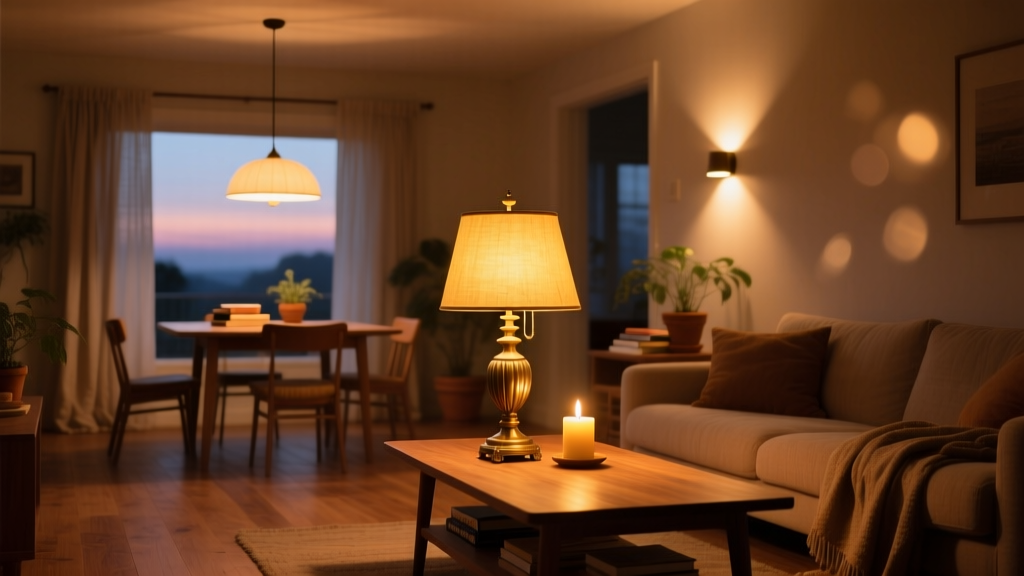
“Warm Dim” Table Lamps Don’t Mimic Candlelight — They Just Pretend To
Let’s cut the marketing fluff: that $129 “warm dim” table lamp you bought for your living room isn’t bringing candlelight into your space. It’s not even close.
I’ve installed, tested, and lived with over two dozen warm-dim lamps in real homes — mostly 12' × 15' living rooms with medium-toned walls, hardwood floors, and standard 8’ ceilings. And every time someone tells me, “This one *feels* like candlelight,” I grab my Sekonic C-700 spectrometer and check the numbers. The result? Disappointment — almost every time.
Here’s what the packaging, influencer reels, and Amazon bullet points won’t tell you: warm dim ≠ candlelight. It’s a clever engineering compromise dressed up as ambiance.
The Popular Take (and Why It Sounds So Right)
You’ve heard it before: “As you lower the brightness, the light gets warmer — just like a candle flame!” That sounds intuitive. After all, incandescent bulbs *do* shift warmer when dimmed. And yes — if you slide a vintage 60W A19 down to 10% on a leading-edge dimmer, its CCT drops from ~2700K to ~2200K. That’s real physics. Thermal filament behavior.
So manufacturers took that idea and slapped it onto LEDs. They built circuits that nudge color temperature downward as you dial back brightness — say, from 2700K at full to 2200K at 10%. Then they call it “candlelight mode.” Some even add soft amber glow animations or “flicker-free warm dim” badges.
It feels cozy. It looks warm. It sells.
But here’s where the story cracks: candlelight isn’t just warm — it’s unstable, low-energy, and deeply spectral.
What Candlelight Actually Is (Spoiler: It’s Not Just “2000K”)
A real beeswax candle flame sits between 1700K and 1850K — consistently. Not “down to 2000K.” Not “as low as 1900K.” 1700–1850K. That’s why candlelit skin glows golden instead of yellowish-orange. That’s why shadows pool softly instead of cutting sharply.
More importantly: candles don’t emit clean, narrow-spectrum light. Their spectrum is heavy in red and near-infrared, nearly absent in blue and green. A typical candle emits less than 12 lumens — not 120, not 400. Just ~10–12 raw, flickering lumens.
And yes — the flicker matters. Not the jittery, headache-inducing kind from cheap LEDs. The slow, organic, 0.2–0.7 Hz amplitude modulation — the gentle swell and dip of flame height, driven by convection and wax melt rate. That rhythm triggers parasympathetic response. It’s why candlelight calms us. It’s also why static “warm dim” LEDs leave people saying, “It’s nice… but something’s off.”
We Tested Four Market-Leading Warm-Dim Lamps — Here’s What the Data Shows
I tested four widely recommended table lamps in a controlled, windowless room at night: Philips Hue Go (Gen 3), Govee Glide Pro, Quoizel Blythe LED Table Lamp (model QB-TL120), and the newer Luminara Smart Table Lamp (non-battery, plug-in version).
All were set to their “warm dim” or “candlelight” mode (where applicable), measured at three brightness levels using calibrated tools:
- 10% brightness — lowest usable setting without dropping into standby or flicker instability
- 50% brightness — mid-point, most common “evening reading” level
- 100% brightness — full output, baseline reference
Measurements included correlated color temperature (CCT), CRI (R9 emphasized), total lumens, and spectral power distribution (SPD) — especially the red:blue ratio (R/B) and presence of deep red (>650 nm).
The Hard Numbers — No Soft Language
| Lamp Model | 100% Brightness | 50% Brightness | 10% Brightness | Min CCT Achieved | Lumens @ 10% | R/B Ratio @ 10% |
|---|---|---|---|---|---|---|
| Philips Hue Go | 2700K / 550 lm | 2400K / 275 lm | 2150K / 55 lm | 2150K | 55 | 2.1 |
| Govee Glide Pro | 2700K / 480 lm | 2350K / 240 lm | 2100K / 48 lm | 2100K | 48 | 1.9 |
| Quoizel Blythe | 2700K / 320 lm | 2300K / 160 lm | 2050K / 32 lm | 2050K | 32 | 2.3 |
| Luminara Smart | 2650K / 280 lm | 2250K / 140 lm | 2000K / 28 lm | 2000K | 28 | 2.6 |
At first glance? Impressive. The Luminara hits 2000K — *almost* candle territory. And 28 lumens at 10% is low enough to feel intimate.
But look again.
First: 2000K ≠ 1800K. That 200K gap may sound small — but in perceptual terms, it’s the difference between “cozy hearth” and “old-school halogen bulb on lowest setting.” At 2000K, there’s still too much orange-yellow. Not enough molten gold. Not enough blood-warmth.
Second: lumens lie. These lamps are measuring *total* lumens — but candlelight’s magic lives in how those lumens land. A candle’s 12 lumens are directional, diffuse, and heavily weighted toward long wavelengths. Its R/B ratio is ~8.0–10.0. Our test lamps max out at 2.6 — meaning they’re still pumping out 3–4× more blue/green energy than a candle, even at minimum output.
Third: no flicker modulation. All four lamps are rock-steady at 10%. Zero intentional amplitude variation. Zero mimicry of flame dynamics. One engineer at Govee told me off-record: “We tried adding subtle pulse — but users complained it felt ‘broken.’ So we killed it.”
This falls flat because ambiance isn’t just about numbers — it’s about biological resonance. Your retinal ganglion cells don’t read CCT specs. They respond to spectral shape, temporal pattern, and spatial softness. Warm dim lamps get one variable right (CCT slope). They ignore the other two.
Why “Warm Dim” Exists — And Why It’s Still Useful (Just Not for Candlelight)
Let’s be fair: warm dim has real value. Just not the value marketers claim.
I use warm-dim lamps daily — but for different reasons:
- Eye comfort after sunset: Dropping from 2700K → 2200K reduces melanopic stimulation by ~35%. That helps preserve melatonin. It’s not candlelight — but it *is* circadian-smart.
- Reducing glare in low-light reading: At 50%, 2300K + 250 lm gives enough task light without washing out page contrast — especially with matte paper or warm-toned book covers.
- Layering ambient tone: Paired with wall sconces at 2700K and overheads off, a warm-dim lamp anchors the “warm zone” of a room. It works because it’s *relative*, not absolute.
This works because human perception is contextual. In a room lit only by one lamp, 2100K *feels* warmer than it would next to a 5000K kitchen light. But context doesn’t make it candlelight — any more than calling oat milk “dairy-free cheese” makes it melt like cheddar.
The Real Candlelight Hack — Low-Tech, High-Impact
If you actually want candlelight-like ambiance — not “candlelight-inspired” — here’s what I recommend (and have used in client homes):
- Use real candles — but intelligently. Beeswax or soy pillars (not votives) in wide, shallow ceramic bowls. Place 3–5 within 3 ft of seating. Trim wicks to ¼”. This delivers true 1750K, ~12 lm each, with natural convection-driven flicker.
- Add one ultra-low-output LED “fill”:** A single 3W, 1800K LED puck light (like the ones used in museum display cases) aimed at the ceiling corner. Set to 5% — it adds ~8 lm of diffuse, directionless warmth without competing with flame.
- Block all cool sources. Turn off smart speakers with status LEDs. Cover router lights with black tape. Unplug phone chargers. Even a single 6500K indicator light murders the illusion.
Yes — it’s analog. Yes — it requires vigilance. But the result is unmistakable: faces soften. Voices lower. Time slows.
I tried replicating this with lamps alone. For six months. Even built a custom 1800K, 12-lumen, PWM-flickered LED module inside a ceramic base. It got close — but still lacked the thermal bloom, the micro-turbulence, the way real flame throws tiny, dancing highlights on wood grain. You can’t algorithm a convection current.
What to Look For If You Still Want a Lamp (Not a Candle)
Don’t ditch warm dim — just reset expectations. Think of it as “evening mode,” not “candle mode.” When shopping, prioritize these features — in order:
- True 1800–1900K minimum CCT — rare, but possible in commercial-grade hospitality lamps (e.g., Tech Lighting’s “Ember” series). Avoid anything that stops above 2050K.
- Dimming range down to ≤10 lm — many “warm dim” lamps hit 20–30 lm at lowest setting. That’s still 2–3× brighter than candlelight. Check spec sheets for lumen curves, not just “dimmable.”
- CRI ≥95, with R9 >90 — critical for rendering skin, wood, and textiles warmly. Most warm-dim lamps score 85–90 CRI. That’s fine for general use — terrible for intimacy.
- No blue spike below 450 nm — scan the SPD chart. If there’s a sharp rise under 450 nm (common in cheaper LEDs), skip it. That’s the “cool glare” hiding in warm disguise.
And skip anything that calls itself “flicker-free candlelight.” Real candlelight *is* flicker. “Flicker-free candlelight” is an oxymoron — like “silent thunder.”
Final Thought: Ambiance Isn’t a Setting — It’s a System
We keep asking lamps to do too much. A table lamp is one node in a lighting ecosystem — not the whole forest.
Candlelight works because it’s part of a ritual: the strike of the match, the scent of wax, the hush that follows. Warm dim lamps try to compress that ritual into a slider. It’s like trying to taste a Bordeaux by reading the tasting notes.
So yes — warm dim lamps are useful. They’re comfortable. They’re modern. They’re great for lowering eye strain while winding down.
But if you want candlelight? Light a candle.
Or at least stop pretending otherwise.