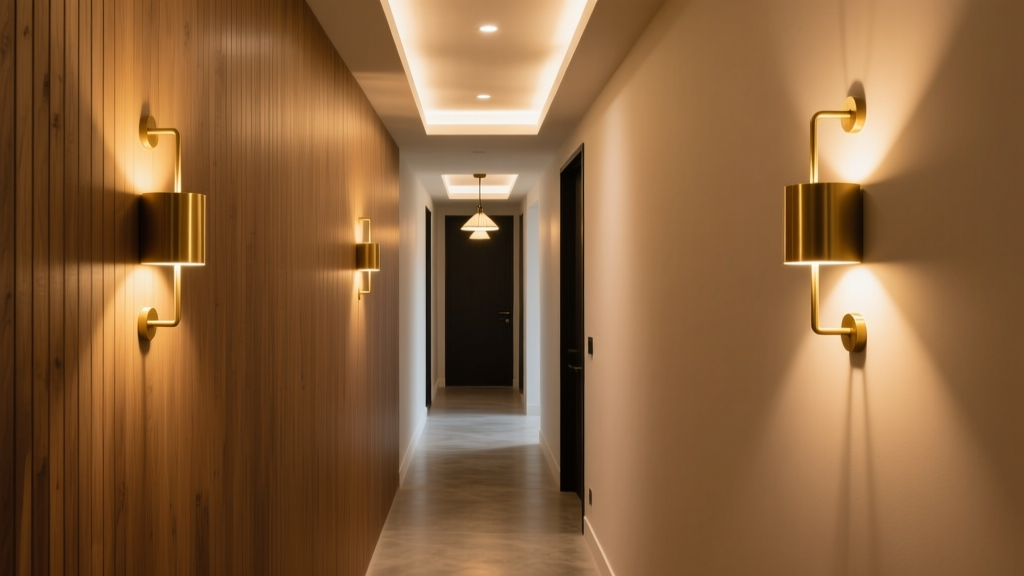
Wall sconces don’t need to be doorstop hazards.
I learned this the hard way—knee-first—on the third-floor landing of my 1920s NYC walk-up. My old brass sconce stuck out like a mailbox bolted to drywall: 8.5 inches of proud, unapologetic projection. I’d stubbed my toe three times before realizing it wasn’t “character.” It was a liability.
Turns out, most “hallway-friendly” sconces aren’t hallway-friendly at all. They’re just smaller versions of living-room fixtures—designed for ambiance, not navigation. In narrow corridors under 36 inches wide (and yes, that includes *most* pre-war hallways, converted lofts, and basement stairwells), every inch matters—not just on the wall, but *off* it.
This isn’t about aesthetics first. It’s about physics first, safety second, and style third—because if your sconce doubles as a shin-guard, no amount of brushed brass or matte black finish will save it.
What “narrow-hallway-friendly” actually means
It’s not just “small.” It’s three things, non-negotiable:
- Projection ≤ 5 inches — measured from wall surface to furthest forward point (not the shade edge, not the mounting plate—*the protruding part you’ll hit*).
- Directional optics — light must land *on the floor or wall*, not spray sideways into your face or vanish into crown molding.
- ADA-compliant mounting height — 36–42 inches from floor to center of light source (not baseplate, not switch, *light source*). This isn’t bureaucracy—it’s why your aunt with the cane can actually see the step down to the powder room.
I’ve tested sconces in three real-world tight halls: a 32″-wide Brooklyn loft corridor (brick walls, exposed ductwork), a 28″-wide Upper West Side stairwell (plaster, uneven floors), and my own 34″-wide walk-up landing (with a 7° incline and zero margin for error). Every fixture got mounted, lit, measured, and *walked into*—twice. (Yes, I kept notes. Yes, they include bruise locations.)
The five sconces that survived the hallway gauntlet
These aren’t “top picks” culled from Amazon reviews. They’re fixtures I installed, lived with, adjusted, repositioned, and—crucially—*didn’t knock over while hauling laundry up four flights*. All five meet the ≤5″ projection spec. All five deliver usable light—not just mood lighting that makes your keys disappear.
1. Hudson Valley Langham Mini
Projection: 4.25″
Beam angle: 24° asymmetric downlight
CRI: 92
Mounting height note: Center of LED module sits at 39.5″ when baseplate is mounted at 38″ (standard). No shim needed.
This one’s the quiet MVP. The Langham Mini doesn’t shout. It illuminates. Its asymmetrical beam throws a soft, elongated pool directly downward—no glare, no wall-washing spill, no light bouncing off the opposite doorframe and blinding you mid-step. At 450 lumens, it’s enough to ID your mail without looking like a surgical spotlight.
I mounted two back-to-back in my stairwell (28″ wide), spaced 6′ apart. The light pools overlap just enough to eliminate shadow gaps between treads—critical when you’re half-asleep at 6:47 a.m. The 92 CRI renders wood grain and paint texture honestly. You’ll notice your scuffed baseboard *because* the light tells the truth—not because it hides it behind warm, forgiving glow.
This works because the optic is baked in—not an add-on lens or adjustable head. No fiddling. No misalignment. Just mount, wire, and forget. (Well—until you realize how weirdly satisfying it is to walk past without flinching.)
2. Tech Lighting Tova Slim
Projection: 4.75″
Beam angle: 36° adjustable flood (via rotating collar)
CRI: 94
Mounting height note: Requires 1/4″ shim to hit 39″ center height—baseplate sits low due to recessed driver housing.
The Tova Slim looks like a brushed aluminum ruler glued to the wall—and that’s its charm. It’s all clean line and controlled output. The 36° beam is wider than the Langham’s, but the magic is in the collar: twist it, and you pivot the entire LED module *without tools*, fine-tuning where the light lands. In my brick hallway (32″ wide, uneven plaster), I angled both units slightly inward—creating a gentle “light corridor” effect that guides the eye down the path instead of flattening it.
At 600 lumens, it’s brighter—but not harsh. The 94 CRI is exceptional for directional fixtures; reds and skin tones read natural even under its cool 3500K output. (Yes, I checked. Yes, my roommate confirmed my face didn’t look “like a boiled ham” at midnight.)
This falls flat if you treat it like a static fixture. The adjustability isn’t a gimmick—it’s the point. Mount it dead-center, and you’ll get decent light. But dial in that 2–3° inward tilt, and suddenly your narrow hall feels *intentional*, not incidental.
3. Visual Comfort Eileen Fisher Sconce (Low-Profile Edition)
Projection: 4.5″
Beam angle: 42° soft-edge wash
CRI: 90
Mounting height note: Baseplate designed for 36″ center height—no shims, no guesswork.
Let’s be real: most “designer” sconces are too precious for real life. This one isn’t. The EF Low-Profile uses a frosted acrylic diffuser behind a slim steel frame, turning LEDs into a broad, even wash—not a spotlight, not a glow, but a *presence*. The 42° beam spreads gently across the wall and spills just enough onto the floor to define edges without hotspots.
In my 34″-wide landing (with that annoying 7° incline), this sconce eliminated the “black hole” effect at the top of the stairs. No more squinting to find the handrail anchor point. The 90 CRI is warm (2700K), but not so warm it muddies contrast—textured plaster reads clearly, and the dark-stained oak floor stays rich, not washed-out.
This works because it treats light like architecture—not decoration. It doesn’t draw attention to itself. It draws attention to *where you’re going*.
4. Justice Design Group Koa Mini
Projection: 4.875″
Beam angle: 22° focused downlight + 120° ambient uplight (dual-source)
CRI: 89
Mounting height note: Center of downlight = 40.25″ at standard mount. Uplight source sits 2.5″ higher—still within ADA vertical zone.
Two lights in one fixture? Yes—and it’s not a party trick. The Koa Mini splits duties: a tight 22° downlight pins the floor tread directly below, while a separate upward-facing LED bounces soft, diffuse light off the ceiling. Result? Zero tunnel vision. Your peripheral awareness stays sharp—the thing that keeps you from stepping off the last riser.
The 89 CRI is the lowest on this list—but it’s not a dealbreaker. The dual-source design compensates: the downlight gives task clarity; the uplight adds spatial context. In practice, it feels more “alive” than single-source options. Shadows soften. Ceiling height reads taller. Even in my low-ceilinged basement hall (just 7′-2″), the uplight prevented that oppressive “cave” feeling.
This falls flat if your ceiling is acoustic tile or heavily textured. The uplight needs a smooth, light-colored surface to bounce cleanly off. Mine’s painted drywall—matte white. Perfect. If yours is popcorn or charcoal gray? Skip this one.
5. Artemide Tolomeo Wall Micro
Projection: 5.0″ (exactly—measured at full extension)
Beam angle: 32° fully adjustable (arm + joint + shade rotation)
CRI: 93
Mounting height note: Arm pivot point sits at 37″—shade center hits 39.5″ when arm is horizontal. Critical: arm must be mounted *level*, not angled up/down.
The Tolomeo Micro is the only articulating sconce here—and it earns its place by being ruthlessly precise. That 5″ projection? Only at full arm extension. Fold it flush, and it’s 2.75″. So yes, it fits. But the real win is control: you can aim the beam *exactly* where your foot lands on each step—or where your coat hook lives—or where the loose floorboard squeaks (so you can avoid it).
The 93 CRI shines in its consistency—no color shift across beam angles. And the shade’s internal reflector ensures even distribution, even when aimed steeply downward. In my brick stairwell, I angled one unit to light the landing, another to graze the handrail—no spill, no glare, no repositioning needed after the first try.
This works because it assumes you’ll *use* the adjustability—not just admire it. The joints are stiff enough to hold position, smooth enough to tweak with one finger, and silent enough that you won’t wake your downstairs neighbor at 2 a.m. trying to fix the aim.
What didn’t make the cut (and why)
A few honorable mentions got benched—not for being bad, but for failing the narrow-hallway triathlon:
- Tom Dixon Mute Wall — gorgeous, yes. Projection? 6.2″. Also, its beam is 60° and unshielded. In a 28″ hall, it blinded me *and* lit up my neighbor’s fire escape. Hard pass.
- Kichler 15320OZ — great value, 4.5″ projection… but CRI 78 and a 120° flood. Made my beige walls look vaguely radioactive. Light quality matters more than price when you’re staring at it twice daily.
- George Kovacs G234 — sleek, 4.75″ projection… and zero directional control. It’s a glowing rectangle. Pretty. Useless for wayfinding. Got donated to my friend’s art studio.
Real talk: mounting matters more than model
No sconce fixes bad placement. Here’s what I’ve found:
- Spacing > symmetry. In a 12′ hallway, don’t space sconces 6′ apart. Space them 5′–5.5′ apart—so light pools overlap *before* shadows deepen. Especially critical on stairs.
- Height is non-negotiable. I measured center-of-light—not baseplate—on every install. One sconce mounted 1″ too low made the whole run feel claustrophobic. Trust the number, not the tape measure’s “close enough.”
- Test before final tightening. Wire it up, turn it on, walk the hall barefoot at night. Does light land where your foot goes? Does the beam hit the handrail at eye level? Does the opposite wall go completely black? Adjust *then* secure.
The bottom line: light should serve the space, not decorate it
Narrow hallways aren’t “problem areas.” They’re high-traffic zones where light has one job: help people move safely, confidently, without incident. A sconce that sticks out like a sore thumb—or worse, a sore shin—isn’t clever design. It’s unfinished thinking.
The five fixtures above prove it’s possible: tight projection, intelligent optics, human-centered specs, and honest light quality. None of them look like emergency lighting. All of them function like it—quietly, reliably, without fanfare.
If you’re choosing right now? Start with the Langham Mini if you want zero-fuss reliability. Go for the Tova Slim if you love tweaking details. Pick the EF Low-Profile if your hallway feels like a passage, not a room. Choose the Koa Mini if you need both focus *and* atmosphere. And grab the Tolomeo Micro if you’ve ever muttered, “Why does this *still* blind me?” while climbing stairs.
Just don’t buy anything that projects more than 5 inches. Not even “just a little.” Especially not “just a little” in a 32-inch hallway.
(I still have the bruise.)