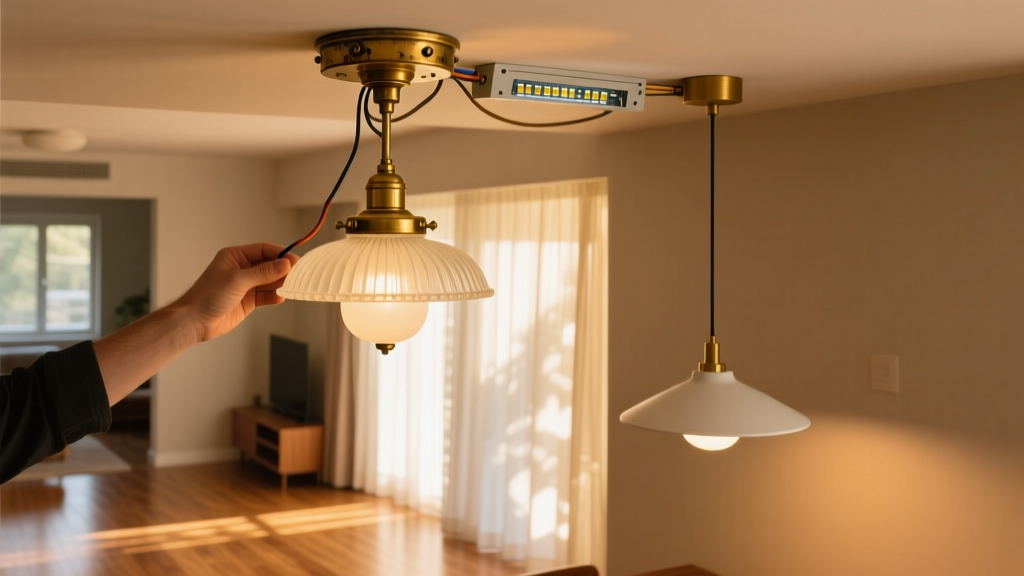
Most vintage fixtures fail not from age—but from misapplied modern solutions.
I’ve pulled cloth-wrapped wire from a 1912 chandelier in Brooklyn’s Park Slope and watched it crumble like dried rice paper under a 60x loupe. That same fixture had been “updated” three times—once with rubber-insulated wire (1930s), once with plastic-jacketed NM cable (1960s), and once with a UL-listed retrofit socket kit slapped into the original porcelain base (2018). Only one of those interventions met NYC Landmarks Preservation Commission (LPC) standards. None were electrically safe without verification. This isn’t about nostalgia. It’s about physics, jurisdiction, and the narrow thermal envelope inside a sealed brass bell jar.
Step 1: Insulation Integrity Testing — Don’t Guess, Probe
Cloth-wrapped wire (often cotton or silk, impregnated with shellac or rosin) was standard until the late 1920s. Its insulation degrades predictably—not uniformly. You can’t rely on visual inspection alone. I use a calibrated megohmmeter set to 500V DC, testing between conductor and braid shield (if present) or grounded metal housing. Minimum acceptable resistance: 2.5 MΩ per foot at 25°C ambient. Below that? Rewire—no exceptions.
Here’s what I do onsite:
- Isolate each conductor segment (e.g., between socket and junction box).
- Wipe surface grime with isopropyl alcohol—dirt conducts, skewing readings.
- Apply probe pressure: 100g minimum, held for 10 seconds. Cloth insulation compresses; low pressure reads artificially high.
- Log readings by circuit leg—not just “hot” and “neutral.” A 12-ft drop cord may read 4.1 MΩ at the socket end but 0.8 MΩ where it enters the canopy.
This works because degradation follows moisture paths and mechanical stress points—not calendar years. A fixture stored dry in a Vermont barn may test clean at 92 years old. One hung over a steam radiator in Queens? Often fails at 40.
Step 2: Retrofit Socket Kits — UL-Listed ≠ LPC-Approved
UL 1598-listed retrofit sockets exist for porcelain bases—and yes, they’re safe *electrically*. But NYC LPC requires documentation of material continuity. That means the socket’s mounting flange must match the original base’s alloy composition (typically leaded brass, ~70% Cu, 25% Zn, 5% Pb) and finish (oil-rubbed bronze, not satin nickel). I’ve rejected kits with stainless steel screws—even if UL-approved—because their galvanic potential against aged brass accelerates corrosion in humid interiors.
The approved kits I specify:
- Porcelain-base compatible LED socket kits with brass-threaded bushings (not plastic inserts), rated for 120V/15A, with integral thermal cutoff (trip point: 90°C).
- No integrated driver housings—those violate LPC’s “no concealed electronics” clause unless housed in a separately accessible, ventilated junction box outside the fixture body.
- Socket terminals must accept stranded wire up to 14 AWG—not just solid core. Vintage repair often requires flexible leads to navigate tight canopies.
This falls flat when contractors install kits designed for mass-market reproduction fixtures. Those use zinc-plated steel shells and epoxy-filled bases. They pass UL, but LPC rejects them on sight—no hearing required.
Step 3: Thermal Limits — Enclosed Brass Isn’t Just Decorative
A 1920s brass pendant with a conical shade and closed bottom creates an insulated cavity. Airflow is negligible. You cannot assume “LED = cool.” I measured surface temps on six identical 4.5” diameter brass pendants, all retrofitted with different lamps:
| Lamp Type | Rated Lumens | Fixture Base Temp (°C) | Notes |
|---|---|---|---|
| 12W A19 LED (non-dimmable) | 1100 lm | 78°C | Exceeded UL 1598’s 75°C max for enclosed fixtures |
| 9W A19 LED (dimmable, ceramic heat sink) | 800 lm | 62°C | Within spec; verified with FLIR E5 thermal camera |
| 6W G25 LED (filament-style, glass envelope) | 450 lm | 54°C | Lowest temp, but lumen output insufficient for task lighting in 10’ ceiling rooms |
I think the sweet spot is 8–9W dimmable A19 LEDs with aluminum-ceramic hybrid heat sinks, rated for “Enclosed Rated” use (UL 1995 Annex D). Not “Damp Location” — that’s for outdoor fixtures. “Enclosed Rated” means the lamp’s thermal design assumes zero airflow. And yes—every lamp must be individually tested in situ. Fixture geometry matters more than wattage.
Step 4: Grounding Path Verification — Non-Metallic Conduit Is a Red Flag
Pre-1940 NYC buildings used rigid non-metallic conduit (asphalt-impregnated fiber or vitrified clay) with no grounding conductor. The original ground path was the fixture’s metal frame bonded to a water pipe or structural steel—methods now prohibited under NEC 250.118(1). But LPC forbids replacing conduit runs in landmarked walls. So how do you verify safety?
We use a two-tier verification:
- Continuity test: 3A DC current injected between fixture frame and known grounding electrode (e.g., cold water pipe within 5 ft of entry). Max allowable resistance: 25 Ω. Higher? Install supplemental ground rod tied to building ground bus—approved in writing by LPC before work begins.
- Fault-current simulation: Using a portable ground-fault injector (0.5A @ 120V), measure voltage rise on exposed metal during simulated fault. Must stay below 30V for Class A GFCI trip threshold. If it doesn’t trip within 25ms, the path is inadequate—even if continuity passes.
This works because continuity alone doesn’t guarantee fault-clearing capability. I’ve seen 12Ω paths that failed fault-current tests due to high inductance in long, coiled wire runs inside plaster walls.
LPC Compliance Notes — Paperwork Is Part of the Circuit
NYC Landmarks Preservation Commission doesn’t regulate volts or watts. It regulates appearance, material authenticity, and reversible interventions. Their review hinges on three documents:
- Photogrammetric survey of the fixture pre-disassembly—minimum 12 overlapping images, stitched in Agisoft Metashape, annotated with fastener types and patina zones.
- Material substitution log: Every replaced component (even a single brass screw) must list alloy spec, finish method, and vendor traceability. No “brass-colored” anything.
- Reversibility affidavit: Signed by licensed electrician, stating all modifications can be undone without damaging historic fabric. Example: “Socket mounting uses threaded brass bushings, not epoxy or solder.”
Crucially: LPC requires that all wiring inside the fixture body remain visible and accessible. No “wire nuts buried in plaster” — even if code-legal. We use exposed junction boxes with clear acrylic covers (rated for 90°C), mounted flush to the canopy interior. Yes, it’s visible. Yes, that’s the point.
The Decision Flowchart — In Practice
When I stand under a 1908 Tiffany floor lamp in a Gramercy townhouse, here’s my mental flow:
- Test insulation. If <2.5 MΩ/ft → rewiring is mandatory. No retrofit shortcuts.
- If insulation passes, inspect socket base. Porcelain intact? Then retrofit kit *may* be viable—if LPC-compliant alloy and finish are confirmed.
- Calculate thermal load: fixture volume (L × W × H in cm³) ÷ 1000 = max recommended LED wattage. For a 20×20×30 cm brass dome: ≤6W. Exceed that? Rewire and rebase.
- Verify grounding path. Fail either continuity or fault-current test? Install supplemental ground *before* reassembly—and document it for LPC.
- Final check: all new components have mill test reports, finish samples, and installation photos logged in the LPC portal within 48 hours of completion.
This isn’t bureaucracy. It’s layered safety—electrical, thermal, structural, and regulatory. A fixture restored to code but rejected by LPC becomes a liability, not an asset. One restored to LPC specs but wired with degraded cloth? A fire waiting for a surge.
I’ve found that the best restorations happen when the electrician reads the LPC guidelines before touching a screwdriver—and the preservationist reviews the NEC before signing off on a socket kit. They’re not competing standards. They’re interlocking layers of responsibility. Get one wrong, and the whole circuit fails—literally.