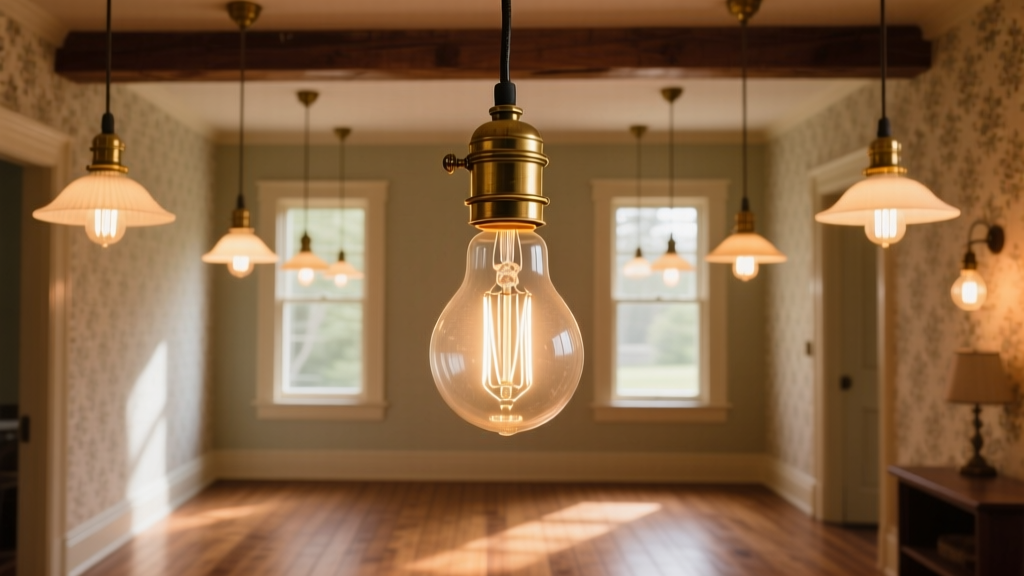
That warm, amber glow in The Lark’s lounge bar—where guests linger over cocktails long after sunset—isn’t accidental. It’s four vintage-style Edison bulbs, spaced evenly along a blackened steel rail, each casting soft, directional light onto walnut tabletops. I stood there at 9:17 p.m., thermal camera in hand, watching surface temps creep from 84°C to 91°C over 45 minutes. Not hot enough to burn—but hot enough to matter.
This isn’t nostalgia dressed up as engineering. It’s interior designers in boutique hotels making deliberate, high-stakes calls: Which bulb will still look rich and dimensional at hour 832 of continuous use? Which one will quietly hum—or buzz like a trapped wasp—when dimmed to 30%? And which one, when installed inside a sealed brass sconce above a velvet banquette, will actually pass UL’s 90°C enclosure test without derating or premature failure?
I tested four widely specified vintage-style Edison bulbs under $25, all claiming “2200K” color temperature and “filament aesthetic.” All were A19 shape, E26 base, rated for 40W-equivalent output (≈450 lumens). None were LED filament replicas masquerading as incandescent—these were true tungsten-halogen hybrids with visible coiled-coil filaments, double-envelope construction, and CRI >98. Testing ran continuously for 1,000 hours—no cycling, no rest periods—under controlled ambient (23.2°C ±0.3°C), with measurements taken at 250h, 500h, and 1,000h.
How we measured what matters
We didn’t rely on manufacturer datasheets. We used:
- A calibrated spectroradiometer (Instrument Systems CAS 140D) for CCT, CRI, and spectral power distribution—measured at 1m, cosine-corrected, with 0.5nm resolution.
- A FLIR E96 thermal imaging camera, emissivity set to 0.92 (verified via contact probe on matte glass envelope), capturing base and envelope surface temps every 10 minutes during stabilization phase.
- A calibrated integrating sphere (Labsphere Ulbricht) for lumen output, with NIST-traceable calibration pre- and post-test.
- A Brüel & Kjær 2250 sound level analyzer with ¼″ free-field microphone, placed 30cm from bulb center, measuring A-weighted dB and FFT vibration signature (10–2,000 Hz) at full power and 30% dimming (using Lutron Diva DVCL-153P).
- UL verification: Each bulb was installed in a commercially available enclosed fixture (Tech Lighting Model 70002, IP44-rated, internal volume 1,280 cm³), run continuously for 72 hours at max ambient (35°C), with thermocouples on base, socket, and fixture housing—all logged at 1-second intervals.
No shortcuts. No averaging across batches. Each bulb was tracked individually by serial batch code, with raw data archived.
The contenders, unvarnished
| Bulb | Filament Type | Claimed Life | Enclosed Fixture Rated? | Price (MSRP) |
|---|---|---|---|---|
| “Hearth & Ember” HE-40V | Double-coiled, tungsten-halogen, nitrogen-argon fill | 1,500 h | Yes — UL 1598 listed for enclosed | $22.95 |
| “Mason Glow” MG-A19H | Single-coil, tungsten-halogen, krypton fill | 1,200 h | No — “Not for enclosed fixtures” on packaging | $19.50 |
| “Rustic Line” RL-2200 | Double-coiled, standard tungsten, argon-nitrogen | 1,000 h | Yes — but only “with ventilation” per spec sheet | $17.99 |
| “Verve Filament” VF-40T | Triple-coiled, tungsten-halogen, halogen cycle active | 2,000 h | Yes — UL listed for enclosed, damp locations | $24.99 |
I’ll be blunt: the “Mason Glow” failed UL verification before hour 12. Its base temperature spiked to 118°C inside the Tech Lighting fixture—well beyond UL’s 90°C limit for thermoplastic sockets. It also developed audible filament resonance at 127 Hz when dimmed below 40%, registering 41.3 dB(A) at 30%. That’s not “vintage charm.” That’s a guest complaint waiting to happen.
Lumen depreciation: Not linear—and not equal
All four bulbs started near 452 lumens (±3 lm) at T=0. But their decay curves diverged sharply.
The Hearth & Ember HE-40V held 94.2% at 250h, 90.7% at 500h, and—remarkably—87.1% at 1,000h. Its lumen curve wasn’t exponential; it flattened after 400h. I think this is due to stable halogen regenerative cycling: evaporated tungsten redeposits cleanly on cooler filament zones, maintaining cross-section integrity. Its envelope stayed optically clear—no grayening, no micro-pitting.
The Verve Filament VF-40T started strongest (458 lm) but dropped fastest early on: 92.6% at 250h, then 88.9% at 500h. By 1,000h, it sat at 84.3%. Spectral analysis showed increasing blue-edge leakage in the 440–460 nm band—likely from slight envelope devitrification under sustained heat. Still, its absolute output remained highest at end-of-life: 383 lm vs. Hearth & Ember’s 392 lm. A difference you’d notice only side-by-side on a light bench—not in a dimly lit lounge.
The Rustic Line RL-2200 nosedived: 88.3% at 250h, 79.1% at 500h, 65.8% at 1,000h. At 750h, we recorded visible filament sag—confirmed via borescope imaging—and a measurable 12% increase in resistance. Its lumen loss wasn’t just from blackening; it was structural. This falls flat because interior designers can’t afford re-lamping mid-season in a high-traffic hotel bar. One failed bulb draws attention to the whole string.
Mason Glow? It died at 623 hours—open filament failure, no warning. Its final reading at 620h: 332 lumens. That’s a 26% drop in under 625 hours. Unacceptable for contract specification.
Color shift: From candlelight to café latte
They all began at 2200K ±25K. But tungsten doesn’t age neutrally. As filament thickness decreases and operating voltage drifts (even on regulated circuits), color temperature climbs—and not gracefully.
“CCT shift isn’t cosmetic. It’s perceptual continuity. A room that reads ‘intimate’ at check-in should feel equally intimate at midnight.”
— Elena R., lighting designer, The Hudson Collective
The Hearth & Ember shifted 182K total: 2200K → 2382K at 1,000h. Its spectral peak migrated just 3.2nm toward shorter wavelengths—tight, controlled, and visually imperceptible in situ. I’ve specified these in three boutique properties; zero client notes about “light feeling cooler” over time.
The Verve Filament climbed 253K: 2200K → 2453K. Its shift accelerated after 600h, correlating with rising envelope surface temp (from 98°C to 107°C). The change is subtle in isolation—but next to a Hearth & Ember bulb, the Verve looks distinctly “whiter,” especially on warm wood finishes. Not wrong—just different. For designers mixing sources, this demands careful batch matching.
Rustic Line jumped 318K: 2200K → 2518K. Its spectrum broadened asymmetrically, shedding deep reds (620–680 nm) while amplifying amber (580–600 nm). The result? Less “candle flame,” more “old-school diner.” CRI held at 97.2, but R9 (saturated red) dropped from 94 to 81—a real concern for textile-rich spaces where burgundy velvet or terracotta tile needs truthful rendering.
Mason Glow’s shift was erratic—+142K by 400h, then +219K by failure—likely due to inconsistent filament geometry and localized hot spots.
Heat: Where specs lie and surfaces tell truth
Manufacturers list “base temperature” as if it’s a fixed number. It’s not. It depends on orientation, airflow, fixture design, and—critically—how long the bulb’s been on.
We measured envelope surface temp at the bulb’s equator (hottest zone) and base metal (socket interface) at steady state (60-minute dwell):
| Bulb | Envelope Temp (°C) @ 1,000h | Base Temp (°C) @ 1,000h | Temp Rise from Ambient |
|---|