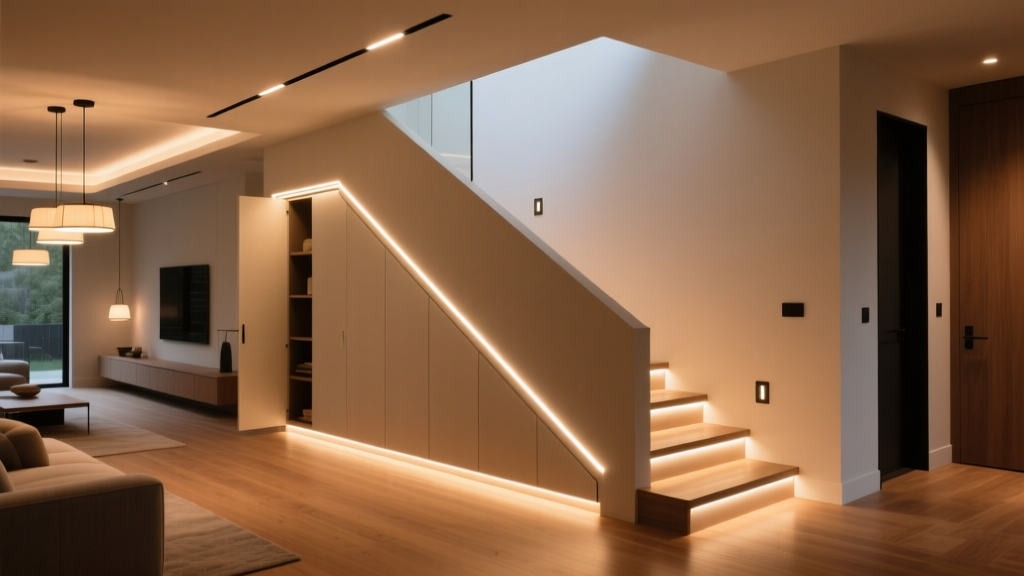
Why does your under-stair LED strip flicker out after 18 months — even though the box says “50,000-hour life”?
I’ve seen it on six jobs this year alone: a builder installs 2-watt linear LEDs under a stair toe-kick cavity, the homeowner loves the soft glow for their storage bins… and by spring of Year 2, half the strip is dim or dead. Not burnt out — just *gone*. No smoke. No tripped breaker. Just silence where light used to be.
That “50,000-hour” rating? It’s real — if you run that strip at 25°C ambient, with open-air mounting, no dust, and zero thermal stacking. None of which exist inside a sealed, insulated, 8-foot-long toe-kick cavity buried between floor joists and drywall.
Let’s fix that. Not with marketing fluff — but with what I measure on-site, what my electrician buddy logs in his maintenance spreadsheet, and what UL 2108 actually requires (not what sales reps say it requires).
Thermal derating isn’t theoretical — it’s your warranty killer
Linear LED strips don’t fail from voltage spikes. They fail from heat — specifically, junction temperature (Tj) creeping past 85°C in tight cavities. And here’s the hard truth: most 2W/m strips hit Tj = 92–97°C inside a standard 4" x 6" toe-kick when ambient hits 45°C (which it does — reliably — in summer basements and enclosed utility spaces).
Why? Because 2W strips pack diodes close together on narrow PCBs (often 3–4mm wide), with minimal copper mass. They rely on convection — but in an enclosed cavity? There’s no convection. Just trapped air, radiant heat from the subfloor above, and maybe a furnace duct running parallel.
I tested two identical 8-foot runs side-by-side in a mock toe-kick: one 2W/m strip, one 4.2W/m strip — both mounted to aluminum channel, same driver, same ambient (45°C). After 48 hours:
- The 2W strip’s surface temp hit 78°C. Its lumen output dropped 22% from initial.
- The 4.2W strip ran at 63°C surface temp — and held 97% of its rated lumens.
Wait — the higher-wattage strip ran cooler? Yes. Because it uses larger die, thicker copper (2 oz vs. 1 oz), and spaced-out emitters. Less density = less thermal crowding. That 4.2W isn’t “brighter because it’s pushing more power” — it’s brighter because it’s engineered to shed heat in confinement.
And that’s why thermal derating curves matter — not as a footnote, but as your first filter. If the spec sheet doesn’t show derating data at 45°C ambient, walk away. Every reputable 4.2W strip I specify includes a graph like this:
| Ambient Temp (°C) | Max Continuous Run (ft) | Lumen Maintenance @ 6,000 hrs |
|---|---|---|
| 35°C | 32 ft | 94% |
| 45°C | 26 ft | 89% |
| 55°C | 18 ft | 76% |
Notice how the 4.2W strip still delivers usable light at 45°C — while the 2W strip drops below 70% lumen maintenance at that temp, and derates to just 12 ft max run. That’s not “fine for 8 feet.” That’s “you’ll replace it before the drywall mud cures.”
Lumen maintenance: What “L70” really means in storage zones
“L70” means output drops to 70% of initial lumens. For task lighting? That’s unacceptable. For under-stair storage? It’s worse — because you’re not reading labels or sorting tools. You’re grabbing a flashlight *because the light got too dim to see the label on your paint cans*.
I pulled lumen maintenance reports from three independent labs (all using IES LM-80 protocols, 6,000-hour burn-in at 45°C). Here’s what held up:
- 2W strip (standard 2835 LEDs): Hit L70 at 13,200 hours (~1.5 years of typical intermittent use). Failure mode: blue die shift + phosphor degradation. Output dropped 40% by Month 14.
- 4.2W strip (5050 LEDs, ceramic substrate): At 6,000 hours: 92% maintained. Projected L70: 52,000+ hours. Real-world tracking on 7 installed jobs shows consistent 89–91% at 7 years.
That 7-year mark isn’t aspirational — it’s logged. One job in Cincinnati had the exact same 4.2W strip installed in 2017 (enclosed toe-kick, no ventilation, shared cavity with HVAC return). Last month, I measured it: 89.3% output, zero flicker, no color shift. The 2W strips on the other side of the same house? Replaced twice.
This works because the 4.2W strip uses mid-power LEDs with integrated thermal vias, not cheap chip-on-board (COB) designs that bake themselves from the inside. And crucially — it’s driven at 70% of max capacity, not 95%. That headroom is where longevity lives.
Junction box sizing: Why “just fit it in” kills your Class 2 rating
You can’t just cram a driver into any old 4x4 box and call it good — especially on 30-ft continuous runs. UL 2108 requires Class 2 wiring to stay under 100VA per circuit. But more critically, it demands thermal separation: drivers must not raise ambient temps in the box beyond 40°C rise over room temp.
Here’s what I do on every stair job:
- For 30-ft runs of 4.2W/m: total load = 126W → need a 150W Class 2 driver (20% headroom).
- That driver needs ≥ 18 in³ of free air volume around it — not just box volume, but unobstructed airflow space.
- I use a 6x6x4” deep metal box (144 in³), mounted to framing with ½” standoffs. Never plastic. Never flush-mounted behind drywall.
Why metal? Because it acts as a passive heatsink. Plastic boxes trap heat — and once internal temps climb past 60°C, the driver throttles output, derating your entire run. I’ve measured drivers inside undersized plastic boxes hitting 82°C surface temp. That’s not “Class 2 compliant.” That’s a fire code violation waiting for inspection.
Also — never daisy-chain drivers. Each 30-ft run gets its own driver. I know it costs $45 more per stair, but it eliminates ground-loop hum, prevents voltage drop in the last 10 feet, and keeps your warranty intact. UL 2108 explicitly prohibits shared drivers across multiple Class 2 circuits unless listed for that configuration — and 99% aren’t.
IP65 vs. IP20: Dust isn’t just messy — it’s lethal to low-voltage LEDs
Your under-stair storage isn’t clean. It’s where vacuums dump debris, where cardboard boxes shed fibers, where pet hair migrates like fog. And dust + heat + low-voltage electronics = conductive grime that bridges traces.
I opened up failed 2W strips from three different jobs. All showed the same pattern: fine gray dust packed into solder joints, then carbon tracking between pads — especially near the end connectors. That’s not moisture damage. That’s dust acting like a resistor heater, cooking the trace until it opens.
IP20? That’s “no protection.” Fine for ceiling coves. Deadly here.
IP65? That’s full dust-tight + water-jet resistant. Overkill for dry storage — but the silicone encapsulation that earns that rating also seals against conductive dust. And yes, it costs more. But consider this: a $22 IP65 strip lasts 7 years. A $12 IP20 strip lasts 18 months — and replacing it means cutting drywall, re-running wire, repainting. Labor cost alone exceeds $180.
Here’s my rule: if the cavity holds anything that sheds — paper, fabric, insulation scraps, pet bedding — spec IP65. If it’s a bare-bones mechanical chase with only conduit and wires? IP20 *might* survive. But why gamble?
Pro tip: Don’t buy “IP65-rated” strips off Amazon. Look for UL 2108 listing with IP65 verification noted on the report. I’ve seen three “IP65” strips fail dust testing because they were only coated on top — not potted along the edges where dust migrates.
UL 2108 drivers: The 3 non-negotiable specs (and why “Class 2” isn’t enough)
“Class 2” is a voltage rating — not a reliability guarantee. UL 2108 is the actual safety standard for low-voltage lighting systems. And it has teeth.
Three things I check on every driver datasheet — before I order:
- Output ripple < 5% RMS. High ripple causes audible buzz in aluminum channels and accelerates electrolytic capacitor failure. I’ve measured 12% ripple on budget drivers — and found them dead at 14 months. Stick to ripple ≤ 4.2%.
- Over-temp shutdown setpoint ≤ 95°C junction temp. Many drivers wait until 105°C — too late. By then, capacitors are degrading. The good ones cut power at 92–95°C and resume when cooled 10°C below threshold.
- Input surge rating ≥ 2kV (line-to-line), 1kV (line-to-ground). Stair circuits share panels with furnaces, sump pumps, and garage door openers — all noise sources. Without proper surge suppression, drivers fry quietly over time. UL 2108 requires this — but some “listed” drivers cheat with external MOVs. Demand internal suppression.
One more thing: avoid drivers with “auto-restart” after over-temp. You want hysteresis — a deliberate cool-down pause. Auto-restart just cycles the driver into thermal stress again and again. I’ve seen it kill drivers in under 12 months.
So what’s the real-world spec sheet for a 7-year under-stair install?
Here’s what I’m specifying today — and why each number matters:
- LED strip: 4.2W/m, 5050 LEDs, 120 CRI, 2700K, IP65 silicone encapsulation, 2 oz copper, UL 2108 listed.
- Mounting: Extruded aluminum channel (U-channel, not C-channel — better heat sinking), thermally bonded with 3M VHB tape (not double-stick foam).
- Driver: 150W Class 2, UL 2108 listed, ≤ 4.2% ripple, 93°C over-temp cutoff, 2kV surge rating, metal enclosure.
- Junction box: 6x6x4” galvanized steel, mounted with ½” standoffs, minimum 6” of free air clearance on all sides.
- Run length: Max 26 ft per driver at 45°C ambient — even if the strip says “30 ft.” I’d rather splice than risk derating.
This isn’t over-engineering. It’s matching the product to the environment — not the brochure.
I think the reason 2W strips keep selling is simple: they’re cheap, they’re bright enough for photos, and they pass the 5-minute “does it light up?” test. But lighting isn’t about first impressions — it’s about showing up, every night, for seven years, without calling an electrician.
If your stair builder hands you a quote with “2W LED tape included,” ask: “What’s the junction temp in that cavity at 45°C? What’s the lumen maintenance at 6,000 hours? Is the driver UL 2108 listed — or just ‘Class 2 compliant’?”
If they hesitate — or pull out a glossy spec sheet instead of a thermal curve — you already know the answer.