“Lighting art isn’t about brightness—it’s about reverence.” — Elena Ruiz, lighting designer for the San Francisco Museum of Craft & Design
I’ve stood in too many home offices where a beloved photograph or limited-edition print hangs under the same recessed can that lights the desk. It’s not malicious neglect—it’s just uncalibrated light. Art in compact WFH spaces deserves intentionality: not spectacle, but subtlety; not glare, but grace.
Here are three track layouts I’ve tested in real 10’ × 12’ home offices (with 8’ ceilings), each calibrated for original prints and fine-art photography—no museum budget required, just precision.
Linear Track: The Focused Gallery Wall
Best for: A single vertical row of 3–5 framed pieces (e.g., 16” × 20” prints spaced 4” apart) along one wall.
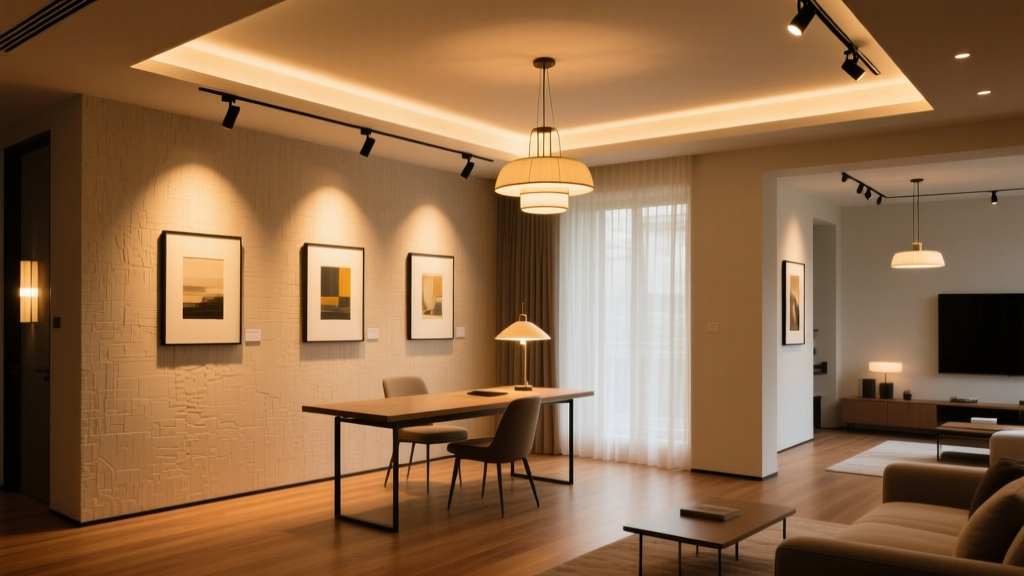
I mounted a 60” linear track 12” back from the wall’s leading edge, centered at 66” AFF (above finished floor)—just above eye level when seated. Three adjustable 20W, 95+CRI LED heads (3,200K, 1,200 lm each) were spaced evenly at 20” intervals.
Aiming angle? 30°. Not 45°—not even close. At 30°, the beam hits the center of each frame with minimal spill onto adjacent walls or the desk surface. Lux readings on the artwork ranged from 210–260 lx—right in the sweet spot. Any steeper, and you risk hot-spotting; any shallower, and the lower third of taller frames falls into shadow.
This works because it isolates attention without isolation: the light feels curated, not clinical.
L-Shaped Track: The Corner Collection
Best for: Two perpendicular walls meeting at a corner—say, a 30” × 40” abstract print on one wall, a triptych of black-and-white street photos on the other.
I used two linked 36” tracks forming an L, mounted flush to the ceiling at the corner junction. Each arm carried two heads: one aimed at 30° for the larger piece (to control spread), one at 45° for the triptych (to gently wrap light across the three panels without cross-beaming).
Crucially: both arms shared the same 2700K, 95+CRI LED modules—but with different beam angles (24° narrow for the large print, 36° medium for the triptych). Total lux on all surfaces landed between 170–290 lx. No UV emission—verified with a handheld spectrometer—so no fading risk over months of daily use.
This falls flat if you try to force symmetry. I learned that the hard way: matching beam angles across both arms created a harsh “light seam” at the corner. Let the art dictate the angle—not the geometry.
Perimeter Track: The Floating Frame Effect
Best for: A single oversized piece (e.g., a 36” × 48” canvas) centered on a blank wall—where you want the art to feel suspended, not spotlighted.
No central fixture. Instead: a 120” perimeter track mounted 6” inside the wall’s outer edges—like a luminous frame. Four 15W, 95+CRI LED heads (3000K, 900 lm), each aimed inward at 30°, spaced at the midpoints of each side.
The result? Even, shadow-free illumination across the entire surface—225 lx measured at center and corners alike. No darkening toward the edges. No visible fixtures from a seated position. Just quiet, even reverence.
I think this layout is criminally underused in home offices. It doesn’t scream “look at me”—it whispers “look *closer*.” And that’s exactly what good art asks for.
One Non-Negotiable
You can nail every angle and lux target—and still ruin the work if your LEDs emit UV. Don’t trust marketing copy. Look for “UV-free” stated in technical specs, or confirm spectral output peaks strictly between 400–700 nm. I carry a portable UV meter now. It’s saved two prints I’d otherwise have lit with cheap “gallery-style” LEDs sold online. They looked warm. They were damaging.
Lighting art at home isn’t about replicating a museum. It’s about honoring scale, material, and silence—three things every great print already holds.