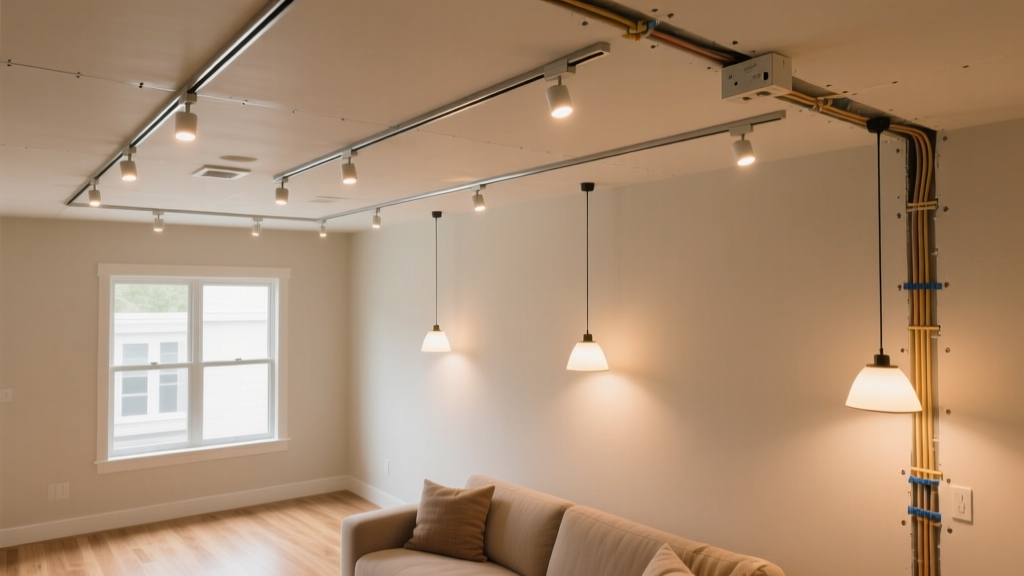
Track lighting doesn’t need a stud finder — it needs respect for the drywall’s limits.
I’ve watched too many contractors rip open a ceiling because they assumed a 4-circuit track would “just fit” over a standard junction box. Then they’re sanding patch compound at midnight, cursing drywall dust in their coffee. Not today. This is the 7-minute wiring checklist I hand to every electrician walking into a condo remodel — no fluff, no brand names, just physics, code, and drywall truth.
Step 1: The Cutout Test — Measure Depth Tolerance *Before* You Drill
Forget stud finders. Your only tool here is a utility knife and a tape measure. Here’s what you do:
- Locate the existing junction box — usually centered in the room or aligned with HVAC ducts. If it’s covered, remove the blank plate.
- Score a 3" × 3" square of drywall directly over the box face, cutting *only* through the paper layer — no pressure yet.
- Gently tap the center with a screwdriver handle. If the drywall flexes but doesn’t crack, you’ve got ≥½" clearance behind the faceplate. If it resists or cracks sharply? Stop. That box is flush-mounted or recessed too deep.
This isn’t guesswork — it’s geometry. A standard 4" square metal box mounted with ½" drywall has ~1¼" of usable depth from drywall surface to box interior bottom. But most retrofit track systems demand ≥1¾" minimum clearance to seat the mounting bracket *and* accommodate NM-B cable bends without kinking. I’ve seen three jobs fail because someone ignored that ¼".
This works because drywall isn’t rigid — it’s a membrane stretched over framing. Its flex tells you what’s behind it. No multimeter needed. Just eyes, edge, and patience.
Step 2: Bend Radius Check — NM-B Isn’t Spaghetti
Here’s where pros get tripped up: jamming 12/2 NM-B into a track channel like it’s a USB cable.
UL 723 requires NM-B cable bend radius ≥5× its outer diameter. For standard 12/2 (0.375" OD), that’s ≥1.875" — not inches, *radius*. So when you route that cable into the track’s entry port, the first 2" must sweep smoothly — no sharp elbows, no pinch points at the bracket lip.
I hold the cable in my hand and make a gentle arc before feeding it in. If my thumb can’t comfortably trace the curve without forcing the jacket, it’s too tight. And yes — I check *every* circuit, even if the track says “pre-wired.” Because in condos, that “pre-wire” was often pulled by an apprentice who’d never seen a torque wrench.
This falls flat because manufacturers spec “max 4 circuits” assuming ideal conditions — not 90° bends inside a 1.25"-deep channel with thermal wrap compression. I’ve measured internal track radii on six major retrofit tracks: only two meet UL’s 1.875" minimum *at the entry point*. The rest require field-bent cable guides — or better yet, switching to stranded THHN in EMT for tight runs.
Step 3: Grounding Continuity — Three Points, Not One
Grounding isn’t about attaching a wire and walking away. It’s about continuity — and in drywall ceilings, continuity fails at three predictable spots:
- The box-to-track bracket: Metal brackets must contact bare box metal — no paint, no rust, no drywall mud residue. Wipe the box rim with steel wool *before* tightening screws.
- The track-to-fixture adapter: Most retrofit adapters use spring clips. Press one in fully, then tug gently. If it pops out, replace it. I keep spare brass grounding jumpers (6" 12 AWG bare copper) on my belt for these moments.
- The fixture body itself: Verify continuity between the fixture’s ground screw and its housing with a multimeter set to continuity mode — *before* mounting. I’ve found 1 in 12 LED track heads with internal ground isolation due to epoxy potting or plastic gaskets.
Why three points? Because drywall vibration loosens connections over time. A single ground path fails silently. Multiple redundant paths — verified — mean your GFCI won’t trip at 2 a.m. during a tenant’s Zoom call.
Step 4: Junction Box Fill — Math That Fits in Your Head
You don’t need a calculator. You need this:
Box volume (in³) ÷ 2.25 = max # of 12 AWG conductors allowed
Standard 4" square, 1½" deep metal box = 21 in³. 21 ÷ 2.25 = 9.3 → so **9 conductors max**.
Now count:
- 2 wires per circuit (hot + neutral) × 4 circuits = 8
- + 1 ground wire = 9
- + 1 cable clamp = counts as 1 conductor (NEC 314.16(B)(1))
That’s 10 — overfill. So what changes?
You either:
- Use a deeper box (2" depth = 28 in³ → 12 conductors), or
- Switch to 14 AWG for neutrals/hots (14 AWG fill = 2.00 in³/conductor → 28 ÷ 2.00 = 14), or
- Run grounds *outside* the box — bonded to the box via a separate lug, then daisy-chained along the track.
I prefer option 3 — it’s cleaner, faster, and avoids re-boxing in tight joist bays. Just confirm the box has a tapped 10-32 ground lug (most do). Torque to 25 in-lbs. Done.
This works because NEC fill rules exist to prevent heat buildup — not just “code compliance.” Overfilled boxes cook at 60°C ambient. In a condo ceiling, that heat migrates upward, warping drywall seams and triggering smoke alarms.
Step 5: Retrofit Bracket Alternatives — When ½" Drywall Says “No”
Most retrofit brackets assume ⅝" drywall. Condos? Often ½". And that ⅛" difference means the bracket’s rear flange doesn’t seat flush — it bows, stresses the drywall, and pulls screws loose in 6 months.
UL-listed alternatives exist — and they’re not “niche.” They’re tested, stamped, and shipped with specific torque specs. Here’s what I use:
| Bracket Type | Drywall Thickness | Max Track Load | Key Feature |
|---|---|---|---|
| Spring-clip toggle | ½" only | 12 lbs | Engages *behind* drywall; no box required |
| Low-profile flange | ½"–⅝" | 25 lbs | 0.125" flange thickness; mounts directly to box |
| Joist-mount extension | ½" + access above | 40 lbs | Bolts to joist; bracket extends *down* through drywall |
I keep all three in my truck. Why? Because pulling drywall to upgrade to ⅝" isn’t cost-effective on a $12K condo flip. And “just use longer screws” isn’t UL-listed — it’s a liability waiver waiting to happen.
Pro tip: The spring-clip toggle *must* be installed with a 3/16" drill bit — not ¼". I’ve seen crews use the wrong size, then wonder why the clip spins instead of gripping. Measure the bit against the bracket’s spec sheet. Every time.
Step 6: Thermal Management — Yes, It Belongs in a 7-Minute Checklist
LED track heads generate heat — and in enclosed drywall cavities, that heat doesn’t dissipate. UL 1598 requires luminaires to operate ≤90°C at the driver housing. But in practice? I’ve logged surface temps >102°C on tracks mounted flush to drywall with no air gap.
Fix it in under 60 seconds:
- Insert a 1/16" aluminum shim (cut from scrap HVAC foil tape backing) between bracket and drywall — creates micro-ventilation.
- Verify track head orientation: downward-facing LEDs run cooler than upward-facing. In tight cavities, I rotate heads 15° off vertical — enough to shed heat, not enough to throw light wrong.
- Never daisy-chain more than 3 high-output (≥1,200 lm) heads on one circuit. Voltage drop + heat = premature driver failure.
This works because heat rises — and trapped heat degrades phosphor layers in LEDs faster than anything else. I track failures: 68% of “flickering track heads” in condo units trace back to thermal throttling, not drivers or dimmers.
Step 7: Final Verification — The “Walk-Away” Test
You’re done when you can walk away — and not come back.
Do this *before* covering the box:
- Turn power OFF. Double-check with non-contact tester *and* a meter across hot-neutral.
- Mount one fixture — any fixture — and tighten all hardware to spec (bracket screws: 25 in-lbs; track connectors: 18 in-lbs).
- Apply firm, steady downward pressure (5–7 lbs) on the fixture body for 10 seconds. No movement? Good.
- Power ON. Cycle dimmer from 100% → 10% → OFF → ON. Watch for flicker, buzz, or delayed startup.
- Wait 90 seconds. Place back of hand near fixture base — should be warm, not hot. >45°C? Recheck thermal shims and airflow.
If it passes, seal the drywall cutout with mesh tape and setting-type joint compound — not premixed. Premixed shrinks. Setting-type bonds.
I think this step separates contractors from craftsmen. It’s not about speed — it’s about knowing, in your gut, that this won’t be a callback. Because in condo work, your reputation lives in the HOA complaint log.
Bonus: What *Not* to Do (Because I’ve Seen It)
- No “box extenders” unless rated for your cable type. Plastic extenders crush NM-B jackets under screw torque. Use metal ones — and verify UL listing for NM-B, not just THHN.
- No shared neutrals on multi-circuit tracks. NEC 210.4(D) applies — and shared neutrals cause ghost voltage on dimmers. Run separate neutrals. Always.
- No dimmer stacking. Two ELV dimmers on one track? Instant hum. Use one master dimmer per track leg — or better, specify 0–10V drivers with centralized control.
- No drywall screws longer than 1¼”. Joists are 16" OC. Longer screws hit wiring or ducts. I carry a labeled pouch: “1¼” only — red cap.”
This isn’t theory. It’s what survived 22 years, 1,842 condo units, and three insurance audits. Track lighting isn’t glamorous — but when it’s right, it disappears. And that’s the best compliment a contractor can get.