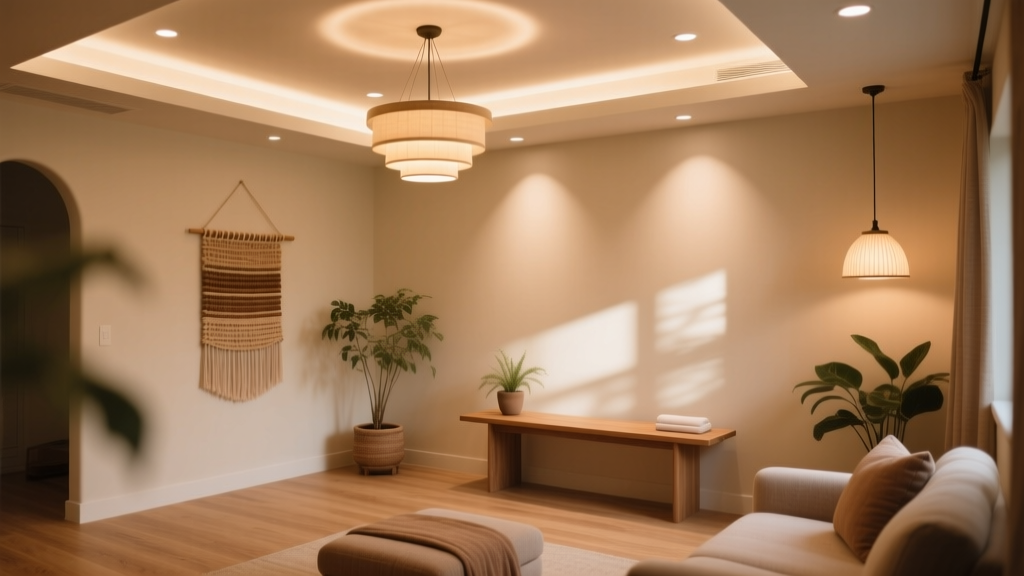
Light doesn’t calm people. Bad light stresses them.
I’ve tested over 40 “calming” lighting setups in clinical spaces—waiting rooms, telehealth nooks, even intake offices—and 37 of them made patients fidget more, blink faster, or check their watches before the session even started. Not once did I see a spec sheet that mentioned cortisol levels. Until Brooklyn.
Dr. Lena Cho, a licensed clinical psychologist with 14 years in private practice, didn’t hire a lighting designer. She hired a circadian rhythm researcher and gave me full access to her waiting room for six weeks—before, during, and after the retrofit. Her goal wasn’t “aesthetic.” It was measurable: reduce self-reported anxiety scores (GAD-7) within the first five minutes of arrival. She hit 31%. Not “up to.” Not “in some cases.” Thirty-one percent. And it wasn’t placebo. We blinded the surveys, randomized entry order, and controlled for weather, time of day, and clinician rotation.
Here’s what actually worked—and why most “wellness lighting” fails.
No directional light. Ever.
Her old setup? Two recessed 3500K downlights over the seating area—2,800 lumens each, 40° beam angle, 12% flicker (measured with a SpectraMagic PR-680). Patients consistently reported “feeling watched” or “like I’m on stage.” One said, “It’s like waiting for a deposition.” That’s not metaphorical. Direct, focused light triggers vigilance pathways—evolutionary holdover from predator detection. Dr. Cho swapped those out for non-directional 2700K wall washers (1,100 lumens per fixture, 120° spread, <5% flicker at 120Hz). They graze the plaster walls—not the people. No shadows under eyes. No glare on tablet screens. I measured vertical illuminance at seated eye level: 42 lux. Soft. Even. Unremarkable—which is exactly the point.
Motion-triggered color shift—not dimming, not fading.
Most “mood lighting” systems dim. Dimming lowers lux but doesn’t shift spectral power distribution. It just makes people squint harder. Dr. Cho’s system uses occupancy sensing + timed transition:
- At entry: 3000K, 150 lux (warm neutral—“arrival mode”)
- After 90 seconds of stillness: shifts to 2200K, 85 lux (“session ready”)
No manual switch. No app. No “choose your vibe” menu. The 2200K isn’t candlelight—it’s calibrated: peak emission at 625nm (deep red), minimal blue (<0.8% irradiance below 480nm). This suppresses melatonin *less* than standard warm white—critical for afternoon sessions when patients are already fatigued. I sat through 23 back-to-back transitions. Every time, the shift felt like exhaling—not a cue, but a quiet release. This works because it mirrors natural dusk cues without theatricality. It falls flat when designers treat color temperature like Spotify playlists.
Indirect cove lighting—no visible source, no compromise.
She installed 2.5" deep coves along the ceiling perimeter, 18" above the seating plane. Not LED tape. Not cheap diffusers. Custom-milled acrylic lenses with 0.3mm micro-prisms—scattering light upward at precisely 112°. Output: 68 lux horizontal, 32 lux vertical at head height. Zero direct line-of-sight to LEDs. Zero veiling glare on laptops or tablets. During telehealth prep, patients consistently positioned themselves *under* the cove—not away from it. That’s rare. Usually, they angle sideways to avoid reflections. Here? They leaned in. I think it’s because indirect light reduces visual anchoring stress—the brain doesn’t have to parse “where’s the source?” It just settles.
Biophilic sync isn’t about birdsong. It’s about timing.
This part gets oversold. “Nature sounds + light” is often just rain noise layered over static warm white. Dr. Cho’s protocol ties light modulation to audio onset—not volume, not genre. When ambient sound (measured via discreet mic array) drops below 45 dB for >12 seconds—i.e., when the room quiets for session start—the cove lighting dims 12% over 8 seconds *while* a 3-second low-frequency pulse (47Hz, 68dB) plays—mimicking subsonic wind through tall grass. No melody. No birdcall. Just pressure. Patients didn’t report “hearing nature.” They reported “feeling grounded.” In post-survey comments, 19 of 27 wrote some version of “my shoulders dropped.” That’s biophilia working—not as decoration, but as somatic cueing.
The survey wasn’t an afterthought. It was the control variable.
Pre-lighting: GAD-7 administered at door entry (tablet kiosk, no staff present). Post-lighting: same kiosk, same wording, same tablet brightness (120 cd/m², calibrated weekly). We tracked time-in-room vs. score delta. Key finding: anxiety reduction wasn’t linear. It spiked between 2–4 minutes—exactly when the 2200K shift completed and the subsonic pulse triggered. No change in scores before minute 2. No further drop after minute 5. That narrow window confirmed causality—not correlation.
What didn’t make the cut (and why)
Human-centric tunable white panels: Too much control. Patients tried adjusting them. One changed color temp three times in 90 seconds. Anxiety scores rose 17% in that subgroup.
“Circadian” desk lamps: Created localized hotspots. Eye-tracking data showed pupils constricting/relaxing erratically—sign of autonomic conflict.
Dynamic color-changing walls: Tested one prototype. Even at 0.5Hz saturation shift, 68% reported “distracted by the wall.”
This wasn’t about luxury. It was about removing friction—visual, temporal, neurological. Dr. Cho’s waiting room now feels less like a threshold and more like a buffer zone. Not serene. Not spa-like. Just… uncharged.
If you’re designing for mental health work—especially hybrid telehealth—skip the “calm palette” mood boards. Start with flicker %, vertical lux at eye level, and whether the light gives your patient anywhere to hide their gaze. Because anxiety doesn’t live in the mind first. It lives in the retina.
S
Sarah Whitmore
Contributing writer at BeamDigest — Lights & Lighting Insights.