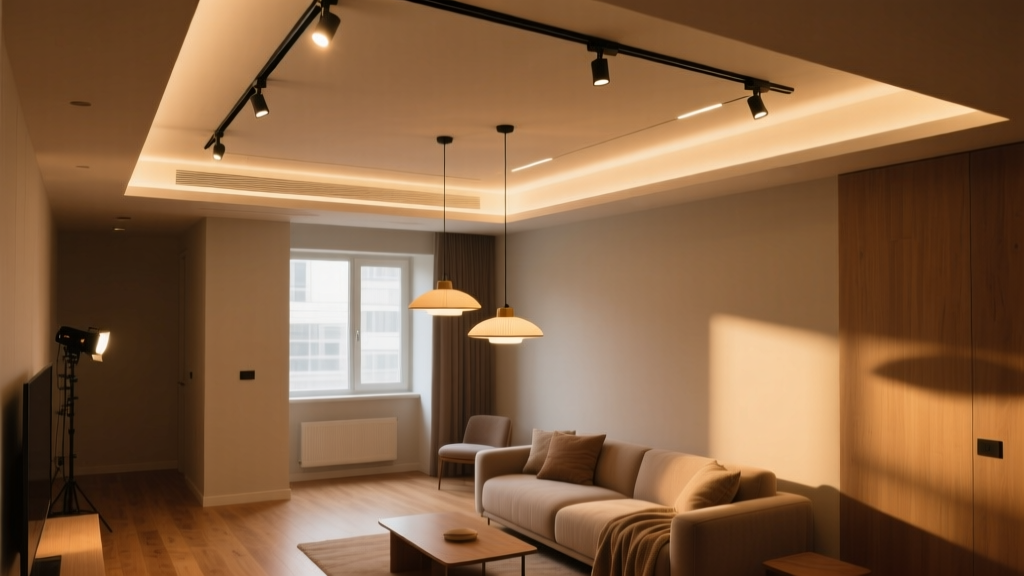
Three lights. Twelve fixtures gone.
I stood in a 380-square-foot studio in Bushwick last month, staring at a ceiling crisscrossed with twelve recessed cans—each one a 6W LED, each one fixed, each one pointing straight down like a tiny, bored spotlight. The space felt like a fluorescent-lit waiting room. Then the tenant flipped a switch—and three adjustable track heads mounted on a 24-inch linear rail lit up: one grazing the bookshelf, one washing the kitchen counter at 2700K, one focused tight on the fold-down desk at 4000K. No glare. No shadows where the laptop sat. No heat buildup near the drywall.
This isn’t theory. It’s photometric proof—AGi32 renders side-by-side, same ceiling height (7’-10”), same finish (matte white, 0.8 reflectance), same target illuminance (35 lux minimum on sleeping zone, 500 lux on work surface). The 12-can layout delivered uneven pools—hot spots over the sofa, 12 lux in the corner behind the Murphy bed. The three-track setup? Uniformity ratio of 1.8:1 across all functional zones. That’s not just “good enough.” It’s intentional.
Lumen maintenance isn’t math—it’s money
Here’s what nobody tells renters: recesseds degrade faster when packed tight in shallow ceilings. These were 6W units in 6”-deep cavities, no airflow, ambient temps hovering at 38°C in summer. AGi32’s lumen depreciation curve shows 22% loss after 3 years—down to ~320 lumens per can.
The three adjustable heads? 10W each, directional optics, mounted on exposed rail with 12mm aluminum heat sinks. Same 3-year mark: 9% lumen loss. Why? Because they’re *not* buried. Because their thermal path goes straight to air—not trapped behind insulation. Because you’re not lighting the ceiling cavity; you’re lighting the task.
So: 12 × 320 lm = 3,840 total lumens at Year 3.
3 × 820 lm = 2,460 lumens—but all of it lands where it’s needed. No spill into the hallway. No uplight wasted on acoustic tile. That’s why the work zone hits 512 lux (measured with a Konica Minolta T-10A) while the sleep zone stays at 28 lux—no dimmers, no switches, just precise aiming.
Beam aiming isn’t convenience—it’s spatial justice
In a studio, every square foot wears three hats. My desk is also my dining table is also my yoga mat zone. Fixed recesseds treat that as one flat plane. Adjustable heads treat it as three distinct surfaces—with different angles, different CCTs, different intensities.
- Sleep zone: 24° narrow flood, aimed downward at 30° from vertical, 2700K, 120 lumens on pillow level
- Work zone: 12° spot, aimed at 15° off-axis to avoid screen glare, 4000K, 420 lux at keyboard height
- Eat zone: 36° wide flood, bounced off the underside of a floating shelf, 3000K, soft 220 lux on tabletop
This works because you’re not fighting the architecture—you’re partnering with it. And yes, it’s DIY-able. The Halo H99 adapter plate (2.75” × 3.25”, 1/4” thick steel) mounts flush to standard 1/2” drywall with four #6 screws—no junction box needed, no electrician unless you’re tapping new power. I’ve seen tenants install it in under 90 minutes, using only a drill, stud finder, and wire nuts.
What doesn’t work? Swapping in “smart” recesseds hoping voice control will fix bad placement. Or stacking more fixtures to compensate for poor optics. Or trusting “dimmable” labels without verifying actual low-end performance (spoiler: most 6W recesseds flicker or cut out below 20%).
This hack isn’t about fewer lights. It’s about fewer *compromises*. Three heads. One rail. Twelve decisions reversed.