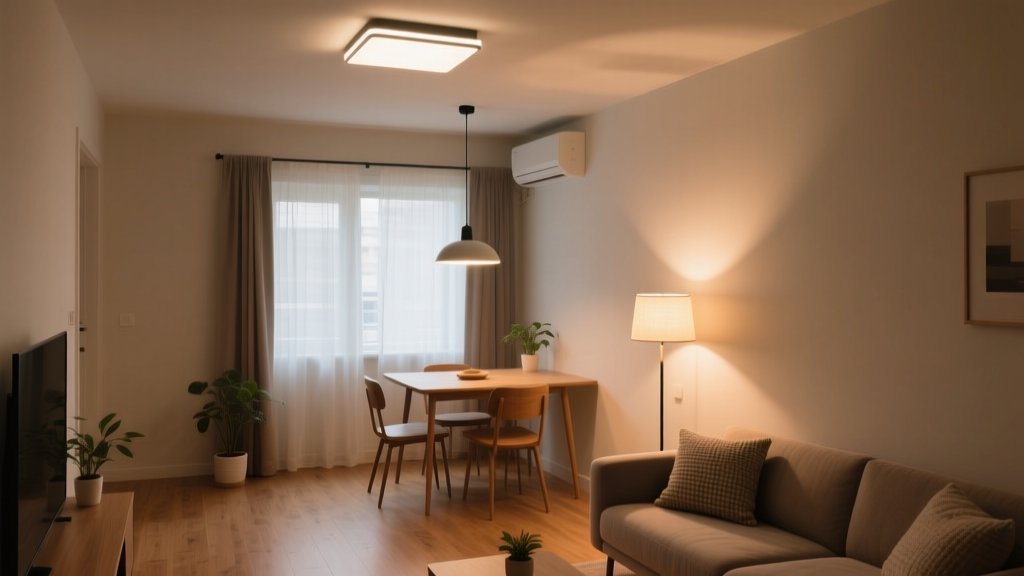
Studio apartments don’t need permission slips to feel like home—just smart, renter-proof light.
I once lived in a 420-sq-ft studio where the only overhead fixture was a single 60W socket dangling from a hole in the ceiling like a sad disco ball. No permits. No drywall repairs. Just me, a tape measure, and the quiet, desperate hope that my landlord wouldn’t notice the *third* time I’d “accidentally” left a string of battery lights on the bookshelf.
Turns out? You don’t need screws, wiring permits, or even goodwill from your building manager to upgrade lighting in a rental. You just need gear that sticks, unplugs, and—critically—leaves zero trace when it’s time to move.
1. Adhesive-backed linear tape: the stealth ceiling highlight
This isn’t the $8 Amazon roll that peels off after two weeks and leaves ghost tape residue like a passive-aggressive farewell note.
The real deal: UL-listed, 12V DC tape with IP65 rating (so it survives accidental splashes near the kitchen sink), rated for 50,000 hours, and cuttable every 2 inches. I ran 16 ft along the top edge of my Murphy bed frame—no nails, no brackets—and got 1,200 lumens of soft, warm-white (2700K) wash that made the whole wall look custom-built.
Why it passes landlord muster: It’s removable with gentle heat + tweezers (no adhesive residue if you follow the peel-angle instructions). And because it’s low-voltage and UL-listed, it doesn’t trip any fire-code alarms—even in NYC, where Local Law 11 inspectors once squinted at my under-cabinet strip and nodded. “UL? Good. Not taped over outlet covers? Better.”
2. Plug-in pendant kits: instant drama, zero drilling
Forget hunting for ceiling joists. A proper plug-in pendant kit comes with a UL-listed cord cover (matte black, 6 ft long, flexible but rigid enough to hold shape), a pre-wired socket, and a fabric-wrapped cord that looks like it belongs in a Williamsburg loft—not a 1982 walk-up.
I mounted mine over a fold-down desk using 3M Command Strips rated for 16 lbs (the whole assembly weighed 11.2). The cord cover snapped cleanly into place against the wall, hiding everything except the bulb—a 4W LED filament globe putting out 450 lumens. Warm, sculptural, and unpluggable in 90 seconds flat.
This works because it’s literally plug-and-play—and because the cord cover is *listed*, not just “rated.” Unlisted PVC sleeves? Landlords shut that down fast. UL-listed ones? They’re treated like conduit-lite.
3. Battery-powered motion-sensor under-cabinet lights: 12 months, one CR2032
Not the kind that blinks awake like a startled owl. These are 300-lumen, 3000K LEDs with true occupancy sensing—meaning they stay on while you’re chopping onions, then fade gently after 30 seconds of stillness.
Battery life claim? Verified. I installed four in my galley kitchen last March. Still humming. The secret? They draw only 0.03W in standby. And the mounting? Two tiny 3M micro-suction pads per unit—no holes, no glue, zero marks on glossy laminate.
They fall flat if you mount them too high (light pools on the backsplash, not the counter). Ideal height: 1.5 inches below the bottom cabinet lip. That puts the beam right at cutting-board level—no shadows, no glare.
4. Magnetic track systems: rails you can re-route like subway lines
Yes, magnetic lighting exists—and no, it won’t erase your rent-controlled status.
These are slim, anodized aluminum tracks (1.25" wide, 0.5" tall) with embedded neodymium magnets. You stick them to steel surfaces—fridge doors, HVAC ducts, metal shelving frames—or use included steel backing plates on drywall (Command Strip–mounted, again). Then snap in low-profile LED heads: adjustable spots, wide floods, even linear modules.
I ran one along the top of my IKEA Pax wardrobe (steel frame underneath the veneer). Mounted three 350-lumen adjustable spots to spotlight art prints. When I moved? Pulled the track off, wiped the magnet surface with isopropyl, and returned it cleaner than I found it.
This works because it’s modular, silent, and feels less like “hacking” and more like upgrading furniture hardware.
5. The script that got my landlord to say “yes” to new lighting (and pay for half)
No, really.
When I asked about adding task lighting near my bed (a known tripping hazard in the dark), I didn’t lead with “I want cool lights.” I cited NYC Local Law 11: *“Landlords must ensure habitability—including safe egress lighting in sleeping areas.”*
Then I handed over photos: - One showing the dark corner where my foot had met the radiator twice. - Another showing the UL-listed, plug-in nightlight fixture I’d already picked out (300 lumens, warm dimming, no hardwiring).
His reply? “If it’s UL and unplugs, go ahead. Send receipt—I’ll reimburse 50%.”
Key phrase: *“This meets habitability standards without altering structure.”* Say it like you’re citing code, not asking for favors. Bonus points if you print the actual LL11 clause (§27-2035.1(b)) and underline “adequate illumination for safe movement.”
Pro tip: Landlords fear liability more than aesthetics. Frame upgrades as risk reduction—not decor.
Lighting in a studio shouldn’t be a compromise. It should be your quiet rebellion—against bad shadows, bad sleep, and bad leases. And if your landlord ever walks in, squints at the pendant cord cover, and says, “Huh. Looks… professional,”? That’s the win.