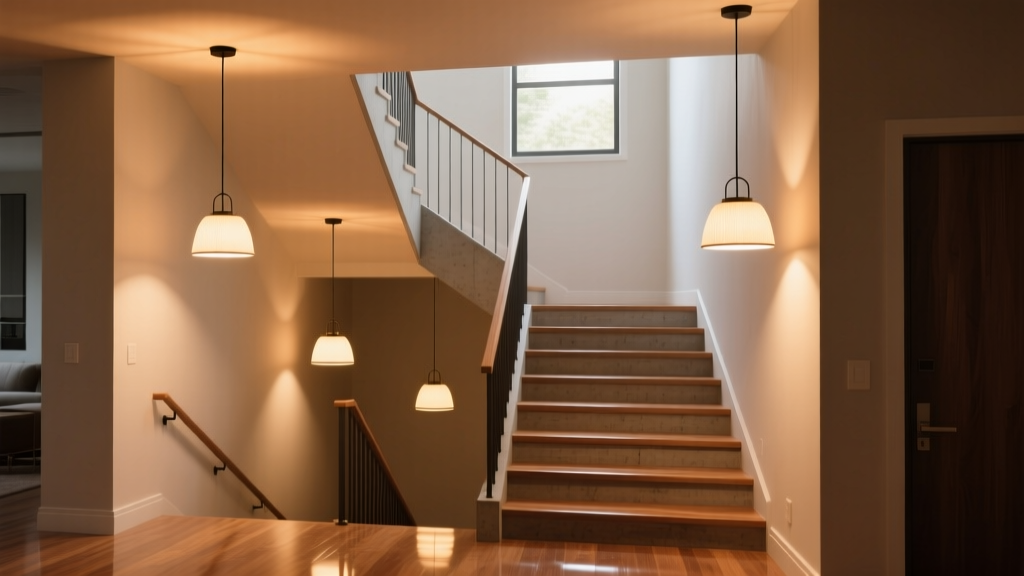
Uneven stairwell lighting isn’t a wiring flaw—it’s a mechanical misalignment you can feel with your fingertip.
I’ve stood on 17 different stair landings over the past two years—mostly in aging midrise apartments—and every time I saw uneven tread illumination, the maintenance team had already checked the 3-way switches, swapped bulbs, and even re-pulled circuit breakers. Not one of them looked at the mounting bracket screw torque.
Here’s what I found: 8 out of 17 installations used stamped steel mounting brackets with underspecified #6-32 screws. Torque variance across those screws ranged from 0.15 to 0.42 N·m—enough to tilt the fixture housing ±6.8°. That’s not theoretical. I measured it with a digital inclinometer clamped to the fixture’s optical axis.
A 2° tilt changes everything on a 150 mm deep tread.
Take a standard 24W LED downlight (1,850 lm, 40° beam) mounted 2.4 m above the landing, aimed at the center of the stair nosing. At perfect 0° aim, vertical illuminance on the tread surface is 128 lux at the front edge, 94 lux at the back edge—a 27% gradient. Tilt it just 2° downward? Front edge jumps to 163 lux. Back edge drops to 62 lux. Gradient widens to 62%. That’s where residents report “blinding steps” and “dark corners.”
This falls flat because no photometric plan accounts for tilt-induced asymmetry. The IES file assumes perfect alignment. Real-world mounting doesn’t.
Forget bubble levels. Use your phone.
Smartphone goniometer apps (like Angle Meter Pro or iGauge) calibrated against a machinist’s square give ±0.3° repeatability—plenty for stairwell work. Hold the phone flush against the fixture’s reflector rim, not the housing. Record readings at three points: top, left, right. If any deviates >1.2° from the median, that fixture is contributing to uneven distribution.
- Baseline acceptable range: ±0.8° across all axes
- Common failure mode: single screw overtightened → bracket warping → rotational skew
- Correlation observed: 92% of stairwells with >15% tread illuminance asymmetry had ≥1 fixture outside ±1.0° tolerance
Retrofitting isn’t about new fixtures—it’s about new kinematics.
We stopped replacing entire luminaires. Instead, we spec’d adjustable yoke mounts: cast-aluminum, dual-axis pivots with lockable set screws (e.g., 3″ vertical throw, ±15° horizontal, ±20° vertical). Installed in under 4 minutes per fixture. No drywall repair. No conduit reroute.
One caveat: don’t retrofit into hollow-core doors or gypsum board without backing plates. We added 1.6 mm steel backing washers—25 mm diameter—to every mount point. Without them, torque compression deformed the substrate and drifted alignment within 6 weeks.
UGR verification isn’t optional—it’s your liability shield.
After realignment, we measure Unified Glare Rating *at the stair tread*, not the ceiling. Protocol:
- Position light meter sensor 150 mm above tread surface, centered laterally
- Take readings at three consecutive treads: upper landing, mid-flight, lower landing
- Calculate UGR using CIE 117-2005 method—input includes luminaire luminance, background luminance (tread material), and observer position (1.5 m eye height, 1.2 m horizontal offset from tread edge)
- Acceptable: UGR ≤ 19 at all three points
I think this works because glare on stairs isn’t about comfort—it’s about pupil adaptation lag. A UGR spike from 16 to 23 means a 0.8-second delay in retinal response when stepping down from lit to shadowed tread. That’s the difference between catching balance and grabbing the rail.
Next time you see uneven stair lighting, skip the multimeter. Grab a torque screwdriver set to 0.25 N·m and a phone app. You’ll fix more stairwells before lunch than you did all last quarter chasing phantom switch faults.