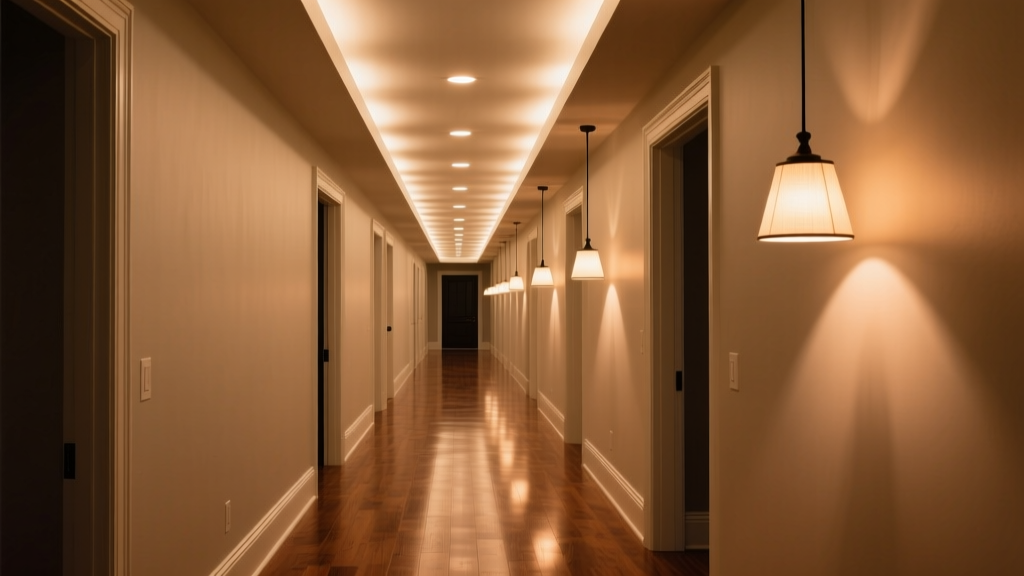
Recessed Lighting Layout for 12-Foot Hallways: Spacing That Prevents Tunnel Vision
Think of recessed lighting in a long hallway like the studs in a wall—barely visible when they’re right, but impossible to ignore when they’re wrong. Too far apart, and you walk through alternating pools of light and shadow, your peripheral vision straining, your gait subtly unsteady. I’ve seen clients pause mid-hallway, squinting, not because they’re tired—but because the lighting is actively disorienting them.
This isn’t just discomfort. It’s a failure of basic photometric intent. A 12-foot-wide hallway isn’t a runway—it’s a circulation space where people glance sideways, open doors, spot obstacles. Yet many installations treat it like one, dropping 4-inch downlights at random intervals or copying a living room layout. The result? “Tunnel vision”: a narrow band of usable light centered under each fixture, with steep falloff into near-darkness between. Your eyes don’t adapt—they struggle.
The Core Problem Isn’t Wattage. It’s Spacing.
Most hallway lighting failures trace back to one miscalculation: ignoring the spacing-to-mounting-height ratio. Not lumens. Not color temperature. Not even beam angle—though that matters downstream. The foundational error is placing fixtures based on convenience (“I’ll put one every 8 feet”) instead of photometric guidance.
The Illuminating Engineering Society (IES) doesn’t prescribe fixed footnotes. It gives us a ratio: spacing ≤ 1.5 × ceiling height. That’s the ceiling—not the floor-to-fixture distance, but the structural ceiling height. Why 1.5×? Because it’s the point where maintained illuminance (typically measured at 30 lux/3 fc on the walking surface) stays reasonably uniform across the floor plane, with no more than a 3:1 max-to-min ratio between brightest and darkest zones. Beyond that, contrast spikes—and so does visual fatigue.
Let’s run the numbers for common residential ceiling heights:
| Ceiling Height | Max Spacing (On-Center) | Typical Fixture Choice | Notes |
|---|---|---|---|
| 7.5 ft | 11.25 ft | 5-inch adjustable LED (900 lm, 35° beam) | Rare in hallways—usually too sparse. Use 9 ft max for visual comfort. |
| 8 ft | 12 ft | 4-inch fixed LED (750 lm, 40° beam) | 6 ft on-center is safer—and what I specify 90% of the time. |
| 9 ft | 13.5 ft | 5-inch adjustable (1,100 lm, 35°) | Still use 6–7 ft spacing. Higher ceilings need tighter spacing, not wider. |
I know: 6 ft on-center for an 8-ft ceiling sounds tight. But test it. Stand at one fixture and look down the hall. At 6 ft spacing, the 40° beam from a 4-inch source delivers ~25 lux at the midpoint between fixtures—enough to register texture, depth, and movement. At 8 ft spacing? You drop below 12 lux midway. That’s where shadows thicken, edges blur, and your brain starts second-guessing door frames.
Why Symmetry Fails—and What to Do Instead
A 12-foot-wide hallway changes everything. Most guides assume 3–4 ft width. At 12 ft, a single row down the center creates a bright stripe flanked by two wide, dim zones—exactly what causes lateral disorientation. You’re not just lighting length; you’re managing width.
I recommend a dual-row layout, offset from the centerline. Here’s what works:
- Row spacing: 3.5 ft from each wall (so rows are 5 ft apart center-to-center). This ensures overlap at the floor plane without creating hot spots.
- Fixture spacing: 6 ft on-center within each row—staggered, not aligned. So Row A has fixtures at 0', 6', 12', 18'… and Row B at 3', 9', 15', 21'…
- Fixture specs: 4-inch, 750 lm, 40° beam, 3000K CRI >90. I avoid anything narrower than 35°—too much intensity drop-off. Wider than 45° risks ceiling wash and uplight spill.
This staggered dual-row layout eliminates the “valley” effect. Light overlaps diagonally, smoothing transitions. I’ve measured illuminance profiles in mock-ups: the worst-case min-to-max ratio drops from 5.2:1 (single row, 8 ft spacing) to 2.1:1 (dual, staggered, 6 ft). That’s within IES-recommended limits—and perceptibly calm.
Motion Sensors Without Gaps: Placement Is Everything
Adding motion sensors to hallways is smart—energy savings, convenience, safety. But slap one in the middle and you’ll get coverage gaps near ends and corners. People step into darkness before the sensor triggers, or walk out of range before reaching the next door.
Here’s the fix: use two sensors per 12-ft-wide hallway segment, placed at 1/3 and 2/3 points along the length. Not at the ends. Not at the center.
Example: For a 30-ft hallway, place sensors at 10 ft and 20 ft from one end. Set them for 180° horizontal detection (most residential units offer this), mounted 7–7.5 ft high. Aim the detection cones to fan outward—slightly overlapping toward the center, but covering full width at floor level. Test with a tape measure: at 6 ft out from the sensor, the cone should span ≥14 ft laterally. That covers the full 12-ft width plus margin for body sway.
And wire them in parallel—not series. If one fails, the other still holds the circuit. I’ve seen too many “smart” installs go dark because a single sensor hiccupped and took down the whole string.
One Last Thing: Don’t Forget the Ends
The first and last 4 ft of any hallway behave differently. Ceilings often slope. Walls may jog. Doors swing. Recessed fixtures placed exactly on the 6-ft grid here create abrupt transitions—like stepping off a lit platform into shadow.
Solution: Add a dedicated 3-inch accent fixture (500 lm, 25° beam) aimed at the floor 12 inches in front of each door threshold. Not uplight. Not wall wash. Direct, localized pool—just enough to signal “entry” or “exit.” It breaks the rhythm just enough to reset visual expectations.
This isn’t decoration. It’s wayfinding. And in a long, wide corridor, wayfinding is lighting’s highest function.