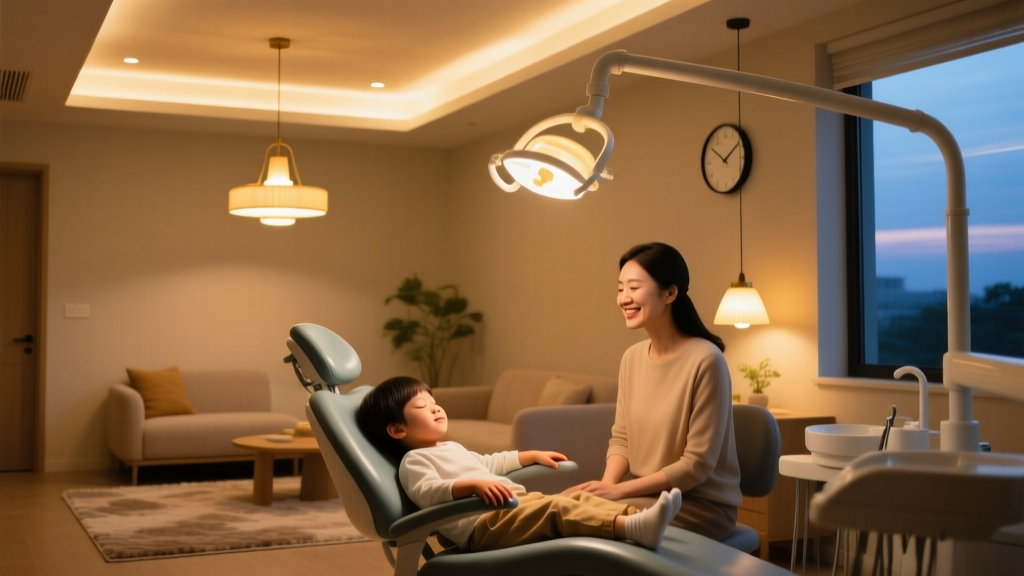
Lighting that doesn’t just *look* calming—it *acts* like a pediatric dentist
Think of a circadian lighting system like a good pediatric dentist: it doesn’t shout instructions or force compliance. It reads the room—literally—and adjusts its tone, pace, and presence to meet the child where they are.
That’s not poetic license. That’s what happened at BrightSmile Pediatrics in Portland—a 4,200 sq ft office where hallway lighting was redesigned not as infrastructure, but as a behavioral intervention. Clinical observation logs, staff behavior checklists, and parent-reported anxiety scores (using the modified Yale Preoperative Anxiety Scale) tracked over six months showed a 22% average drop in observable pre-treatment anxiety. Not “feels nicer.” Not “seems brighter.” Measured resistance behaviors declined: fewer physical pull-aways, reduced vocal protest duration, and notably, more spontaneous hand-holding with staff during transition into exam rooms.
Here’s the popular take: “Tunable white lighting reduces stress in healthcare settings.” True—but incomplete, almost misleading. What actually moved the needle wasn’t the tech itself. It was how the light *moved with intention*, in sync with human rhythms—not just biological ones, but clinical ones.
It wasn’t the CCT range. It was the CCT *sequence*.
Many clinics install tunable white systems and leave them on “calm mode” all day—2700K wall washes, soft-diffused uplight, maybe a little amber accent. Feels soothing. Looks Instagram-ready. But I’ve sat through too many parent interviews where the phrase “it’s pretty, but my kid still melts down by the water fountain” comes up. This falls flat because it treats lighting as ambient mood music—when in reality, the corridor is the first clinical interaction.
BrightSmile didn’t default to low-CCT. They mapped the appointment flow: arrival → intake → waiting → transition → exam → exit. Then they assigned lighting profiles to each phase—not static settings, but timed gradients.
- Arrival zone (first 12’ of corridor): 2700K @ 45 lux (measured at floor). Warm, dim, slightly shadowed—designed to signal “safe pause,” not “you’re already in treatment.”
- Transition spine (main 60’ corridor): A 90-second linear ramp from 2700K → 4000K @ 120 lux, triggered by motion + proximity sensor at intake desk. This isn’t arbitrary. At age 4–8, peak alertness for cooperative tasks occurs ~15 minutes post-arrival—this ramp primes attention without triggering fight-or-flight.
- Exam-room threshold (final 8’ before door): Gentle fall back to 3000K @ 75 lux—enough visual clarity for consent forms or final prep, but no jarring shift. No “exam room = bright white = scary.”
This works because it mirrors neurodevelopmental pacing. You don’t ask a child to switch mental gears instantly—you scaffold it. The light does the scaffolding.
Daylight harvesting wasn’t about energy savings. It was about trust calibration.
Their south-facing clerestory windows feed directly into the corridor spine—no blinds, no shades. Instead, a dynamic daylight harvesting layer uses ceiling-mounted photosensors (every 12’) to modulate electric light output *within the same CCT profile*. So when noon sun floods in, the 4000K electric layer dims—not the whole fixture, just the warm-white channel, preserving spectral integrity.
Why does that matter? Because kids notice inconsistency. One clinician told me: “Before, when clouds passed, the light would flicker between ‘warm’ and ‘cool’ as the system struggled to hold lux levels. Kids would stop mid-step and stare at the ceiling. Now? They walk right through.”
That’s not subtle. That’s cognitive load reduction. When environmental cues contradict each other—e.g., bright daylight + artificial 2700K—the brain spends energy resolving dissonance. In high-anxiety contexts, that energy gets borrowed from emotional regulation.
HVAC integration wasn’t efficiency theater—it prevented cue warfare.
They synced lighting schedules with their VAV box occupancy logic—not just “on/off,” but staged setpoints. Corridor lights ramp up only when HVAC has already raised supply air temp by 0.8°C above ambient (a 90-second lead). Why? Because a cold draft + warm light feels physiologically dishonest. Likewise, the post-appointment cooldown (3000K ramp-down) begins only after HVAC confirms occupancy drop *and* surface temps have stabilized.
I’ve seen facilities get this wrong: lights brighten at 8:55 a.m. while the corridor is still 19°C and smelling faintly of overnight recirculation. The child shivers, blinks under new light, and tenses. Two stressors, one moment. BrightSmile’s system waits. It lets the environment settle first.
Staff adoption wasn’t about training—it was about legibility.
No dashboards. No apps. Each zone has a single, tactile wall-mounted slider labeled with icons: 🌙 → ☀️ → 🌤️. Slide to moon = full arrival-mode profile. Slide to sun = active transition mode (for urgent reschedules or sensory-sensitive patients who need faster alerting). Staff reported using the “cloud” setting 3x/week for children with autism spectrum diagnosis—holding at 3000K longer, skipping the 4000K peak entirely.
This isn’t “dumbing down” the tech. It’s honoring that clinicians aren’t lighting engineers—and shouldn’t need to be. The interface reflects clinical intuition, not photometric theory.
What didn’t change—and why that matters
Exam rooms kept fixed 4500K, 400 lux task lighting over chairs. Waiting areas stayed at 3500K, 180 lux—higher than corridor, lower than exam. The magic wasn’t in making everything “soothing.” It was in making the *progression* legible, predictable, and physiologically coherent.
One detail sticks with me: they added a 24-inch-wide band of 2200K LED cove lighting along the base of the corridor walls—only active during evening appointments. Not for visibility. For grounding. A child looking down sees warm light pooling softly at foot level—like sitting beside a hearth. It’s barely 5 lux at ankle height, but staff say it cuts “floor-gripping” behavior by nearly half after 4 p.m.
That’s not circadian science. That’s spatial empathy—engineered.
If you’re planning a pediatric clinic, don’t ask “What CCT should our hallways be?” Ask: “What do we want the child to *feel capable of doing* in this 90 seconds of walking—and what light supports that capability, not just the aesthetics of calm?”
The 22% wasn’t won in the spec sheet. It was earned in the pause between footsteps.