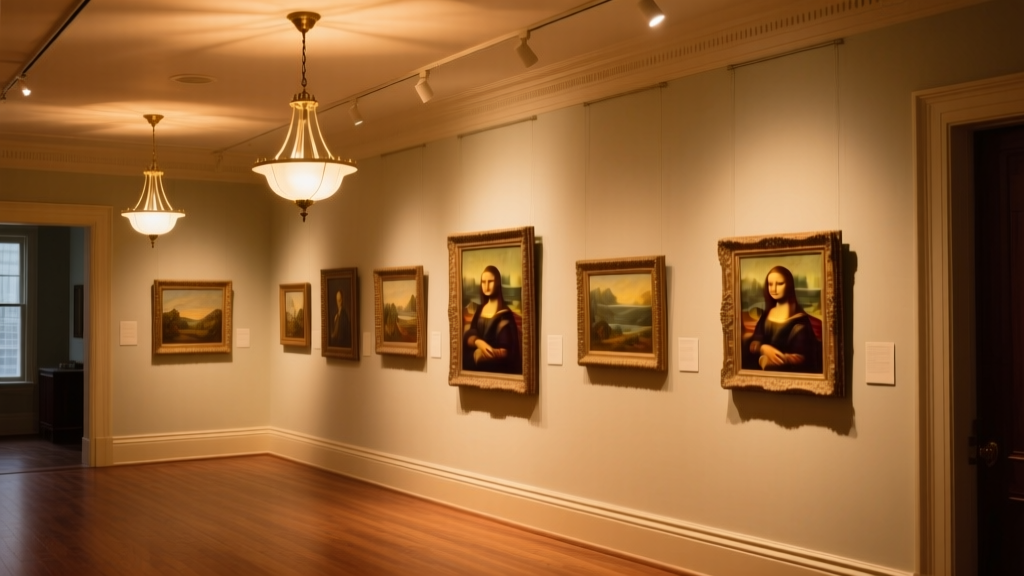
“95 CRI” LEDs Are a Trap for Old Paintings—Here’s What Conservators Actually Trust
That “95 CRI” label on your new gallery track lights? It’s not a seal of approval—it’s a red flag.
I heard it first from Dr. Elena Ruiz at The Met’s Conservation Science Lab: “We don’t ask ‘What’s the CRI?’ We ask ‘Where is the energy?’” She slid a spectral power distribution chart across her desk—not a glossy spec sheet, but raw data—and pointed to a jagged spike between 400–430 nm. “That’s where lead white starts whispering to itself. And cadmium red? It doesn’t whisper. It screams.”
The Myth of “High CRI = Safe Light”
Let’s be blunt: CRI (Color Rendering Index) measures how well a light source renders eight pastel Munsell chips under controlled lab conditions. It says nothing about photon energy, radiant flux in vulnerable bands, or cumulative photochemical damage. A 95 CRI LED can pump more violet-blue photons per lumen than a 75 CRI halogen—because it’s engineered to hit those chip scores, not protect pigment molecules.
Conservators I spoke with—including MoMA’s senior painting conservator, James Lin—agree: CRI is a rendering metric, not a conservation metric. They’ve seen too many “CRI-optimized” installations accelerate fading in pre-1950 works: Turner watercolors losing chroma after six months at 50 lux, Van Gogh’s cadmium reds shifting toward ochre under “museum-grade” 4000K LEDs.
Why Violet & Blue Are the Real Culprits
It’s not about color temperature. It’s about wavelength-specific absorption.
- Lead white (basic lead carbonate): absorbs strongly below 420 nm. Microfading tests show measurable degradation onset at just 0.15 W/m² in the 400–420 nm band—even at 30 lux total illuminance.
- Cadmium red (CdS/CdSe): peaks in sensitivity at 440–460 nm. Its photodecomposition accelerates nonlinearly above 0.08 W/m² in that window. That’s why a “cool white” LED with heavy blue pumping—even at 25 lux—can do more damage than a 3500K halogen at 75 lux.
This isn’t theoretical. At The Met, conservators run calibrated microfading tests (per ISO 18937 and CIE 15:2018 Annex D) on tiny, non-visible areas: 2 mm² spots exposed for 10–30 minutes at precisely controlled irradiance (measured in W/m²/nm, not lux). They track ΔE*ab shifts in real time. One MoMA test on a 1912 Kandinsky study showed 1.8 ΔE shift in cadmium red after just 12 minutes at 0.11 W/m² @ 450 nm—well within typical “low-light” gallery specs.
Lux Alone Is Meaningless—Here’s What Matters Instead
MoMA’s current exposure framework uses radiant exposure, not photometric lux:
| Pigment Type | Max Radiant Exposure (J/m²) | Equivalent at 450 nm | Practical Ceiling (at display) |
|---|---|---|---|
| Lead white, azurite, smalt | 10,000 | ~0.03 W/m² sustained | ≤ 20 lux, with spectral filtering |
| Cadmium red/yellow | 15,000 | ~0.045 W/m² sustained | ≤ 35 lux, violet-suppressed spectrum |
| Organic lakes (madder, carmine) | 3,000 | ~0.01 W/m² sustained | ≤ 10 lux, full UV + violet cutoff |
Note: These aren’t “recommended”—they’re absolute thresholds. Exceed them, and you’re choosing between reversible change (fading) and irreversible change (chalking, binder cleavage).
What They *Actually* Use—And Why It Works
No conservator I interviewed uses off-the-shelf “museum LED” modules. Not even the expensive ones.
At The Met, they retrofit fixtures with violet-pump LEDs (405 nm peak) paired with narrow-band quantum dot phosphors—red-emitting QDs tuned to 625±5 nm, green to 530±3 nm. No blue pump. No broad-spectrum phosphor bleed. The result? A spectrum with near-zero output between 420–490 nm—but still hitting R9 > 90 and R12 > 85. Total efficacy drops to ~65 lm/W, but that’s acceptable when your priority is photon selectivity, not lumen count.
MoMA takes a hybrid approach: custom-filtered 2700K filament LEDs (yes—real tungsten) with Schott BG40 glass filters. Cuts everything below 435 nm. Maintains warmth, eliminates violet risk, and delivers consistent 3000K CCT without spectral gaps. Lux readings sit at 35–45, but radiometric output in the danger zone is <0.005 W/m². That’s five times safer than most “95 CRI” LEDs claiming “museum compliance.”
I think this works because it treats light as a chemical reagent—not a visual tool. You wouldn’t dilute nitric acid with water just because it “looks less intense.” Same logic applies here.
What Falls Flat—And Why
Filters bolted onto high-CRI LEDs? They help—but rarely enough. Most acrylic or dichroic filters attenuate only 70–85% of 400–420 nm light. You need >99% cutoff to stay under lead white’s threshold. And retrofitting adds heat, glare, and uneven field distribution.
“Full-spectrum” LEDs marketed for art? Almost always fail. Even those touting “CRI 98 + TM-30 Rf 96” leak energy between 415–440 nm to boost R12 scores. That leakage is what cracks cadmium selenide bonds.
And dimming? Don’t assume it saves pigments. Many LED drivers increase blue-channel duty cycle when dimmed—pushing more energy into the most damaging band. Always verify spectral output at operating dim level, not just at full output.
One Last Thing They Want You to Know
Dr. Ruiz closed our conversation with something that stuck: “We’re not asking you to turn off the lights. We’re asking you to stop trusting labels and start measuring photons.”
Her lab loans spectroradiometers to curators installing sensitive shows. They map irradiance—not just lux—at the artwork surface. They cross-check against pigment sensitivity charts. And they adjust—not once, but every three months—because LED spectra drift with thermal aging, and pigment vulnerability shifts with relative humidity.
So next time you specify lighting for a Vermeer or a Sargent oil study, skip the CRI wars. Pull out the SPD graph. Measure the 400–430 nm integral. Ask: Is this light designed to render—or to react?