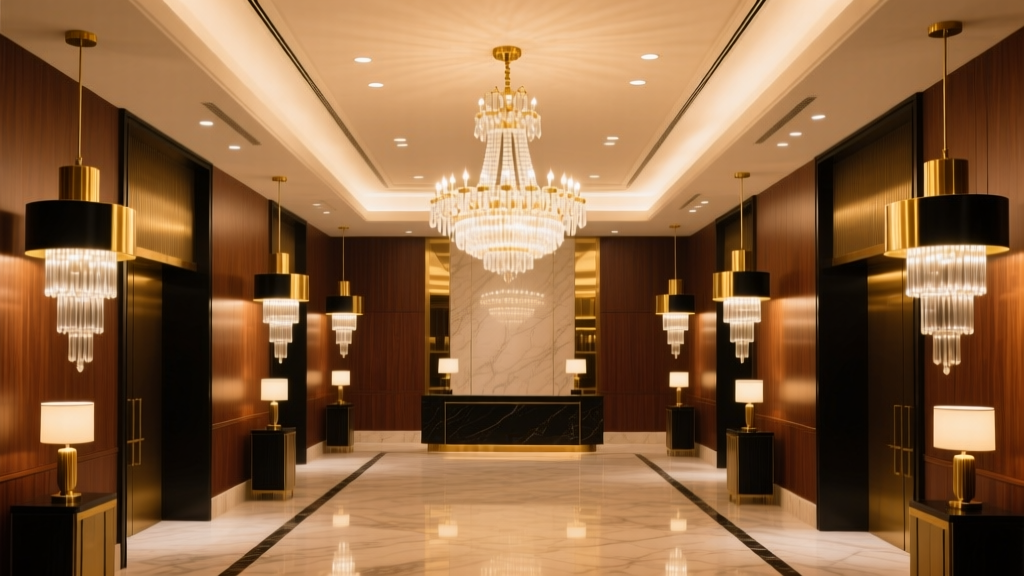
Did you really check the lobby lighting—or just sign off because the chandeliers look expensive?
Let’s be real: luxury condo lobbies get signed off on *way* too often with “Looks good to me” and a handshake. I’ve walked into handover meetings where the GC was holding a coffee cup, the lighting designer was checking Slack, and the commissioning agent was already halfway out the door—while the emergency egress path measured 0.4 lux at the stairwell threshold. Not a typo. Zero point four. That’s not “luxury.” That’s a liability waiting for its first after-hours security call. So here’s the 12-point inspection checklist I use—not as a formality, but as a *litmus test*. If even one of these fails, I don’t sign. And neither should you. This isn’t about perfectionism. It’s about avoiding the 3 a.m. call where the building manager says, “The lights flicker when the HVAC kicks on—and the fire inspector failed the exit path.”1. Photometric report ≠ as-built fixture count
You’d think this is obvious. It’s not. I’ve seen reports specifying 28 recessed downlights in the concierge zone—only to find 22 installed (and 6 missing from the ceiling grid entirely). Why? Because someone swapped “28 × 1,200-lumen” for “22 × 1,500-lumen” mid-install… without updating the photometrics.
Walk the space with your printed photometric plan in hand. Count every fixture—yes, even the ones behind acoustic baffles or under soffits. Then cross-check against the final IES file. If they don’t match, ask: Who approved the deviation? Where’s the revised calculation showing uniformity still meets IES RP-20-22 (min 5 lux avg, max/min ≤15:1 in public circulation zones)?
2. DALI group address mapping isn’t “set and forget”
DALI addresses aren’t like MAC addresses—they’re assigned manually, and they drift. I’ve seen Group 7 control the elevator lobby lights while Group 12 ran the mailroom… because the installer reused old firmware and didn’t re-address after swapping drivers.
Test it live. Use the DALI USB interface or app. Cycle through each group address. Verify the physical fixture(s) responding match the labeled zone on the commissioning log. Bonus red flag: if Group 0 responds to everything, that means no addressing happened at all.
3. Emergency egress path illuminance: 1.0 lux minimum, ratio ≤40:1
This isn’t “just code.” It’s life-or-death. And yes—1.0 lux sounds absurdly low until you realize it’s measured *at floor level*, under battery power only, during full black-out conditions.
Bring a calibrated Lux meter (not your phone app). Test at 1-meter intervals along every marked egress path—including the last 1.5 meters before each exit door. Document min/max values. If you get 0.9 lux at the stairwell landing? Fail. If you get 42 lux at the corridor midpoint and 0.8 lux at the door threshold? Ratio = 52.5:1 → fail.
I once found a $42k linear LED tape running the perimeter wall—but zero emergency downlights over the actual exit doors. The tape lit the wall. Not the step-down. Not the handrail. Not the door frame. Fire marshal said, “Fix it or don’t open.”
4. Finish matching under D50, A, and F11 light sources
“It looks fine in the warehouse” is the most expensive sentence in lighting. You need to verify finish consistency—metal trims, glass diffusers, plaster-in housing bezels—under three distinct spectra:
- D50 (daylight simulant): reveals cool undertones, gray shifts
- A (incandescent/tungsten): exposes warmth bleed and orange cast
- F11 (TL84, retail fluorescent): highlights green/magenta inconsistencies
Do this *after* all fixtures are powered, warmed up (30+ mins), and in their final mounting positions. No “we’ll tweak CCT later.” If the brushed nickel trim looks lavender under F11 but silver under D50? That’s a finish mismatch—not a color temp issue. And yes, it matters. Luxury buyers notice. Instagram influencers photograph it.
5. Maintenance logins documented, not just “sent via email”
“The password is in the shared drive” is not documentation. I require:
- Username + password written on the commissioning sign-off sheet (yes, physically)
- Screenshot of successful login to each system: DALI gateway, lighting control panel, emergency battery monitor
- Proof of firmware version logged *in situ*: e.g., “DALI Driver FW v3.2.1 (installed 2024-05-12)” — verified by reading the driver label *and* querying the device
6. Circuit-level load verification—not just breaker labels
Labeling says “Lobby Chandelier – Cir. L12.” Great. But is L12 actually sized for 14A continuous load at 277V? Pull the panel cover. Measure voltage drop under full load (all fixtures on, HVAC running). If you see >3% drop across the circuit, dimming curves distort, sensors misfire, and drivers overheat.
7. Sensor calibration validated—not just “test mode activated”
Motion sensors set to “occupancy” mode must trigger within 3 seconds of entry—not 12. Ambient light sensors must hold setpoint ±5% under varying daylight contribution (test at dawn, noon, dusk). I use a handheld light meter and stopwatch. No exceptions.
8. Dimming curve linearity confirmed
Set dimmer to 10%, 30%, 50%, 70%, 90%. Measure output lumens at each step. It should be linear *within ±8%* of expected output. If 30% input yields 12% light? The curve’s wrong—and residents will complain the lights “don’t respond” or “feel sluggish.”
9. Acoustic performance verified (if fixtures are near quiet zones)
Those gorgeous backlit stone panels? They hum at 120Hz when drivers aren’t isolated. Bring a sound level meter. Measure at 1m distance, A-weighted. Anything >25 dB(A) in concierge or lounge zones violates WELL Building Standard W07. And no—“it’s quiet enough” isn’t data.
10. Thermal imaging of high-output fixtures
Check junction boxes, driver enclosures, and recessed housing cans with an IR camera after 60+ minutes of operation. Surface temps must stay <70°C (per UL 1598). I’ve seen 92°C on a 24W driver buried in insulation. That’s not aging—it’s arcing waiting to happen.
11. Control sequence validation—no “default scene assumed”
Does “Night Mode” actually reduce ambient light to 20% *and* disable non-egress accent lighting? Or does it just lower the chandelier? Run every programmed scene. Document timing, fade rates, and which circuits respond. If the “Welcome Scene” turns on the mailroom lights but not the front desk—someone missed a relay assignment.
12. As-built drawings stamped, dated, and filed—not “will send next week”
No PDFs. No Dropbox links. One printed, signed, and stamped set of as-builts—delivered to site office *before* sign-off. Includes: fixture schedule with exact model numbers, DALI address map, sensor zoning diagram, and emergency circuit routing. If it’s not on paper with a wet signature, it doesn’t exist for liability purposes.
I know what you’re thinking: “This is overkill.”
It’s not.
It’s what separates “we turned it on” from “we commissioned it.”
Because the day the first resident trips on a darkened stair landing—or the night the fire alarm triggers and half the egress lights stay dark—that’s not a lighting issue anymore. That’s a contractual, reputational, and potentially legal event.
And nobody remembers how beautiful the pendant looked during handover.
They remember whether the light was there when it mattered.