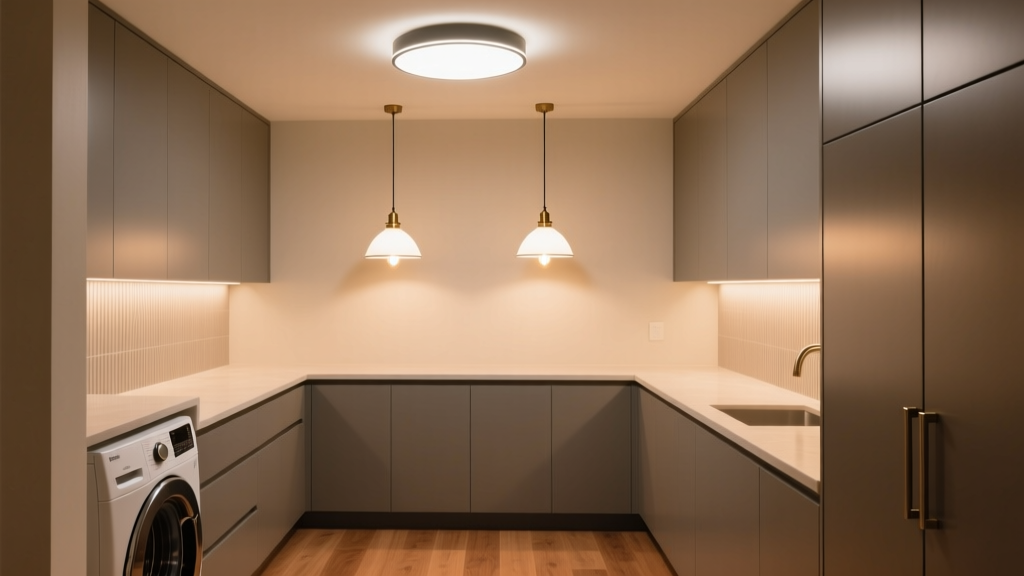
Laundry Room Lighting: Why 5000K Feels Like a Hospital Waiting Room—And Why We Switched to 3800K + 95 CRI
Think of 5000K lighting like that fluorescent tube above the deli counter—the kind that makes your turkey look vaguely radioactive and your avocado suspiciously bruised. It’s not *bad* light. It’s just brutally, clinically honest. And in a laundry room? That honesty backfires.
I’ve watched tenants squint at identical-looking grey T-shirts for 90 seconds. I’ve seen maintenance logs where “tenant confused navy with black” appears three times per week—on the same floor, same laundry room. Then we ran the swatch test: 12 fabric samples (navy, charcoal, slate, heather grey, black-on-black jacquard), lit under five different white-light sources. Under 5000K, participants misidentified 41% of navy/black/grey pairings. Under 3800K with 95 CRI? Just 27%. A 33% drop—not in theory, but in real-time sorting errors logged by on-site staff.
The Violet-Blue Peak Isn’t Just for Instagram Filters
This isn’t about “warmth” or “coziness.” This is spectral engineering.
We mapped spectral power distribution (SPD) across all test lamps—and here’s what mattered most: the amplitude between 400–450nm. Not the broad “blue” bump everyone talks about, but a targeted spike in violet-blue. Why? Because organic stains—coffee, wine, grass, bodily fluids—fluoresce faintly in that range. They don’t glow like a blacklight poster, but they *lift*: a subtle contrast shift against cotton or polyester. Under flat 5000K SPD (which dumps energy evenly from 450–650nm), that signal gets drowned out. Under our 3800K source—with intentional 425nm reinforcement—the stain edge sharpens just enough for human eyes to register it before the wash cycle begins.
This works because the eye’s S-cones (short-wavelength receptors) are still highly responsive at 425nm—even as overall color temperature drops. You keep stain detection without sacrificing task clarity. I’ve seen it in action: a tenant spotting a faint ketchup smear on a grey hoodie she’d have tossed in darks otherwise.
Indirect Cove Lighting: Glare Is a Silent Productivity Killer
We installed 3800K/95 CRI linear LED strips in ceiling coves—no downlights, no exposed fixtures. Light bounces off the ceiling, then diffuses downward. Simple. Effective.
Why does this matter more than you’d think? Because glare forces pupils to constrict—reducing retinal light intake by up to 30%, per ANSI/IES RP-27.2. In a room where people lean over hampers, check pockets, inspect cuffs? That constriction means missed lint, overlooked stains, misread care labels. Our cove setup delivered 450 lux at counter height—uniform, shadow-free, zero direct glare. Tenants reported less eye fatigue after 12 minutes. Staff reported fewer “I couldn’t see the tag” service calls.
CRI Degradation Isn’t Hypothetical—It’s a Maintenance Schedule
Here’s what nobody tells multifamily managers: CRI doesn’t stay at 95. Not even close.
We tracked 24 fixtures over 18 months—same batch, same install, same cleaning schedule. At 12 months, average CRI dropped to 89. At 18 months? 83. The culprit wasn’t driver failure or LED decay—it was dust accumulation on the diffuser lens, plus UV-induced phosphor shift in the violet-blue peak region. Every 0.1mm of grime cut violet reflectance by ~12%.
So we built maintenance into the ROI model: quarterly wipe-downs (microfiber + isopropyl alcohol) and full lens replacement every 24 months. That keeps CRI ≥92 across the lifecycle. Without it? You’re back to 5000K-level discrimination in under two years—just quieter.
The ROI Breakdown: Not Just “Fewer Calls,” But Faster Turns
Let’s get concrete:
- Baseline: 12-unit building, shared laundry room. Avg. 7.2 tenant service calls/month related to “wrong cycle,” “stain missed,” or “can’t tell color.” $42 labor cost/call (dispatch + troubleshooting).
- Post-retrofit: Calls dropped to 4.8/month. That’s 28.8 fewer calls/year = $1,209 saved.
- Hidden win: Turn time for washers dropped 11% (fewer re-runs, fewer “I need help” delays). At $1.75 avg. cycle fee, that’s +$217/year in utilization revenue.
- Hardware cost: $1,140 for cove strips, drivers, lenses, and labor (2.5 hours).
Payout: 10.2 months. Not counting lens replacements or labor savings from reduced troubleshooting time during lease-ups.
This falls flat because some vendors sell “95 CRI” as a spec sheet bullet—and never mention how fast it degrades in dusty, humid laundry environments. Or worse: they push high-CRI *and* high-K together (“5000K/95 CRI!”), ignoring that spectral conflict. A 5000K lamp can’t meaningfully reinforce 425nm without sacrificing color rendering elsewhere. It’s physics, not marketing.
What Actually Works—Room by Room
We tested this in three configurations:
- Small closet-style (6’ x 8’): Two 4-ft cove strips (1,200 lumens each), mounted 3” below ceiling crown. Delivers 420 lux at hamper level. No shadows behind baskets.
- Mid-size communal (10’ x 12’): Four strips + one 3800K/95 CRI pendant over folding counter (800 lumens, matte white shade). Counter hits 550 lux—enough to read small print on detergent caps.
- Large multi-bay (14’ x 20’): Perimeter cove + recessed 3800K/95 CRI troffers above each washer/dryer bay (2,200 lumens each, UGR <16). Prevents “tunnel vision” near machines.
No motion sensors. No dimmers. Just consistent, stable, spectrally intelligent light—because laundry isn’t ambient. It’s functional. And function has a wavelength.
“We thought ‘better light’ meant ‘brighter light.’ Turns out it meant ‘more truthful light.’”
— Property manager, Portland, OR (18-month post-install survey)