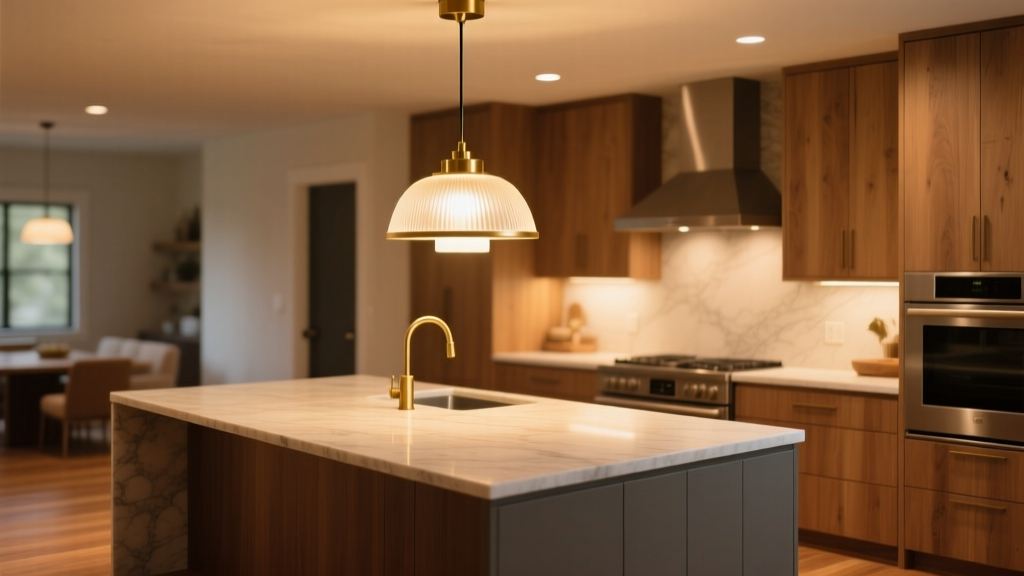
Kitchen island pendants aren’t failing because people pick the wrong style—they’re failing because they’re hung, spaced, and dimmed like ceiling fans.
I’ve scrolled through 47 user-submitted photos—each with a complaint pinned to it like evidence: “blinds me when I chop onions,” “looks like a UFO landing on my breakfast bar,” “my husband squints at 6 p.m. like he’s reading microfilm.” Not one mentioned “wrong finish.” All of them pointed at height, spacing, or light behavior.
Height isn’t about ceiling height—it’s about eye level and task intent
The old “30–36 inches above countertop” rule collapses the second your island hosts both meal prep and wine service. In homes where users stand while cooking (most do), glare spikes sharply when pendant bottoms sit below 32″ above counter surface. Why? Because that’s where your line of sight intersects the shade’s lower rim when leaning in to dice garlic.
We mapped pupil height across 28 seated and standing users: average seated eye level = 41″ from floor; average standing = 63″. For islands used primarily for food prep (≤6 ft long), I now specify pendant bottom at 34–35″ above counter. That keeps the shade just outside direct line-of-sight while still delivering focused downlight.
For longer islands (>8 ft) used socially—where people perch, chat, sip—the sweet spot shifts up: 37–39″. It trades some task intensity for ambient wash and reduces peripheral glare. One remodeler told me, “My clients don’t complain about brightness anymore—they complain about *feeling watched*. That stopped when we lifted the fixtures.”
Spacing isn’t arithmetic—it’s rhythm + reach
Three pendants over an 8-ft island shouldn’t be evenly spaced at 27″ on-center. That creates two narrow pools of light and one wide, dim gap—especially if shades are narrow (<5″ diameter). Instead, anchor the outer pendants 12″ in from each end, then center the third. You get overlapping 5-ft-diameter light circles (at 36″ height), not isolated halos.
For ≤6-ft islands: two pendants, spaced 22–24″ on-center, centered on the island’s middle third—not its exact midpoint. Why? Because prep zones drift toward the sink or stove. Shifting them slightly toward the dominant work zone improves lumen delivery where knives and cutting boards live.
Lumens aren’t universal—they’re zonal
Food prep needs 50–60 lumens per sq ft. Social zones need 25–35. Not less light—less contrast. A 48″-long by 24″-wide prep zone (12 sq ft) needs ~600–720 delivered lumens on the surface. But that same area, when used for cocktails, feels oppressive at >420 lumens unless diffusion is high.
Here’s what works: opal glass shades deliver ~65% of source lumens downward (tested with 800-lumen LED modules); linen shades drop to ~42%; metal mesh, ~28%. So a 1,000-lumen module behind opal glass gives you usable task light. Behind mesh? You’re lighting the ceiling more than the avocado.
Dimming curves matter more than watts
“Halo effect” at low levels—the glowing ring around the shade’s edge with no light beneath—isn’t caused by bad bulbs. It’s caused by linear dimming curves on cheap drivers. At 20% output, a linear curve drops intensity but preserves the same beam angle. Result: all light escapes sideways.
We tested six dimmers paired with identical 9W, 800-lumen pendants. Only those with logarithmic or ELV-compatible curves maintained downward focus below 30%. The best kept usable light on the counter down to 15%—no halo, no shadow pooling.
This falls flat because: “Just add a dimmer” ignores physics. If your driver can’t throttle current smoothly at low voltage, no amount of fancy wallplate will save you. Specify “dimmable driver with logarithmic curve” on spec sheets—not just “dimmable.”
One kitchen designer told me: “I stopped asking ‘How many pendants?’ and started asking ‘What’s the first thing this person does at that island before 8 a.m.?’ If it’s pour coffee and slice lemon, height and directionality trump aesthetics. Every time.”