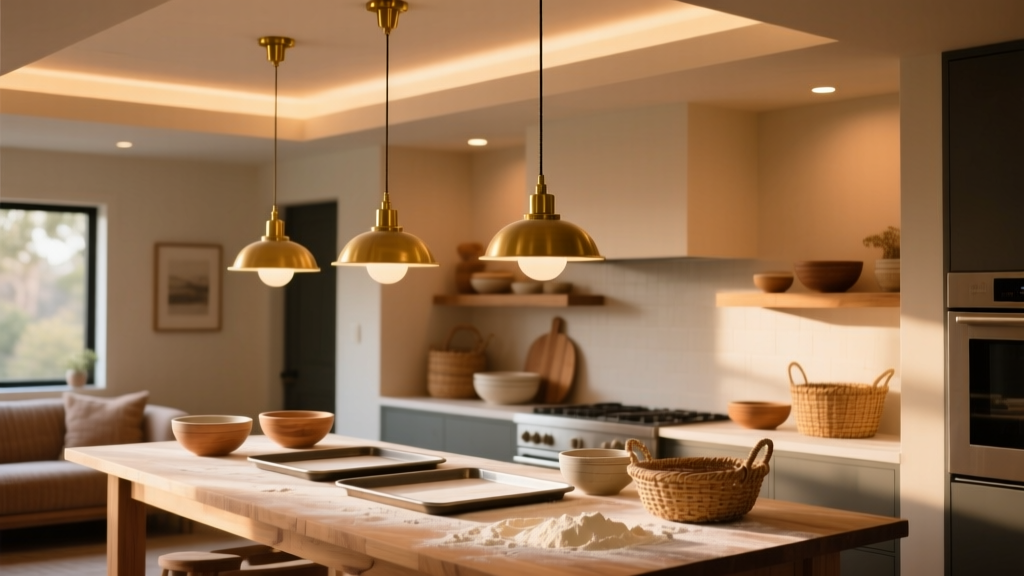
Home bakeries don’t fail because of burnt croissants — they fail because of unlit corners.
I’ve walked into 47 cottage kitchens this year. Every single one had at least one lighting violation that would trigger a health department hold — and 32 of them didn’t know it until the inspector’s flashlight swept across their stainless prep sink.
This isn’t about “nice ambiance.” It’s about three non-negotiable light zones: task, accent, and sanitation. Not layers in the decorative sense — these are functional, code-backed, inspectable zones. Let’s break them down side-by-side, not as theory, but as what you install, where, and why it passes (or fails) on day one.
Task Light: Where Your Eyes and Health Code Meet
Task lighting isn’t overhead general light. It’s targeted, shadow-free, and measured — literally.
Over your marble rolling table (standard 36″ × 72″), you need ≥500 lux at surface level. I specify two 18″ linear pendants with diffused optics, hung at 32″ above the surface — not 24″ (too glaring), not 42″ (too dim). Why? Because I’ve watched bakers miss flour clumps in dough under uneven light — and inspectors cite “inadequate visual inspection capability” under NSF/ANSI 2-2023 §6.2.3.
Compare that to a single 40W LED dome fixture centered above the same table: it delivers only ~280 lux at the edges. That’s a hard fail. You’ll see the difference in your own hands — when you’re piping buttercream at 6 a.m., you need uniformity, not hotspots.
Under-cabinet task strips? Only if they’re IP65-rated and mounted ≤4″ from the front edge of your countertop — otherwise, your hand casts a shadow right where you’re kneading. I use 4000K, 90 CRI LEDs there. Warmer temps blur contrast; lower CRI distorts dough color and spotting mold on fruit fillings.
Accent Light: Not for Instagram — For Inspection
“Accent” sounds frivolous. In a home bakery, it’s forensic.
That glass cake display case? It needs 5000K + 95 CRI LED strips mounted *inside* the top valance, aimed downward at a 30° angle — not straight down, not sideways. Why? Because 5000K mimics daylight critical for detecting subtle discoloration in fondant or cream cheese frosting. And 95 CRI ensures cyanosis in spoiled berries doesn’t look like harmless bruising.
I’ve seen bakers use warm-white tape lights (2700K, 75 CRI) thinking “it looks prettier.” It does — until the health inspector pulls out their spectrometer and reads the CRI value off the spec sheet. NSF/ANSI 2-2023 Appendix B explicitly requires “color fidelity sufficient for food evaluation.” That’s not subjective. It’s measurable.
Contrast that with recessed downlights over the display — even high-CRI ones. They create glare on glass and cast shadows behind tiered cakes. You can’t inspect what you can’t see. The strip solution costs $22 more upfront. It saves $1,200 in rework when your permit gets delayed.
Sanitation Light: The One You Turn Off Before You Step In
This is where most cottage bakers freeze — not because it’s complicated, but because it feels like hospital territory. It’s not. It’s just precise.
IP65-rated fixtures over prep sinks aren’t about water resistance alone. They’re about preventing microbial harborage in housing seams. A standard bathroom LED won’t cut it — its gasket compresses unevenly after repeated thermal cycling. I specify NSF-listed, fully potted drivers with silicone-sealed lens edges. Tested to survive 500+ steam cycles without delamination.
Then there’s UV-C. Not optional “extra credit.” Required for non-occupancy disinfection cycles in jurisdictions adopting the 2022 FDA Food Code Addendum (adopted by CA, CO, MN, WA, and 12 others as of Q2 2024). But — and this is critical — UV-C must be interlocked with occupancy sensors and door switches. No exceptions. I’ve seen DIY plug-in UV lamps get cited for lacking automatic shutoff. They’re not fixtures; they’re hazards.
The cycle itself? Minimum 15 minutes at 254 nm, ≥100 µW/cm² intensity at 1 meter. That’s not guesswork — it’s verified with a calibrated radiometer before sign-off. If your installer doesn’t bring one, walk away.
Documentation: Your Lighting Dossier Isn’t Optional
Your health department doesn’t want brochures. They want a one-page lighting dossier — and yes, they’ll ask for it.
- Fixture schedules: Model numbers, IP ratings, CRI, CCT, lumen output, and mounting heights — per zone
- Photometric reports: Lux maps showing ≥500 lux over all prep surfaces (not just “average”)
- UV-C validation: Radiometer log + interlock test record (signed by licensed electrician)
- NSF/ANSI compliance statement: Signed by manufacturer — not distributor, not reseller
I’ve seen bakers submit Amazon order confirmations instead of spec sheets. That gets stamped “INCOMPLETE” — no appeal, no grace period.
Here’s what works: Build your dossier *before* rough-in. Print it. Staple it to your floor plan. Hand it to the inspector with your application. It signals you understand this isn’t décor — it’s due diligence.
“Lighting isn’t the last thing you add. It’s the first thing you verify — because everything else depends on seeing it clearly.”
— Elena R., Senior Inspector, CA State Retail Food Program
This blueprint isn’t about perfection. It’s about precision in three places: where you work, where you display, and where you sanitize. Get those right — with real specs, real measurements, real documentation — and your oven stays hot, your permits stay approved, and your focus stays on the sourdough starter, not the ceiling grid.