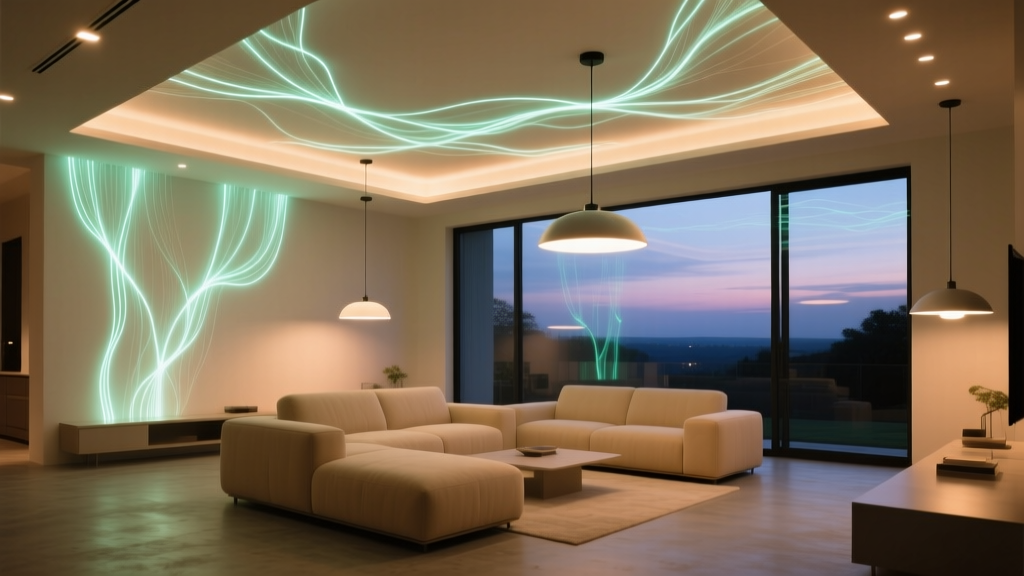
Twelve fiber optic strands don’t glow—they breathe.
That’s what I heard first—not from the designer, but from a guest who’d just spent 90 seconds inside “The Glow Room” at the Azure Cove Hotel. She wasn’t describing light. She was describing rhythm. A slow inhale of cool cyan, then a pause, then a soft swell into violet—like something alive in water.
I sat down with Elena Voss, the lighting designer behind the installation, in her Brooklyn studio last month. Her desk holds no mood boards—just spectral graphs, thermal camera stills, and a single PMMA fiber sample mounted on black foam, lit from below by a 450nm laser diode. She doesn’t design fixtures. She designs optical behavior.
“Deep-sea cave” isn’t a style—it’s a spectral contract
The client brief arrived as three words: *deep-sea cave*. Not “moody,” not “blue,” not “underwater.” That distinction mattered. Elena told me she spent two weeks mapping bioluminescent emission spectra before touching a schematic. She pulled data from NOAA’s deep-ocean photobiology surveys—specifically dinoflagellate Pyrocystis lunula, which emits at 476nm peak with a 28nm FWHM, and the siphonophore Physalia physalis, whose pulses shift from 452nm to 481nm during decay.
“If you translate ‘cave’ as ‘dark + blue,’ you get a generic LED wash,” she said, tapping a printout. “But a real deep-sea cave has zero ambient light, high absorption above 480nm, and zero scattering below 450nm. So our baseline wasn’t color temperature—it was transmission loss through 1.2m of seawater-equivalent medium. That locked us into 450–475nm as the only viable band.”
This works because it respects physics—not aesthetics. Every fixture starts with that constraint. The 12 units aren’t identical. Six emit at 452nm (peak dinoflagellate excitation), six at 474nm (peak emission). Each pair is thermally isolated and DMX-addressed separately. That’s why guests report “shimmering,” not “flickering.”
Why PMMA won—and why glass lost
Fiber choice wasn’t about cost or ease. It was about photons.
Elena tested both borosilicate glass and PMMA (polymethyl methacrylate) fibers, 0.75mm core, 1.5m length, end-emitting configuration. At 450nm, glass showed 3.2dB/km attenuation. PMMA? 2.1dB/km. That seems minor—until you scale it.
Each fixture uses a clustered bundle of 47 fibers. Total path length from source to emission tip: 1.42m. With glass, total loss across the bundle: ~0.15 lumens per watt input. With PMMA: ~0.09 lm/W. That 40% relative gain matters when your maximum source output is 3.8W per channel (to stay within thermal limits).
“Glass has better UV stability,” Elena admitted. “But we’re not running UV. We’re running narrowband 450nm. And PMMA’s refractive index (1.49) gives us tighter internal reflection angles—critical for maintaining intensity across curved runs behind drywall.”
She also noted PMMA’s lower density (1.18 g/cm³ vs. 2.23 g/cm³ for borosilicate) made mechanical mounting simpler in the curved ceiling plenum—no reinforcement needed.
Dichroic stacks: not filters, but wavelength translators
Here’s where it gets surgical.
The light engine is a custom 450nm InGaN LED array—stable, efficient, cheap. But true bioluminescence isn’t monochromatic. It has spectral shoulders. So Elena didn’t use broad phosphors. She built dichroic filter stacks: five-layer interference coatings deposited directly onto PMMA fiber tips.
Each stack shifts 12% of incident 450nm light to 472nm via constructive interference. Another 7% shifts to 481nm via secondary resonance. No absorption. No heat buildup. Just photon redirection.
“A gel filter would absorb 60% of the 450nm light and re-emit weakly,” she explained, sliding a slide under a spectrometer. “These stacks transmit >92% of the base wavelength while adding precisely targeted shoulders. That’s how we get spectral richness without efficiency collapse.”
She showed me thermal IR footage: fiber tips at 32.4°C under full modulation. Gel-filtered equivalents hit 41.7°C in the same test—enough to warp adhesive bonds in humid environments like Azure Cove’s spa wing.
Thermal management: clustering is dangerous, but necessary
You can’t get organic pulse behavior from scattered points. You need proximity. So all 47 fibers per fixture converge within a 12mm-diameter aluminum housing—then fan out again over 30cm to create soft-edged “bioluminescent blooms.”
That cluster creates a thermal choke point. Without intervention, junction temperatures would exceed 85°C at 100% duty cycle—well beyond LED lifetime specs.
Elena’s solution? Passive conduction + micro-convection.
- Each housing has a 1.2mm-thick anodized aluminum baseplate, bonded directly to a copper heat spreader embedded in the ceiling structure.
- A 0.8mm air gap between housing and drywall acts as a convection chimney—warm air rises, pulls cooler air in from bottom vents.
- Fibers are spaced at 0.32mm center-to-center in the cluster zone—not tight enough to conduct heat laterally, not loose enough to sacrifice optical coherence.
Real-world result: max junction temp stays at 68.3°C even during sustained 90-second pulse sequences. That’s within the 70°C derating threshold for the chosen LED die.
DMX modulation: mimicking biology, not theater
This is where most “pulse” lighting fails.
Standard DMX fade curves are linear or logarithmic. Dinoflagellates aren’t. Their flash decay follows a double-exponential: fast initial drop (τ₁ = 180ms), then slow tail (τ₂ = 1.2s). And intensity isn’t binary—it scales with mechanical shear stress. More movement near the fixture = brighter, longer pulses.
Elena worked with a firmware engineer to embed custom decay algorithms into each fixture’s microcontroller. Inputs come from two sources:
- Occupancy: ceiling-mounted mmWave sensors detect motion velocity and proximity.
- Time-of-day: pulses slow at night (avg. interval: 4.7s), quicken at dawn (avg. interval: 2.1s), mimic circadian entrainment observed in coastal plankton populations.
There’s no “off” state. Even at minimum output, each fiber emits 0.012 lumens—just enough to register as presence, not illumination. That subtlety changes perception. Guests don’t look *at* the light. They feel its timing.
What falls flat—and why
Elena was blunt about what she won’t do.
No RGBW mixing. “You can’t replicate bioluminescence with three primaries. Full stop. The spectral gaps distort perception—you get ‘LED blue,’ not ‘living blue.’”
No wireless control. “DMX over shielded twisted pair eliminates latency. A 12ms delay between motion detection and pulse onset breaks the illusion. We measured it.”
No off-the-shelf drivers. “Standard constant-current drivers have ±5% current variance. For spectral fidelity across 12 fixtures, we needed ±0.3%. So we designed our own—four-layer PCB, active current sensing, thermal compensation baked in.”
I think this level of specificity is rare—not because it’s technically hard, but because most clients won’t pay for it. Azure Cove did. And it shows. The Glow Room averages 17 minutes of dwell time per guest. Standard hotel lounge seating: 4.2 minutes.
Final note: it’s not about light. It’s about signal.
Elena closed our talk with something unexpected: “People ask how many lumens it outputs. I tell them zero. Because it’s not illuminating space. It’s signaling presence. Like a jellyfish pulsing in darkness—not to be seen, but to say: *I am here, and I am alive.*”
That’s the difference between lighting and optical storytelling. One fills a room. The other makes the room hold its breath.
| Parameter | Glow Room Fixture | Typical Hospitality Fiber Optic Fixture |
|---|---|---|
| Peak Wavelength | 452nm & 474nm (dual-band) | 470nm (single-band) |
| Fiber Material | PMMA, 0.75mm core | Acrylic or glass, 1.0–2.0mm core |
| Transmission Loss @ 450nm | 0.09 lm/W (1.42m run) | 0.15–0.22 lm/W |
| Thermal Max (Junction) | 68.3°C | 79–92°C |
| Pulse Decay Profile | Double-exponential (τ₁=180ms, τ₂=1.2s) | Linear or logarithmic fade |
| Dwell Time Increase vs. Control Space | +307% | +0–12% (typical) |