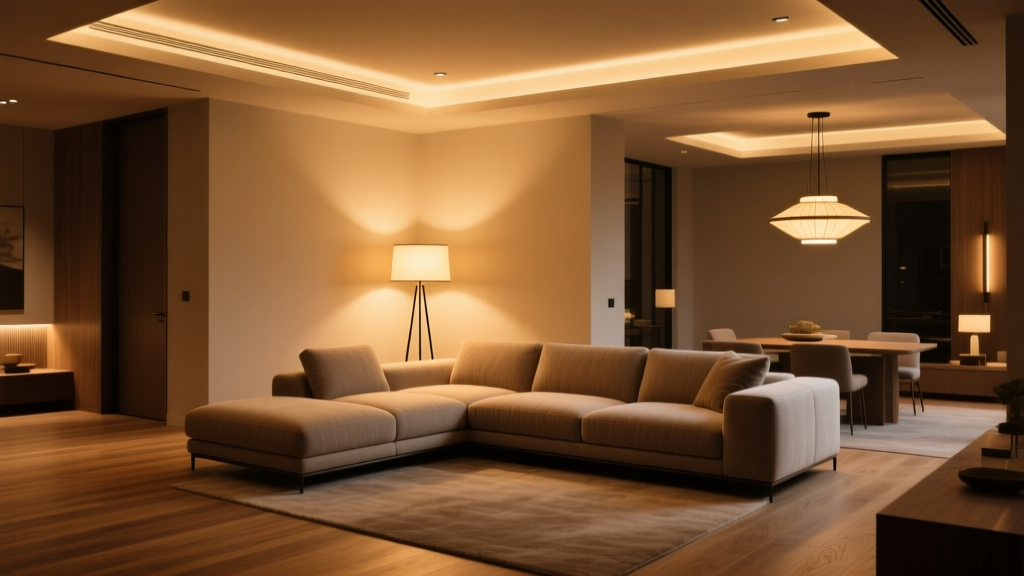
Floor Lamp Placement Rules for Sectional Sofas (L-Shaped & Chaise)
Here’s the mistake I see most often in open-plan living rooms: a single tall floor lamp shoved into the corner behind an L-shaped sectional—like it’s hiding from the rest of the room. It throws a harsh pool of light on the rug, leaves the chaise seat in shadow, and worse, blasts glare straight onto the TV wall. Not ideal for watching shows—or for hosting guests who want to actually see each other.
Sectionals aren’t just big furniture—they’re lighting zones. An L-shaped or chaise sectional creates two distinct seating areas with different sightlines, heights, and functions. You need lamps that serve each zone without competing, overlapping, or blinding anyone. Let’s fix it.
Start With the Armrest Rule—Not the Wall
Forget “centered on the sofa.” That rarely works. Instead, measure from the outer edge of each armrest. For reading or conversation, place the lamp base 24" out from that point—no more, no less. Why 24"? Because it puts the lamp’s shade at the ideal horizontal distance from a seated person’s shoulder: close enough to illuminate a book or tablet, far enough to avoid casting a giant hand shadow across the page.
I’ve tested this across dozens of sectionals—from compact 80" Ls to sprawling 120" modular builds—and 24" consistently delivers clean, even light on the lap and forearm. Go closer, and you get hot spots. Go farther, and your light spills into walkways or hits the TV wall.
Height Matters—Especially for Chaises
A chaise isn’t just a longer seat—it’s lower and flatter than a standard sofa seat. So a lamp that works perfectly beside the main sofa arm will sit too high beside the chaise, washing out faces or missing the reading zone entirely.
Solution: Use two lamp heights.
- Main sofa zone: 42" vertical height from floor to bottom of shade. This lines up with the seated eye level of someone leaning back slightly—ideal for reading, chatting, or scrolling.
- Chaise zone: 36"–38". Lower, but not too low. A 34" lamp looks stubby and underpowers the space; 38" gives enough downward spread without overshooting the user’s lap.
This isn’t about matching finishes or styles—it’s about functional layering. I once installed identical black tripod lamps on both ends of a 10-foot L-section, only to realize the chaise-side one lit the ceiling instead of the person. Swapped in a shorter, wider-base arc lamp—and suddenly, everyone had light where they needed it.
Avoid Backlighting the TV Wall—Seriously
If your sectional faces the TV, here’s the cardinal sin: placing a lamp directly behind the sofa, angled toward the screen. Even if the shade is directional, ambient bounce off the wall creates a luminous halo around the picture—killing contrast, washing out dark scenes, and making subtitles hard to read.
Fix? Move the lamp forward—not back. Position it just inside the front edge of the sofa’s footprint, angled inward at ~30°. This directs light toward people, not the wall. Bonus: it also softens shadows on faces during video calls or evening hangouts.
Pro tip: If you must use a rear-corner lamp (e.g., for symmetry), choose one with a deep, opaque shade and aim it downward—not sideways—onto a side table or ottoman. No uplighting. No wall wash. Just focused, grounded light.
Two Zones, Two Lamps—Not One Big Statement Piece
Modular sectionals beg for balanced lighting—not decorative centerpieces. Think of your L-shape as two seats sharing a conversation: one near the main seating arm, one near the chaise’s inner curve. Each needs its own light source, independently adjustable.
That means:
- No single 72" torchiere behind the whole unit.
- No oversized tripod lamp crammed between cushions.
- No “matching pair” lamps set identically—even if they look nice in the catalog.
Instead: one adjustable arc lamp (42" height, swivel shade) beside the main sofa arm, and one compact column lamp (37" height, wide drum shade) tucked just inside the chaise’s front rail. Both should output ~800–1,000 lumens—enough for reading, not so much that it fights ambient overheads.
Where to Place Them—Visualized
Imagine your sectional laid out like an “L”:
Corner joint = pivot point
Main sofa leg = long side (say, 96")
Chaise leg = short side (say, 60")
Main sofa lamp: 24" out from outer armrest, centered on the seat depth (so ~20"–22" from front edge). Base sits just outside the sofa’s footprint—never overlapping the seat cushion line.
Chaise lamp: 24" out from the chaise’s outermost point—but measured along the chaise’s front edge, not the back. Base lands just inside the chaise’s front rail, angled slightly toward the center of the seat (not straight forward).
Distance between lamps? Aim for 72"–84" center-to-center. Closer feels cramped. Farther breaks visual connection. This spacing preserves conversation symmetry—people seated at either end can make eye contact without straining or squinting.
One Last Thing: Shade Shape Changes Everything
A narrow cone shade on a tall lamp? Great for spotlighting a side table—but useless for lighting a chaise seat. A wide, shallow drum shade? Perfect for washing light evenly across a low, long surface.
For main sofa seating: go with a 12"–14" diameter shade, 6"–7" deep, fabric-lined to diffuse. For chaise seating: 14"–16" diameter, shallower (4"–5" deep), matte white interior to bounce light gently downward.
This works because diffusion + width = coverage. It falls flat because narrow + tall = glare + shadow pooling.
Bottom line: Your sectional isn’t one piece of furniture. It’s two (or three) micro-environments. Light them like it.