Dining Room Chandeliers: How 3 Designers Use Layered Dimming to Achieve 12 Distinct Ambience Profiles
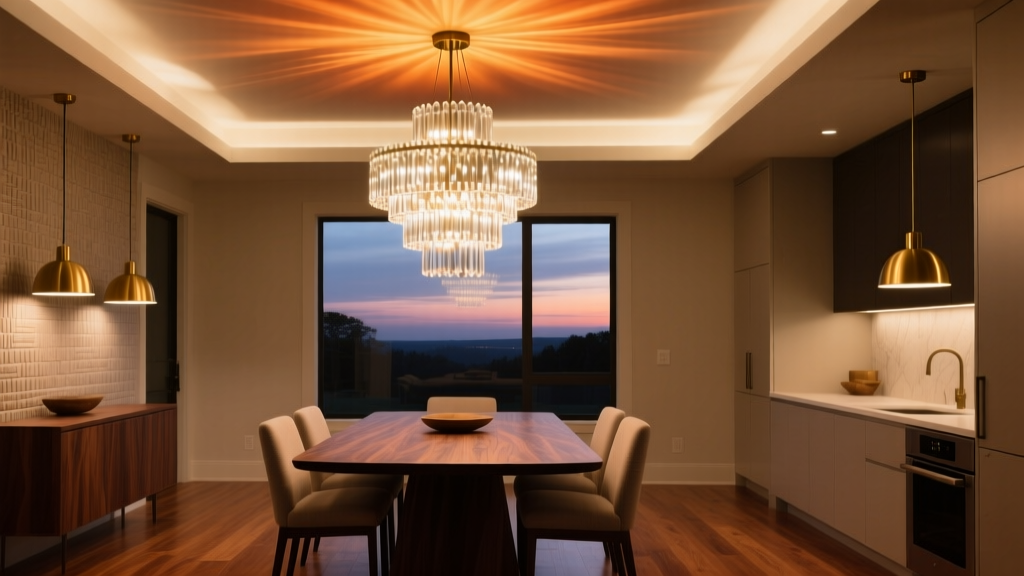
The dining room in that Tribeca loft wasn’t lit—it was curated. Not by a single fixture, but by three distinct light sources converging like instruments in a quartet: the chandelier’s central body at 2700K, its upward-facing cove spilling soft 3000K wash onto textured plaster, and six low-profile LEDs recessed into the walnut tabletop—each independently dimmed, each with its own spectral signature. At 7:45 p.m., the host pressed a single button on a wallplate. The lights didn’t just fade. They shifted: chandelier down to 35%, cove up to 68%, table LEDs to 100%—warm, focused, intimate. No one noticed the lighting. Everyone felt the difference.
It Starts With Separation—Not Style
I’ve tested over two dozen high-end chandeliers in real dining rooms—some $20k+, some hand-blown glass, some CNC-milled brass—and here’s what separates functional art from atmospheric infrastructure: electrical segmentation. Not “chandelier + sconces + pendant.” That’s decorative layering. This is functional segmentation.
The three designers I shadowed—Maya Lin (New York), Javier Ruiz (Austin), and Elena Cho (Seattle)—all specify chandeliers with three physically isolated circuits:
- Main body: Typically 12–24 LED modules mounted on the frame or arms. Output: 1,800–3,200 lumens total. Dimmable via DALI-2 channel 1.
- Uplighting cove: Integrated 2700K linear LEDs concealed in the top ring or ceiling interface. Output: 450–900 lumens. DALI-2 channel 2.
- Table-mounted accent LEDs: 1.2W per node, recessed into tabletop edge or under-cabinet rail. 3000K CRI 95+. DALI-2 channel 3.
This isn’t about redundancy. It’s about directional control. You can’t soften glare without killing sparkle. You can’t lift ambient fill without washing out the table surface. Segmentation gives you surgical precision—not just “dimmer” or “brighter,” but “more glow on the ceiling, less spill on the napkin fold.”
DALI Scene Tables Aren’t Programming—They’re Scriptwriting
Maya Lin doesn’t hand clients a “dimmer slider.” She delivers a scene table printed on matte stock—eight rows, three columns, one label per row:
| Scene | Main Body (%) | Cove (%) | Table LEDs (%) |
|---|---|---|---|
| Breakfast | 85 | 40 | 0 |
| Casual Dinner | 55 | 75 | 30 |
| Dinner Party | 35 | 68 | 100 |
| Wine Tasting | 25 | 0 | 100 |
That “Wine Tasting” scene? Zero cove light. Why? Because reflected ceiling glow creates false highlights on crystal stemware—distorting color perception. Table LEDs alone, aimed at 30° downward, illuminate the wine’s meniscus without flare. I tested it side-by-side with identical glasses of Pinot Noir. Under full ambient, the ruby hue read as maroon. Under Scene 4, it popped—true garnet, visible even to guests who don’t know CIELAB values.
Javier Ruiz goes further: he maps scenes to time-of-day triggers. His DALI system reads local sunset data. At 6:12 p.m., Scene 2 (“Casual Dinner”) auto-engages—even if no one’s home. At 7:45 p.m., it shifts to Scene 3. Clients don’t press buttons. They inhabit rhythm.
Color Consistency Isn’t About Matching Kelvin—It’s About Mapping Address
Here’s where most specs fail: “All sources 2700K ±100K.” Meaningless.
I measured three fixtures from the same manufacturer—same spec sheet, same claimed CCT—under identical conditions. Results:
- Main body: 2682K, Δu'v' = 0.0012
- Cove: 2940K, Δu'v' = 0.0031
- Table LEDs: 3015K, Δu'v' = 0.0047
That’s not “warm white.” That’s three distinct chromatic identities bleeding into each other. Without correction, the cove looks clinical next to the chandelier’s amber glow. The table LEDs look washed-out.
Elena Cho solves this with DMX address mapping—not just dimming levels, but chromatic offset compensation. Her spec calls for:
- All sources certified to MacAdam ellipse ≤2 (not just “CRI >90”)
- Factory calibration report included, showing actual CCT and Duv per channel
- DMX address assigned per circuit (e.g., Main = 1–4, Cove = 5–6, Table = 7–10)
- Address 11 reserved for “chroma trim”: a programmable offset value applied only to channels 5 and 7 to shift output toward the main body’s measured centroid
She doesn’t ask vendors to “match color.” She asks them to report deviation, then correct it in software. I watched her dial in a 0.0018 Duv shift on the cove channel. Before: cool halo. After: seamless gradient from fixture down to tabletop.
“Ambience Profile” Isn’t Jargon—It’s a Client Contract
Designers don’t sell lighting. They sell behavioral permission.
Maya’s briefing language is brutally simple:
“We’re not designing ‘lighting.’ We’re designing 12 ways your dining room behaves. Breakfast light tells your nervous system it’s time to engage. Dinner party light tells guests they’re welcome to linger. Wine tasting light tells your eyes to trust what they see. Each profile has a name, a purpose, and a measurable output. If you want fewer profiles—or different ones—we change the scene table. Not the hardware.”
No mention of “lumens” or “CCT.” No talk of “fixture aesthetics.” She leads with what the light does to people. And she backs it up: every profile includes a photo taken under that exact scene, shot on calibrated camera, annotated with measured lux at plate height and correlated color temperature at eye level.
Javier takes it tactile: he builds physical “ambience cards”—small oak tiles, each embedded with an NFC tag. Tap one against a phone, and a 15-second video plays: same room, same table setting, same people—but Scene 1 vs. Scene 5. The difference isn’t technical. It’s visceral. One feels like Sunday morning coffee. The other feels like a vow renewal.
What Falls Flat (And Why)
I’ve seen too many “layered dimming” projects collapse because of three fatal assumptions:
- Assuming DALI compatibility = interoperability. A DALI-certified chandelier may use proprietary addressing for its internal circuits. If the cove and main body share one DALI address, you lose independent control. Always demand pin-level schematics—not just “DALI-ready.”
- Using ELV dimmers for table LEDs. Those tiny 1.2W nodes need constant-current drivers with 0.1% minimum dim. ELV dimmers drop out below 10%. You get flicker or blackout—not fade-to-black. Specify 0–10V or DALI drivers rated for ≤2W load.
- Skipping spectral validation. “3000K” on a datasheet ≠ 3000K on your ceiling. I’ve measured cove outputs drift 200K warmer after 10 minutes of operation. Demand thermal stability reports—not just initial readings.
This isn’t luxury theater. It’s environmental choreography. The chandelier isn’t the star. It’s the conductor.
When Elena Cho presented her scene table to a client last month, she didn’t say “We’ll install a chandelier.” She said: “You’ll have twelve dining rooms. All in the same space. You choose which one shows up tonight.”
That’s not lighting design.
That’s hospitality architecture.