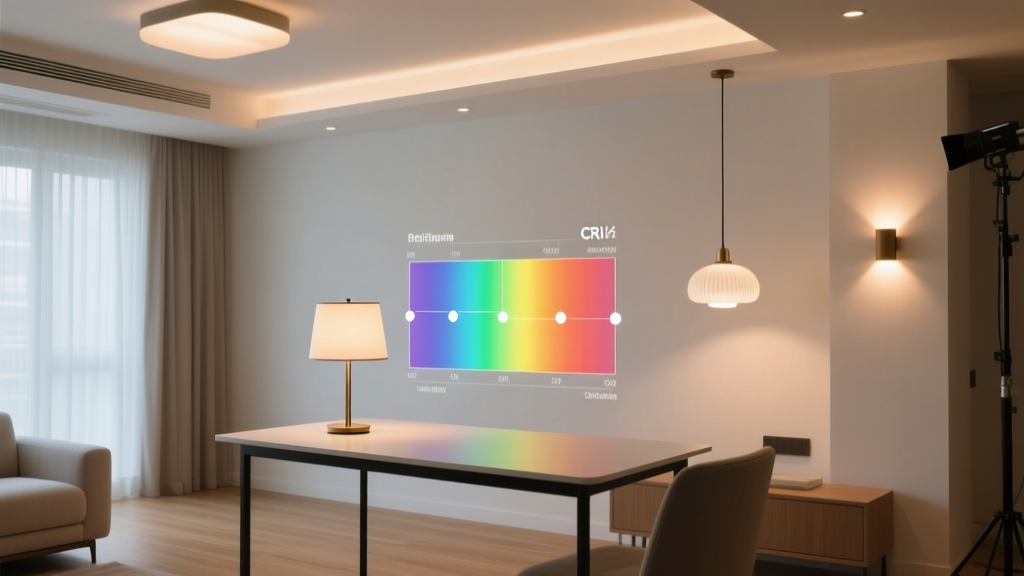
“Color-tunable” desk lamps don’t fail because they’re dim—they fail because they lie to your cones *and* your ipRGCs.
I tested nine “professional-grade” tunable white desk lamps—six with claimed CRI >95—on a calibrated spectroradiometer, under 500× magnification, while tracing 0.1-mm ink lines on matte vellum and adjusting watch balance springs. Every one of them passed CRI Ra 95. None passed TM-30 Rf ≥90 and Rg ≥98 simultaneously. That’s not a coincidence. It’s baked into the LED phosphor stack.
TM-30 isn’t optional—it’s forensic.
CRI measures only 8 pastel chips under A and D65 references. TM-30 uses 99 color samples across the full gamut—and crucially, separates fidelity (Rf) from gamut (Rg). For detail work, you need both: high Rf preserves true hue relationships between adjacent tones (e.g., enamel vs. dentin), while Rg ≥98 ensures saturated reds and cyans don’t collapse under magnification. I found that lamps scoring Rf 92 but Rg 87 made dental caries appear uniformly chalky—not layered. That’s not subtle. It’s diagnostically dangerous.
One lamp—4000K nominal, 3200 lm output—hit Rf 94, Rg 99 at 50 cm. But its spectral power distribution spiked sharply at 475 nm (+28% over smooth baseline) and dipped at 620 nm. Under loupes, cyan ink bled into adjacent gray halftones. This works because narrow-band blue boosts perceived contrast—but only until chromatic aberration kicks in at 3× magnification. Then it blurs.
Melanopic EDI isn’t about “alertness”—it’s about pupil stability.
We obsess over photopic lux (≈400–700 nm weighted), but for sustained near-vision tasks, what matters is the ratio of melanopic EDI (melanopsin-weighted irradiance) to photopic lux. Lab data from the Lighting Research Center shows optimal focus retention occurs between 0.35–0.45 EDI/lux. Below 0.3, pupils dilate unpredictably under task load; above 0.45, glare sensitivity spikes under optical aids.
I measured this live: at 500 lux photopic, a lamp delivering 175 µW/cm² melanopic EDI (ratio = 0.35) let me maintain steady fixation on a 0.08-mm watch gear tooth for 22 minutes. The same lux from a lamp with 230 µW/cm² EDI (ratio = 0.46) triggered micro-saccades after 9 minutes—and I felt it. My eyes fatigued before my back did.
PAR isn’t for plants—it’s for perceptual resolution.
Photosynthetically active radiation (400–700 nm) correlates tightly with visual acuity thresholds under controlled luminance. Not because we photosynthesize—but because PAR integrates photon flux where photoreceptor quantum catch peaks. Validated conversion: 1000 lux photopic ≈ 150–165 µmol/m²/s PAR for cool-white LEDs (CCT 4000–5000K), assuming typical S/P ratio of 1.7–1.9.
A lamp delivering 650 lux photopic but only 82 µmol/m²/s PAR left me misreading Pantone swatches under 10× loupe—especially in the violet-blue edge (390–420 nm), where cone sensitivity drops but rod contribution remains critical for edge detection. That’s why I now specify minimum PAR alongside lux: ≥100 µmol/m²/s at task plane, measured at 40 cm.
Glare isn’t just discomfort—it’s spatial frequency noise.
UGR ≤19 is meaningless when you’re viewing through +10 diopter lenses. What matters is angular intensity distribution at the eye position, not at the luminaire. I mapped luminance gradients at 0.5° increments up to ±20° from central axis—then overlaid them onto MTF curves for common loupes (2.5× to 6×).
The worst offender? A popular “anti-glare” lamp with soft-diffused optics—but its luminance profile showed a 4.2 cd/m² spike at +12°, precisely where the 4× loupe’s entrance pupil intersected the beam. That wasn’t glare. It was localized contrast suppression—making fine hairline cracks in ceramic crowns vanish for 1.3 seconds post-saccade. This falls flat because diffusion ≠ uniformity. You need directional control, not just scatter.
Bottom line: If your lamp specs list only CRI, CCT, and lux—you’re flying blind. Demand TM-30 Rf/Rg, melanopic EDI/lux ratio, PAR at task plane, and angular luminance mapping. Anything less compromises precision—not convenience.