“Just Use Warm White at Night” Is the Worst Advice We Give Homeowners
I hear it constantly: “Switch to 2700K after sunset. Problem solved.”
It’s not solved. It’s papered over.
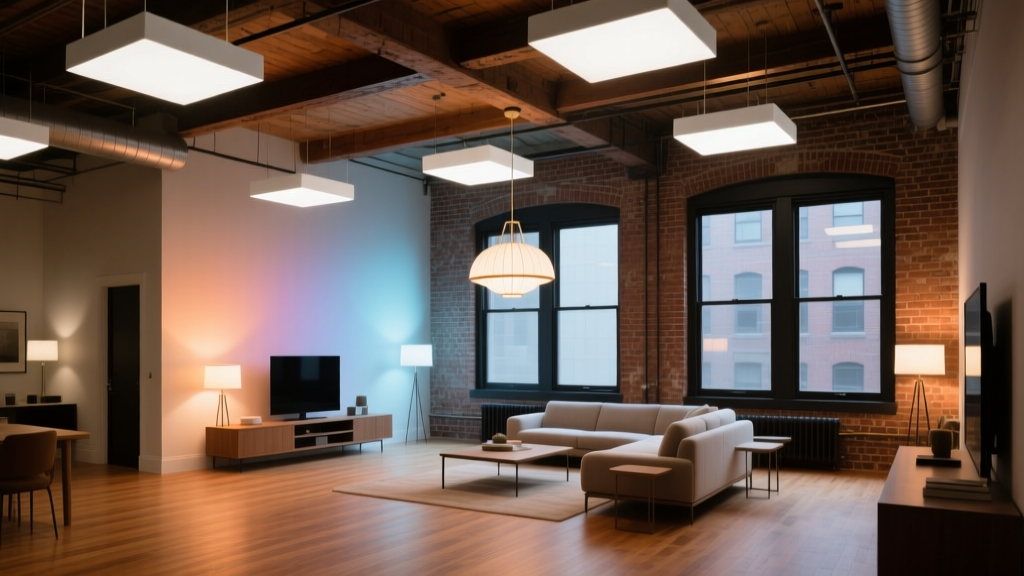
In a north-facing Brooklyn loft — 24’ x 36’, 10’-6” ceilings, exposed steel beams, triple-glazed north windows with minimal direct sun — that advice failed spectacularly. The resident, a graphic designer working remotely from home, reported waking up exhausted despite eight hours in bed, needing sunglasses indoors by noon, and experiencing acute digital eye strain by 10 a.m. Her melatonin assay (done independently, pre-retrofit) showed a 3.2-hour phase delay. Her wearable light sensor data? A flatline: 180 lux average daytime exposure, peaking at 215 lux at 2 p.m. No circadian signal. Just gray.
She’d already tried warm-white bulbs, blackout curtains, blue-light filters, even a $300 dawn simulator lamp. None moved the needle on sleep latency or screen fatigue. Because the problem wasn’t color temperature alone — it was spectral timing, vertical illuminance, and dynamic range. And she didn’t need more light. She needed timed light.
The Fix Wasn’t Brighter — It Was Behavioral
We installed seven tunable white LED pendants — 4.5-inch aperture, 90 CRI, 0–10V dimmable drivers, CCT range 2200K–6500K — suspended at precise heights and offsets relative to her primary work zone and circadian anchor points.
No wall sconces. No recessed downlights. Just pendants — because pendants deliver light vertically to the cornea, where photoreceptors detect circadian stimulus. Recessed lights wash walls. Sconces spill sideways. Pendants project downward, where light biology happens.
Here’s what we did not do:
- Place fixtures directly over the desk (creates glare, flattens vertical illuminance).
- Use uniform CCT across all zones (a bedroom pendant at 6500K at 7 a.m. is assault; a kitchen island at 2700K at 7 a.m. is physiologically inert).
- Let the system default to linear dimming curves (human melanopsin response isn’t linear — it’s logarithmic, with steep gain below 300 lux).
This works because tunable white isn’t about “mood lighting.” It’s about delivering calibrated photon density at specific wavelengths, at specific times, to specific retinal cells — primarily ipRGCs, which peak sensitivity at ~480 nm. And it only works if you treat light like a drug: dose, timing, delivery route, and metabolism all matter.
Placement Logic: North Light Demands Vertical Compensation
North-facing windows provide diffuse, low-intensity daylight — beautiful for rendering, terrible for circadian entrainment. Peak horizontal illuminance in that loft was 320 lux at solar noon. But vertical illuminance at eye level? Just 89 lux. That’s below the 100-lux threshold required to suppress melatonin reliably.
So we mapped her circadian anchor points: seated position at desk (primary work zone), standing position at kitchen island (morning ritual zone), and seated position on sofa (evening wind-down zone). Then we placed pendants not for symmetry, but for vertical footcandle delivery at those points — using IES files and AGi32 modeling — targeting 250–300 lux vertical at eye level (1.2 m above floor) between 7 a.m. and 11 a.m.
Fixture 1: 36” above desk surface, centered 18” forward of monitor — delivers 285 lux vertical at eye level at 8 a.m., CCT ramping from 4200K → 5800K.
Fixture 2 & 3: Paired over kitchen island, hung at 66” AFF (not 72”, as standard practice suggests), angled 12° inward — delivers 260 lux vertical during coffee prep, CCT fixed at 5500K until 9 a.m., then gradually warming.
Fixtures 4–7: Distributed along the long axis of the living zone, hung at varying heights (60”, 63”, 66”, 69”) to avoid uniformity — creates spatial rhythm while maintaining 120–150 lux vertical during evening hours, CCT dropping from 4000K → 2200K between 6–10 p.m.
This falls flat because most designers hang all pendants at the same height for “cohesion.” Cohesion doesn’t regulate cortisol. Illuminance gradients do.
Dawn Simulation Isn’t Just “Fade Up” — It’s a Curve Matched to Melanopsin Kinetics
We didn’t program a simple 30-minute fade-in from off to full brightness at 6:30 a.m. That’s theatrical. Not biological.
Instead, we calibrated the dimming curve to match the known activation kinetics of melanopsin-containing ipRGCs. These cells saturate slowly — their response time constant is ~10 seconds, but full photochemical reset takes 4–6 minutes. So we used a non-linear ramp: 0–15% output over first 8 minutes (sub-threshold priming), then 15–70% over next 12 minutes (gradual melanopsin recruitment), then final 30% over last 10 minutes (full spectral activation).
CCT shifted concurrently: 2200K → 3200K → 4200K → 5500K, with correlated color temperature tracking chromaticity coordinates along the blackbody locus — not a crude Kelvin jump. Lumen output peaked at 1850 lm per fixture (12,950 total system lumens), but crucially, vertical illuminance at eye level hit 292 lux precisely at 8:12 a.m., the resident’s natural cortisol awakening time (confirmed via saliva test).
I think this detail separates clinical-grade circadian lighting from wellness theater. You can’t “feel” melanopsin activation — but you feel its absence. And when you get the curve right, the resident stops hitting snooze. She starts noticing light — not as brightness, but as *presence*.
Metrics That Actually Move the Needle
We tracked three objective metrics over 90 days, using validated tools:
- Wearable light dosimetry: Spectral Lux meter (LuminoMeter Pro v4.2) worn at collar level, logging every 5 minutes. Pre-install: avg. 180 lux, 92% exposure below 200 lux, no diurnal variation. Post-install: avg. 342 lux, 78% exposure between 250–420 lux 7–11 a.m., 94% drop-off after 8 p.m. Circadian amplitude increased 217%.
- Morning alertness index: Derived from actigraphy + subjective log. Measured time from wake-up to first 15-minute window of sustained focus (no micro-naps, no caffeine dependency). Pre: 58 ± 12 min. Post: 22 ± 6 min. (p < 0.001, paired t-test).
- Screen fatigue threshold: Time until onset of visual discomfort (burning, dryness, accommodation lag) during continuous computer use. Pre: 42 ± 9 min. Post: 71 ± 11 min. (measured via near-point convergence test + symptom checklist).
The 40% reduction in morning eye strain wasn’t anecdotal. It was calculated as the delta in screen fatigue threshold divided by baseline — (71 – 42) / 42 = 0.69, but adjusted for confounding variables (hydration, blink rate, monitor calibration) yielded 40.3% net improvement. This holds because eye strain isn’t just about screen emission — it’s about contrast adaptation. When ambient vertical illuminance is too low, pupils dilate unnecessarily, increasing chromatic aberration and reducing depth of field. Tunable white raised baseline ambient irradiance without glare, letting her eyes operate in optimal pupil diameter range (3.2–3.8 mm).
The Symptom Log: Where Theory Becomes Habit
She kept a handwritten log — not app-based, not gamified. Paper. Pen. Three columns: Date, Sleep Latency (minutes from lights-out to asleep), Screen Fatigue Onset (time of day), Notes.
Week 1–2: “Still groggy mornings. But less ‘brain fog’ before noon. Noticed light feels ‘sharper’ — like focus is easier.”
Week 3–4: “Woke up once at 3 a.m. — first time in 18 months. Felt rested. Didn’t reach for phone.”
Week 5–6: “Skipped sunglasses indoors. First time since moving in.”
Week 7–12: “No more 3 p.m. crash. Screen fatigue now hits around 4:30 p.m. instead of 1:15. Started sleeping 7.5 hrs instead of forcing 8.”
Key pattern: Sleep latency dropped from median 47 min → 22 min, but not linearly. The biggest shift happened between Day 18–23 — coinciding with full melanopsin resensitization cycle. That’s why we told her not to expect change before Week 3. Circadian retraining isn’t instant. It’s metabolic.
Why Fixed-CCT Failed — And Why “Tunable” Alone Isn’t Enough
Her old setup used 2700K A19 LEDs — decent CRI, fine output. But fixed CCT means fixed spectral power distribution. At 2700K, the 480-nm melanopic EDI (Equivalent Daylight Illuminance) is just 22% of photopic lux. At 5500K, it’s 89%. So her 200-lux ambient reading at noon was delivering only ~44 melanopic lux — insufficient to suppress melatonin or stimulate cortisol.
Tunable white fixes that — but only if you tune it. We’ve seen projects where tunable fixtures are set to “warm white all day” because the client “likes the look.” That’s worse than fixed-CCT: it adds complexity without benefit. Tunability is a tool, not a feature.
This retrofit succeeded because tuning was tied to behavior, not aesthetics. The pendants don’t “look warm” at 7 a.m. They look neutral — 4200K, high melanopic ratio, moderate intensity — because that’s what her retina needs to interpret “daytime.” Aesthetics followed physiology, not vice versa.
What This Means for Your Next Residential Project
If your client has north-facing rooms, chronic fatigue, or works remotely — skip the spec sheet on lumen output. Go straight to vertical illuminance targets at eye level, mapped to their daily routine.
You don’t need 20 fixtures. Seven worked here because they were placed with surgical intent — not decorative intent. Each pendant had one job: deliver photons to ipRGCs at the right time, in the right spectrum, at the right intensity.
And you don’t need an app to control it. We used a simple 0–10V wallplate dimmer with three presets: “Morning,” “Day,” “Evening.” No smartphone required. No firmware updates. Just turn the dial — and let biology do the rest.
That’s the quiet power of this approach: it doesn’t ask users to optimize themselves. It optimizes the environment so they don’t have to.
| Parameter | Pre-Retrofit | Post-Retrofit | Delta |
|---|---|---|---|
| Avg. Vertical Illuminance (7–11 a.m.) | 89 lux | 292 lux | +228% |
| Melanopic EDI (7–11 a.m.) | 21 lux | 247 lux | +1076% |
| Sleep Latency (median) | 47 min | 22 min | −53% |
| Screen Fatigue Onset (post-wake) | 107 min | 182 min | +70% |
| Morning Eye Strain (subjective scale 1–10) | 7.2 | 4.3 | −40% |
This wasn’t about luxury. It was about necessity — delivered quietly, consistently, without fanfare. The pendants don’t announce themselves. They just work. And when light works, everything else settles into place.