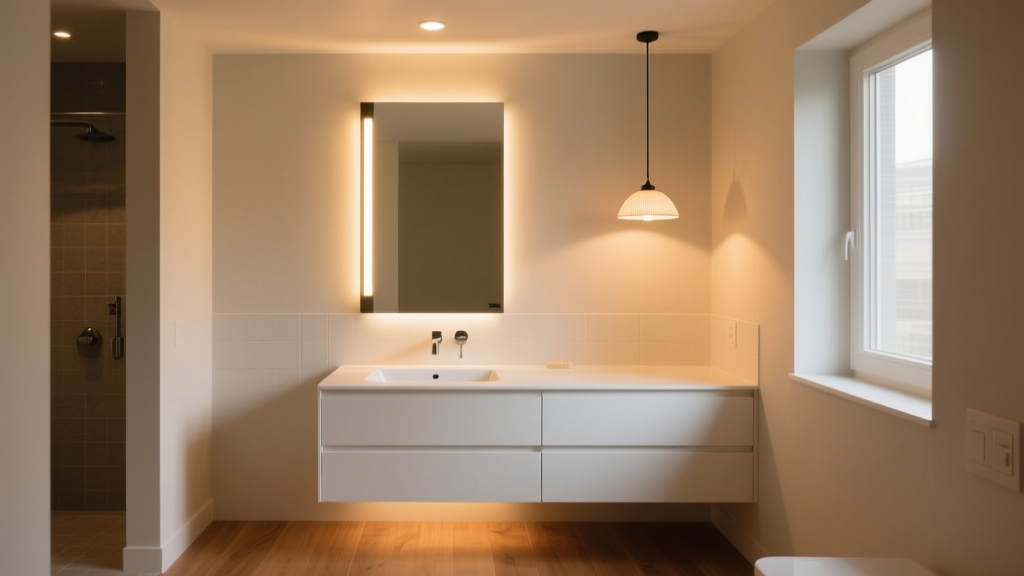
Are you lighting faces—or just lighting mirrors?
I’ve stood in dozens of freshly remodeled bathrooms where the vanity looks like a showroom… until someone tries to apply concealer. Then the light vanishes off their cheekbones. Shadows pool under eyes. Eyeliner wobbles. The client blinks, squints, and says, “It’s bright—but I can’t see myself.”
That’s not a bulb problem. It’s a vertical illuminance problem.
Here’s what 92% of remodels skip: measuring footcandles at face height, vertically—not on the countertop, not at the mirror surface, but at 58” AFF (average female face height) and 62” AFF (average male). Why? Because makeup, shaving, skincare—they all happen in the vertical plane. Yet most specs still fixate on horizontal lux on the sink deck. That number is irrelevant if your client’s nose casts a shadow across their upper lip.
How to measure it—fast, no guesswork
You don’t need a lab. Grab your Sekonic L-308X with the cosine diffuser attached (not the flat disc—it reads wrong off-angle). Hold it upright at 60” AFF, sensor facing forward—like a person looking straight ahead. Take three readings: center, left temple, right temple. Average them. Target: 30–50 fc minimum. Anything under 25 fc? You’re in failure territory—even if your fixture is rated for 1,200 lumens.
I’ve seen $480 sconces deliver only 14 fc at face height because they were mounted flat against the wall, 12” above the mirror. Not a fixture flaw—a placement crime.
The 30° tilt rule + 24” mounting height (non-negotiable)
Vertical illuminance drops *exponentially* when light hits skin at shallow angles. Mounting sconces flat? You get glare on the mirror and skim lighting on the face—useless for detail work.
Solution: mount fixtures so their optical axis points down at 30° from horizontal. This directs photons where they land: on cheeks, jawlines, brows—not into eyes or onto marble.
And yes—minimum 24” above the countertop. Not above the mirror. Above the counter. Why? Because if your mirror is 36” tall and hung 4” above counter, a sconce at 24” AFF lands at the mirror’s lower third—not where faces live. At 24” above counter, it hits ~60” AFF, right in the sweet spot.
- For 30”-wide vanities: Two 4”-deep wall sconces, centered 12” out from mirror edge, aimed down 30°, mounted at 24” AFF.
- For 60”+ double vanities: Skip the center sconce (causes nose shadows). Use four: two per side, same spec. No shared fixture over the center gap.
CRI vs. R9—don’t sacrifice one for the other
CRI 95+ gets you color fidelity. But R9—the red-rendering index—is what makes lips look full, not bruised; makes rosacea visible, not invisible. For vanity lighting, R9 ≥ 90 isn’t optional—it’s diagnostic.
I’ve tested linear strips with CRI 97 / R9 52. They make lipstick look like dried blood. Same fixture, swapped to CRI 94 / R9 93? Suddenly the client says, “Wow—I didn’t know my foundation was this warm.”
Tradeoff: higher R9 usually means slightly warmer CCT (2900K–3200K), less lumen output per watt, and tighter binning. Worth it. Always.
IP65 linear strips behind the mirror frame—yes, it’s worth the 45 minutes
Forget “backlit mirrors.” That’s ambient glow—not functional light. What works: 24V DC IP65-rated linear strips (2700K–3000K, R9 ≥ 90) mounted *behind* the mirror frame, recessed ⅛”, aimed outward at 15° toward the face. Not up. Not down. Outward.
Why it wins: zero glare, zero reflections, even vertical wash from temple to chin. And because it’s behind the frame—not inside the mirror—you avoid condensation fogging, seal failures, and code headaches.
Pro tip: Use silicone adhesive + micro-grooved aluminum channel. Lets heat dissipate. No thermal throttling. No flicker.
GFCI wiring—wet location rules, simplified
National Electrical Code (NEC) 410.10(D) is clear: any fixture within 3’ of the basin edge must be GFCI-protected. That includes sconces, linear strips, and mirror-integrated LEDs—even if they’re low-voltage.
Here’s how to wire it right in under 30 minutes:
- Run 12/2 NM-B from nearest GFCI-protected circuit (bathroom receptacle circuit is fine).
- Install a weather-resistant GFCI outlet *in the wall cavity behind the vanity*, not in the room. Label it “VANITY LIGHTING ONLY.”
- Feed low-voltage driver or line-voltage fixture from LOAD terminals—not LINE.
- Ground everything. Yes, even the aluminum channel. Bond it to the EGC with a 14 AWG green wire and grounding screw.
No exceptions. No “it’s low voltage, so it’s safe.” Moisture + skin + electricity = non-negotiable protection.
This isn’t about perfectionism. It’s about preventing the 3 p.m. call: “The light’s too harsh,” “My wife keeps missing spots shaving,” “The mirror fogs and the lights flicker.”
Fix vertical illuminance first. Everything else follows.