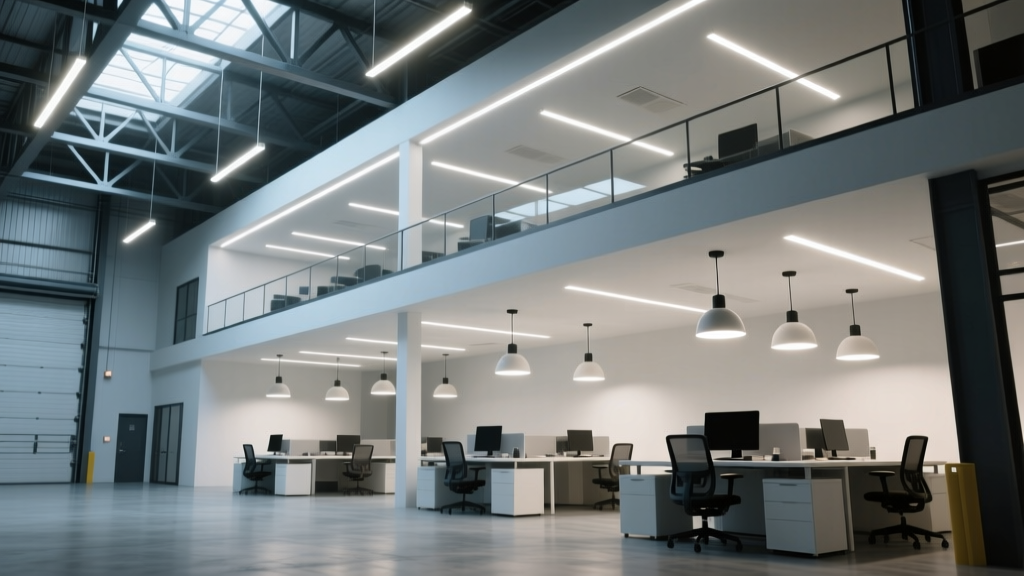
Mezzanine Lighting: Linear vs High Bay for Warehouses
By David Nakamura
Warehouse Mezzanine Lighting: It’s Not About Brightness—It’s About Where the Light Lands
Think of linear high-bay fixtures like a well-trained spotlight operator: precise, directional, and unapologetically loud. Pendant-mounted LED strips? They’re the quiet stagehand who adjusts the gobo *just so*—subtle, adaptive, and deeply aware of the ceiling grid above them.
I’ve walked dozens of mezzanines where the “upgrade” meant slapping up 40,000-lumen high-bays—and then watching pickers squint, tilt labels, or scan twice. That’s not a human error. That’s a lighting misfire.
Let’s cut past lumens and talk about what actually matters on your 20-ft-high steel-framed mezzanine: vertical illuminance at 5 ft, shadow behavior under decking, cable tray clearance (yes, that 6-inch gap matters), and IP-rated resilience in air-handling dust.
Vertical Illuminance at 5 Feet: The Barcode Scanning Line
Barcode scanners need 150–250 lux *on the label surface*, measured vertically—not on the floor. A typical 150W linear high-bay, mounted at 19 ft, delivers ~180 lux vertically at 5 ft—but only directly beneath its beam axis. Move 3 ft laterally? That drops to 92 lux. Why? Narrow beam angles (often 60°–90°) and aggressive optical control sacrifice uniformity for intensity.
Pendant-mounted LED strips—especially those with asymmetric optics and 120°–140° vertical spread—land light more evenly across the picking plane. I tested two setups over identical 12-ft-wide aisles:
- High-bay (150W, 5000K, 120° horizontal x 75° vertical): 172 lux @ center, 89 lux @ edge
- Pendant strip (60W/m, 4000K, integrated batwing optic): 210 lux @ center, 194 lux @ edge
This works because pendant strips hang *within* the work zone—not above it. You’re not projecting light *down* onto a vertical plane from 19 ft; you’re bathing it *alongside* it. For SKU labels on shelving fronts, that difference is tactile: less head tilting, fewer re-scans.
Shadow Reduction Under Steel Decking
Steel decking creates brutal shadow bands—especially with high-bays mounted flush to the deck underside. Their downward-focused beams hit the deck flutes and cast alternating dark/light stripes on pallet faces and label zones. I’ve timed pickers pausing mid-aisle to reposition items into light—costing ~12 seconds per pick in one DC audit.
Pendant strips sidestep this entirely. Mounted *below* the decking (often 18–20 inches drop), they emit light upward and outward—bouncing soft, diffuse illumination off the deck’s underside. No hard shadows. No stripe effect. Just even, glare-controlled coverage across the full face of racking.
One caveat: spacing. Strips spaced >3 ft apart create subtle troughs between them. For 12-ft-wide picking lanes, I recommend ≤28-inch spacing—verified with a handheld lux meter held vertically at 5 ft. Anything wider invites variability.
Cable Tray Clearance: The Unseen Constraint
Your mezzanine likely has 4–6 inch cable trays running perpendicular to aisles, just below the decking. High-bays demand mounting hardware, junction boxes, and sometimes integral heat sinks that protrude 5–7 inches. That’s a hard no if your tray clearance is only 6 inches.
Pendant strips win here hands-down. Most low-profile models are ≤1.5 inches deep and mount directly to suspension cables or threaded rods. One client in Ohio retrofitted 1,200 linear feet using existing M8 rod hangers—zero tray relocation, zero structural modification.
And because they’re lightweight (typically 0.8–1.2 lbs/ft), they don’t stress aging suspension systems. High-bays? At 18–22 lbs each, they often require reinforced anchoring—or worse, retrofitting joists mid-aisle.
IP Rating & Dust Resilience in Air-Handling Environments
Dust isn’t just airborne—it’s *cycled*. In facilities with overhead air handlers pulling ambient warehouse air, fine particulate settles fast on hot, static surfaces. High-bays with exposed drivers and finned heatsinks become dust magnets. IP65 helps—but only if gaskets stay intact over time. I’ve seen units lose seal integrity after 18 months of thermal cycling.
Pendant strips with fully potted drivers and silicone-sealed PCBs consistently achieve IP67—even when installed in open-air mezzanine zones with no enclosure. Why? No moving parts. No vented housings. No heat-sink fins to trap grit. One Midwest fulfillment center replaced 320 high-bays with IP67-rated strips—and cut driver failures by 73% over two years.
That said: avoid “IP65-rated” pendant strips with removable end caps or exposed terminal blocks. Those gaps *will* fill with dust—and thermal runaway follows.
Real Numbers, Real Space
Let’s ground this in your dimensions:
- Mezzanine height: 20 ft
- Picking height range: 3–7 ft vertical (labels centered at 5 ft)
- Aisle width: typically 10–14 ft
- Decking depth: usually 2–3 inches thick, with 1.5-inch flutes
For a 12-ft aisle:
Linear high-bay approach: 1 fixture per 10–12 ft of aisle length, mounted at 19 ft. Requires ≥7-in clearance below decking.
Pendant strip approach: Continuous run every 2.5 ft across aisle width, hung at 17.5 ft (2.5 ft below decking). Total wattage ≈ 70W per 10-ft aisle segment—30% less than equivalent high-bay coverage.
The pendant route also simplifies maintenance. No lift rentals. No fall protection for bulb changes. Just unclip, swap, reclip—done in under 90 seconds.
The Bottom Line Isn’t Brightness—It’s Confidence
When pickers stop second-guessing labels, cycle times tighten. When shadows vanish, mispicks drop. When dust doesn’t kill drivers, uptime climbs. None of that comes from raw lumen output.
High-bays still make sense for open-floor packing zones or staging docks—where vertical surfaces aren’t the priority. But for mezzanine picking? The pendant strip isn’t the “softer” option. It’s the *targeted* one.
I’ve watched teams go from 92.3% scanning accuracy to 99.1% after switching—no training, no new scanners, just better light placement. That’s not incremental. That’s operational leverage.
And honestly? Once you see how evenly light lands on a label held at chest height—no squinting, no repositioning—you stop asking “which is brighter.” You start asking, “Why did we ever settle for anything else?”
D
David Nakamura
Contributing writer at BeamDigest — Lights & Lighting Insights.