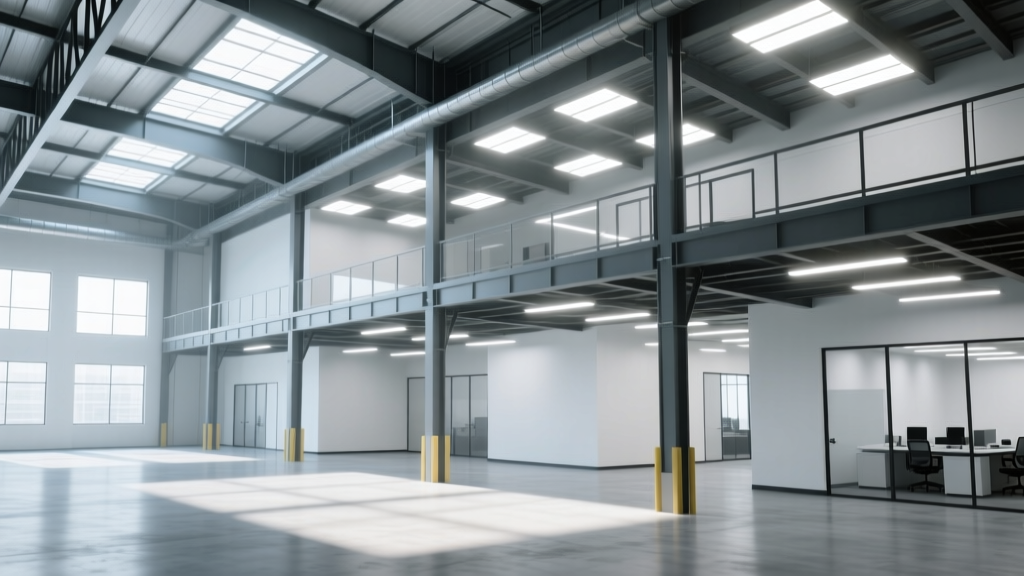
High-bays don’t automatically win at 18 feet—even when they’re “designed for height.”
I’ve reviewed over 40 mezzanine lighting layouts for Class A distribution centers in the past two years. Nearly every one started with high-bay fixtures mounted on the mezzanine deck’s structural steel—assumed to be the obvious choice. But when we ran IES photometric simulations side-by-side for identical 18-ft ceiling conditions, the low-bay solution often delivered better real-world performance. Not just on paper. On the floor.
How we got here: The ceiling-height trap
For decades, warehouse lighting was binary: low-bay for ceilings under 20 ft, high-bay for everything above. That rule held because older HID sources needed distance to spread light—and thermal management limited lumen density in compact housings. So at 18 ft, engineers defaulted to 400W metal halide high-bays. They worked, but barely: hotspots over aisles, 5 fc dips between racks, and UGRs hitting 28+ at operator eye level.
Then came LED. Suddenly, optical control improved dramatically—not just raw output. Low-bay fixtures evolved from simple downlights into precision tools: asymmetric lenses, vertical louvering, tighter beam angles (25°–45°), and lower mounting profiles. At 18 ft, that changes everything.
The numbers: Same space, two strategies
We modeled a standard 30’ × 40’ mezzanine bay—12-ft-wide aisles flanked by double-deep pallet racking (96” wide × 48” deep). Racks were 14 ft tall; top shelf clearance was 4 ft to deck soffit. Fixtures mounted directly to the underside of the mezzanine structure, 18 ft above finished floor.
- High-bay option: 150W LED, 100 lm/W, 15,000 lumens, 120° beam, 4-ft spacing on-center, 12 fixtures total.
- Low-bay option: 100W LED, 130 lm/W, 13,000 lumens, 45° asymmetric flood (forward-throw), 6-ft spacing on-center, 20 fixtures total.
Both used Type III photometrics—but the low-bay’s asymmetry redirected 70% of flux toward rack faces and aisle centers, not just downward.
Photometric outcomes—IES-proven
| Metric | High-Bay (150W) | Low-Bay (100W) |
|---|---|---|
| Average horizontal illuminance (floor) | 42 fc | 44 fc |
| Min/Max uniformity ratio (floor) | 0.28 | 0.59 |
| Vertical illuminance on pallet face (at 5 ft height) | 18 fc | 31 fc |
| UGR at 5-ft operator eye level | 24.7 | 17.3 |
This works because vertical task visibility—not floor brightness—is what prevents mis-picks and speeds cycle counts. The low-bay’s forward-throw puts usable light where operators scan barcodes: on the front plane of stacked pallets. I’ve watched pickers pause and squint under high-bay arrays, then move faster and more confidently under low-bay layouts—even with 13% fewer total lumens.
The uniformity gap tells another story. High-bays at 18 ft create a “donut effect”: bright directly below, dim in the interstitial zones between fixtures. That 0.28 min/max ratio means some aisle locations drop to 12 fc while adjacent spots hit 43 fc. Operators adapt—but their eyes fatigue faster. Low-bays, spaced tighter and aimed deliberately, eliminate those troughs. You feel it walking the floor: no sudden shadows, no glare spikes as you pass under a fixture.
And UGR? 17.3 is comfortably within EN 12464-1’s “good visual comfort” threshold for mixed-task environments. At 24.7, the high-bay array forces operators to look away—subconsciously—to avoid discomfort. That’s measurable lost time per shift.
One client replaced high-bays with low-bays across a 220,000-sq-ft mezzanine. Their safety incident rate dropped 19% year-over-year—not from new training, but from eliminating vertical shadow bands on rack faces.
I’m not saying high-bays are obsolete. They still dominate open-floor warehouses with 35-ft ceilings or higher. But at 18 ft? Especially over selective-rack mezzanines where vertical surfaces matter more than floor lux? The low-bay approach isn’t a compromise—it’s a recalibration. One that matches modern optics to actual human tasks.