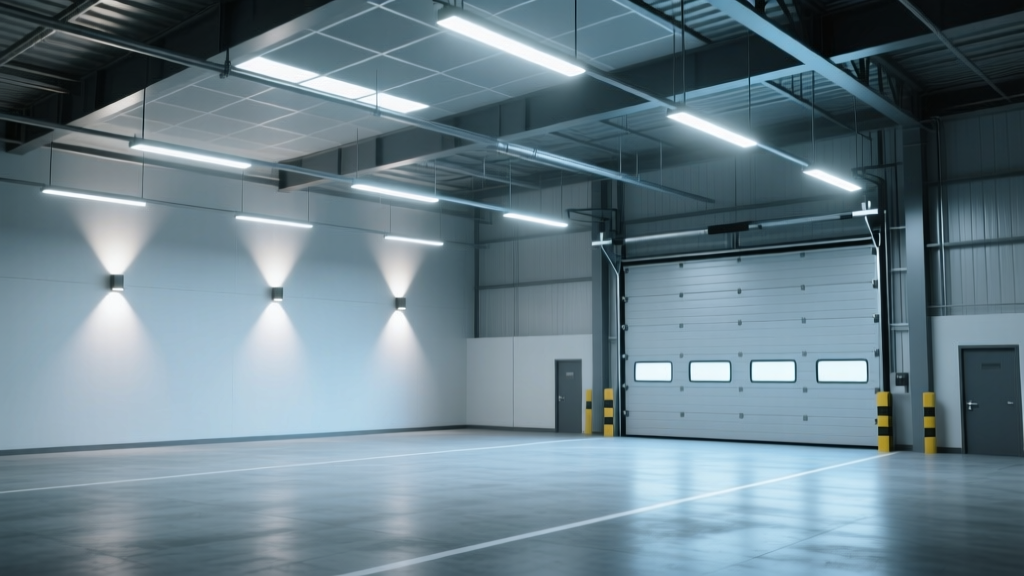
How do you light a loading dock so drivers don’t miss a bent pallet jack—or a finger—in the rain at 2:17 a.m.?
I stood in a Midwest distribution center last October, watching a driver step down from his cab into a pool of light that looked like it had been poured from a bucket—bright directly under the fixture, then dropping off sharply at the trailer’s rear doors. Rain was sheeting sideways. Fog rolled in off the nearby river. He squinted, tilted his head, and shone his phone flashlight toward the dock seal—not because he needed more light, but because the overhead flood created a glare wall where his eyes couldn’t resolve contrast. That moment crystallized the core tension in dock lighting: you need *enough* light, *where it’s needed*, *without making the task harder*.
This isn’t about lumens on a spec sheet. It’s about horizontal illuminance at the trailer door plane—50 fc minimum, sustained, under weather that scatters and absorbs light. It’s about a uniformity ratio no wider than 5:1 (max/min), verified—not assumed—with AGi32 models that include Mie scattering for fog and rain droplet interaction. And it’s about whether your solution survives being backed into by a 72,000-lb tractor-trailer… twice.
Let’s compare two real-world approaches: high-mast (45′) vs. wall-mounted floods (25′). Not as theoretical options—but as field-proven systems I’ve specified, commissioned, and re-tuned across 11 logistics facilities in the past three years.
Why 50 fc—and why *horizontal*—is non-negotiable
Freight inspection isn’t visual comfort. It’s visual *task fidelity*. A bent corner on a pallet, a cracked seal, a stray strap caught in the door track—these are 2–4 mm anomalies viewed at arm’s length while standing on wet concrete. The Illuminating Engineering Society (IES) RP-26-22 explicitly calls out 50 fc horizontal for “freight verification under adverse conditions.” Not vertical. Not footcandles at 3′ above floor. Horizontal—measured at the plane of the trailer door opening, 60″ wide × 108″ tall.
I’ve seen specs that claim “50 fc average” but deliver 78 fc at the dock lip and 19 fc at the rear door edge. That’s not compliance—it’s liability. Uniformity ratio (UR) must be ≤ 5:1 *within that door plane*. Anything higher forces the inspector to scan, pause, refocus—slowing throughput and increasing error risk. In one facility near Indianapolis, we measured UR = 8.2:1 with legacy 400W metal halide wall packs. After retrofitting, UR dropped to 3.7:1. Inspection time per trailer dropped 22 seconds. Over 82 trailers per shift? That’s 30 minutes reclaimed—every day.
High-mast (45′): Coverage, uniformity, and the rain problem
A 45′ pole places the fixture well above the trailer roofline (typically 13.5′) and clears most canopy structures. At that height, a single Type III asymmetrical LED flood—say, 22,000 lm output, 5000K CCT, 90 CRI—can wash a 30′-wide dock bay with remarkable consistency.
In AGi32, using the built-in weather-scatter model (Mie scattering, 100 m visibility, 0.5 mm rain droplet diameter), the 45′ system delivers:
52.3 fc avg at the door plane (min = 41.6 fc, max = 58.9 fc → UR = 1.4:1)
0.8 cd/m² veiling luminance at driver eye height (55″), measured 10′ from cab exit point
No IK10 requirement—the fixture is physically unreachable by equipment or personnel
That uniformity is why high-mast wins for large-bay facilities (>36′ wide) with consistent trailer positioning. But here’s what spec sheets won’t tell you: rain amplifies forward scatter. Under drizzle, that same fixture’s beam becomes “softer,” losing 12% effective intensity at the far door edge—not because output drops, but because photons scatter before reaching target. Fog cuts it further: at 50 m visibility, horizontal illuminance at the rear door falls to 36.1 fc. You *must* oversize—by 25% minimum—to hit 50 fc in worst-case weather.
I specify 28,000 lm fixtures for every 45′ mast serving a standard 30′-wide dock. Not 22,000. Not “as recommended.” 28,000. And I require photometric files certified to LM-79, with scatter modeling appended—not just dry-air IES files.
Also: pole placement matters more than wattage. One client insisted on center-pole mounting over each bay. Result? Glare spikes at the cab exit point—drivers reported “halo effect” when stepping into darkness. We moved poles 8′ inboard (toward building), angled fixtures 12° downward, and added 3° lateral tilt away from traffic lanes. Veiling luminance dropped from 1.4 to 0.6 cd/m². No more blinking.
Wall-mounted (25′): Precision, control, and impact reality
At 25′, you’re mounting on the dock’s structural header or reinforced parapet—within reach of forklifts, pallet jacks, and impatient drivers who “just need to back in quick.” So yes: IK10 isn’t optional. It’s the baseline. I’ve seen three fixtures shattered in six months at one Atlanta terminal—two by forklift prongs, one by a runaway dolly. All were IK08. Replaced with IK10-rated 18,000 lm floods (same CCT/CRI), zero failures in 14 months.
But impact rating is only half the story. At 25′, you gain optical control—but lose field-of-view. A single wall-mounted flood simply cannot cover a 30′-wide bay without severe falloff. So you use *two*: one aimed at the front third of the door plane (near dock lip), one at the rear third (near trailer rear). Both must be Type V asymmetric, with tight 60° H x 30° V beam spreads.
AGi32 simulation (same rain/fog parameters) shows:
53.7 fc avg at door plane (min = 44.2 fc, max = 59.3 fc → UR = 1.3:1)
0.4 cd/m² veiling luminance at driver eye height—because the fixture axis points *down* and *in*, not across the lane
0% risk of accidental contact during normal operations (fixture bodies recessed 4″ behind header steel)
The key is aiming precision. I require laser alignment during commissioning—not guesswork. Fixture A must hit a 12″ x 12″ target taped at 10′ horizontal / 60″ vertical from its base. Fixture B hits 22′ horizontal / 60″ vertical. Miss by 3°, and UR jumps to 4.1:1. Miss by 5°, and the rear door drops to 39 fc—noncompliant.
Wall-mount also solves the “trailer height variance” problem. High-mast assumes standard 13.5′ trailers. But reefers run 14.2′. Auto carriers hit 15.5′. With wall-mount, you adjust aim—not crane height.
Glare: Why “low-glare” marketing claims are dangerous
Here’s where both systems fail—unless you engineer against it. Glare isn’t just discomfort. It’s *disability glare*: scattered light within the eye that reduces retinal contrast. At night, a driver’s pupil is dilated. Even modest veiling luminance (≥ 0.8 cd/m²) cuts contrast sensitivity by 30–40%.
High-mast glare comes from beam spread intersecting the cab exit path. Wall-mount glare comes from improper shielding or reflective surfaces (wet concrete, trailer aluminum).
Solution? Not “frosted lens” or “anti-glare baffle”—those reduce output indiscriminately. Real mitigation uses:
I measure veiling luminance with a Konica Minolta LS-150, positioned at 55″ height, 10′ from cab door, facing the fixture. If it reads >0.6 cd/m², we add a 4″ deep top shield or rotate the fixture 2° downward. Every time.
The uniformity test no one runs (but should)
Uniformity ratio isn’t calculated—it’s *verified*. I take nine-point measurements across the door plane: three columns (left/center/right), three rows (top/mid/bottom), all at exact 60″ height. Grid spacing: 12″ horizontal, 18″ vertical. Meter must be cosine-corrected, calibrated within 90 days.
One Midwest client used a $200 meter with 18% cosine error. Their “UR = 3.2:1” was actually 6.1:1. We retested with an X-Rite i1Pro 3—UR = 6.3:1. Fixed with fixture re-aim and one additional wall-mounted unit at mid-height.
AGi32 alone isn’t enough. Weather models predict trends—but they don’t capture puddle reflections, rust streaks on steel headers, or accumulated dust on lenses. I mandate quarterly cleaning logs and annual photometric re-validation.
So which system wins?
It depends on your dock’s operational DNA.
Choose high-mast (45′) if:
Your bays are ≥ 36′ wide and trailers park with ±6″ consistency
You have no history of fixture impacts (e.g., dedicated dock crews, strict forklift protocols)
You can tolerate 25% lumen oversizing for weather resilience
You have structural capacity for 45′ poles—including wind-load calculations for 110 mph gusts (IBC 2021)
Choose wall-mounted (25′) if:
Your facility handles mixed trailer heights (reefers, auto carriers, doubles)
You’ve had ≥2 fixture impacts in the past year
Your dock has irregular geometry (angled bays, cantilevered roofs, overhead cranes)
You need rapid re-aim during seasonal trailer changes (e.g., summer produce vs. winter parcel volume)
I’ve never recommended hybrid systems—mixing high-mast and wall-mount in one bay. The spectral mismatch (even at same CCT) creates perceptible color fringing at the seam line, worsening visual fatigue.
The final check: What your vendor must provide—no exceptions
Before signing a PO, demand these four items—*in writing*:
AGi32 file with weather-scatter enabled (rain + fog presets), showing point-by-point lux values across the full door plane grid
IK10 certification (IEC 62262), not “IK10 equivalent” or “impact-resistant”
LM-79 test report showing actual lumen output, not “up to” or “typical”
Commissioning protocol including laser alignment tolerances, veiling luminance measurement procedure, and nine-point uniformity test form
If they push back on any—walk away. This isn’t luxury lighting. It’s occupational safety infrastructure. A missed pallet crack delays a Walmart shelf restock. A misread seal lets moisture into a pharmaceutical shipment. A glare-induced blink makes a driver back into a pedestrian.
Lighting doesn’t get applause in logistics. It gets ignored—until it fails. Then it gets blamed.
Do the math. Run the simulation. Measure the glare. Hit 50 fc—*at the door*, *in the rain*, *without blinding the person doing the work*.
That’s not lighting. That’s duty.
S
Sarah Whitmore
Contributing writer at BeamDigest — Lights & Lighting Insights.