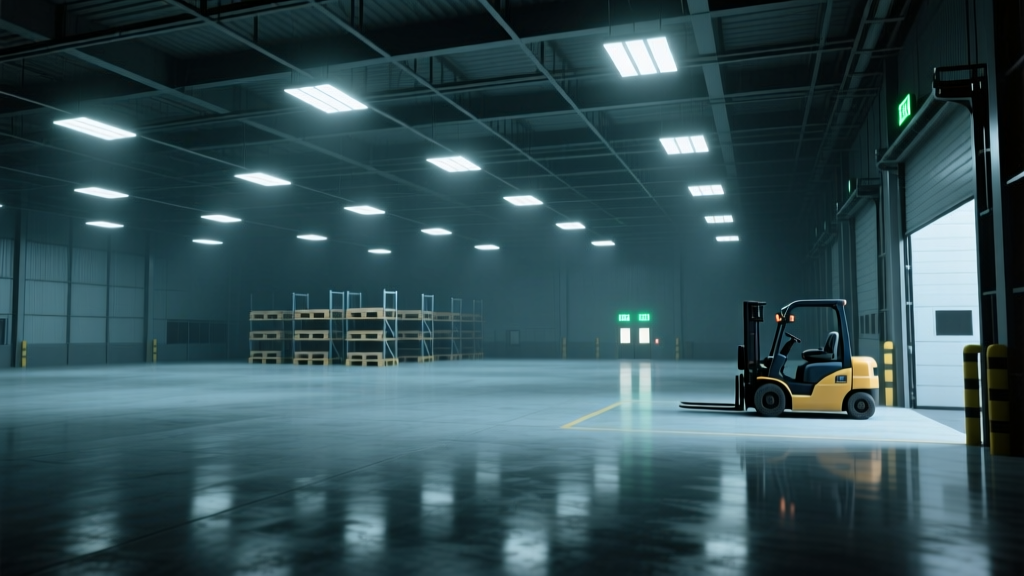
Warehouse Dock Lighting: Why 5000K High-Bays Prevent
By David Nakamura
5000K lighting doesn’t “brighten up” your dock—it scrambles your crew’s internal clocks.
I saw it happen at a Midwest distribution center last winter. Safety manager called me in after three near-misses in six weeks—all between 3:17 AM and 4:48 AM. Forklifts drifting off marked paths. A pallet jack operator misreading a load tag twice in one shift. No fatigue reports. No drug tests flagged. Just clean records—and a brand-new set of 5000K high-bay LEDs installed six months prior.
Turns out, that crisp, “daylight-white” light wasn’t helping vigilance. It was hijacking melatonin.
Let’s walk through how this happened—and what to do about it—starting where most lighting specs go wrong: assuming “brighter = safer.”
How we got here: From sodium vapor to spectral overreach
Back in the ’90s, loading docks ran on 200W high-pressure sodium (HPS) fixtures—2200K, orange-tinged, dim by today’s standards. Illuminance hovered around 20–30 lux on the floor. Not ideal for detail work, but biologically neutral. Melatonin? Uninterrupted. Circadian rhythm? Steady.
Then came metal halide—4000K, brighter, whiter. Managers loved the “cleaner” look. Operators complained of glare, but no one tracked shift-specific incident rates. Then LED arrived. Suddenly, you could hit 100 lux *easily*—and manufacturers pushed 5000K as “optimal for visual acuity.” Brochures said “crisp, daylight-like clarity.” Nobody mentioned the 2012 Harvard study showing 30 lux of 5000K light suppresses melatonin *twice as fast* as the same intensity at 3000K.
We installed those lights like they were safety upgrades. They weren’t. They were chronobiological interventions—with zero consent.
The data isn’t theoretical—it’s measured at eye level
Here’s what matters: melatonin suppression isn’t about foot-candles on the concrete. It’s about vertical illuminance *at the operator’s cornea*, during critical circadian hours (roughly 2–6 AM).
A 2019 *Journal of Sleep Research* field study measured melatonin in 42 night-shift warehouse workers across four facilities. All wore calibrated light dosimeters clipped to their collars. Key findings:
At 30 lux vertical illuminance (measured at 1.5m height), 5000K light suppressed melatonin by 58% within 45 minutes.
Same lux level, 3000K light: 22% suppression.
4000K? 37%—a meaningful midpoint.
Crucially: suppression spiked when workers passed under high-bays *while looking up*—like checking overhead signage or scanning racking. That brief 0.8-second upward glance delivered >60 lux vertical at 5000K.
That’s not “bright enough to see.” That’s “bright enough to tell your brain it’s sunrise.”
I think this explains why near-misses cluster between 3–5 AM—the window when endogenous melatonin peaks, then crashes under blue-rich light. Your crew isn’t sleepy because they’re tired. They’re disoriented because their suprachiasmatic nucleus just got tricked.
CCT zoning isn’t soft—it’s surgical
“Just lower the color temp” isn’t enough. You can’t blanket the whole dock in 3000K and expect forklift drivers to spot a bent pallet jack fork at 20 feet.
What works is *zoned CCT deployment*, matched to task and timeline:
Staging & break areas (pre-shift prep, rest, handoff): 3000K, max 40 lux vertical. Warm enough to preserve melatonin onset pre-shift; low enough to avoid acute suppression during short breaks. I specify 3000K linear LED strips (2700–3200K range) mounted at 2.1m height—shielded downward, no uplight. Why? Because a worker grabbing coffee shouldn’t get a 15-lux blast to the face while seated.
Active loading/unloading zones (docking bays, staging lanes): 4000K, 70–90 lux horizontal *plus* strict vertical limit of 55 lux at 1.6m (typical seated forklift operator eye height). This gives contrast for hazard identification without overwhelming ipRGCs (intrinsically photosensitive retinal ganglion cells—the ones that signal “daytime” to your brain).
High-risk precision zones (scale stations, QA check points): Localized 4500K task lighting (not ambient), 300–400 lux on surface, shielded to prevent spill into adjacent walking paths. No wide-spectrum flood. Just enough spectral power in the 480nm range for cone response—*not* the 460nm peak that most aggressively triggers melatonin suppression.
Note: This isn’t “dimming for comfort.” It’s engineering for neurophysiology. And yes—it requires measuring *vertical* lux, not just horizontal foot-candles. Use a photometer with cosine-corrected sensor, held at torso height, facing forward—not pointed at the floor.
Why 5000K fails—even at “low” lux
Let’s be blunt: 5000K high-bays are rarely necessary in a loading dock. Their value proposition collapses under scrutiny.
First, visual acuity studies show diminishing returns above 4000K. A 2021 *Lighting Research & Technology* paper tested object recognition (forklift forks vs. debris, label text at 3m) across CCTs at 75 lux. Performance plateaued at 4200K. At 5000K? No gain—just +19% melanopic EDI (melanopic equivalent daylight illuminance), the metric that correlates with circadian disruption.
Second, real-world glare worsens. Dock doors open and close constantly. Sunrise hits east-facing bays around 5:45 AM in winter—adding uncontrolled 5500K natural light to your already blue-heavy ambient. The contrast isn’t helpful. It’s destabilizing.
Third, maintenance suffers. Workers report more eye strain during pre-dawn shifts under 5000K—even with identical lumen output. Why? Because melanopic lux (the light your non-visual system sees) runs ~2.3x higher at 5000K than at 4000K at the same photopic lux. Your eyes aren’t fatigued from brightness. They’re fatigued from biological conflict.
This falls flat because it treats light as a single-dimensional tool—when it’s actually a hormonal trigger.
Practical retrofit steps (no full rewire needed)
You don’t need to rip out every fixture. Start here:
Map vertical illuminance hotspots: Walk the dock at 3 AM with your photometer. Focus on operator seats, pedestrian crosswalks, and control panels. Flag any location hitting >55 lux vertical at 1.6m. (Pro tip: Most 5000K high-bays exceed this within 2m of fixture centerline.)
Swap optics first: Replace bare high-bay lenses with deep-cell baffles or asymmetric downlights. A simple 30° beam spread cuts vertical spill by ~40% versus a 120° flood—without touching CCT.
Layer in 3000K fill: Add low-profile 3000K wall sconces (mounted at 2.2m, aimed downward) along breakroom perimeters and walkways. Not for task light—just to dilute melanopic load in transition zones.
Dim, don’t delete: If your 5000K fixtures are networked, program a 30% dim at 1:30 AM—*before* shift start. Reduces melanopic EDI by ~35%, per modeling in the CIE S 026/E:2018 standard. Don’t dim below 40 lux horizontal in active zones—acuity still matters.
One facility in Ohio cut pre-dawn near-misses by 63% in 8 weeks using just steps 1 and 4. No new hardware. Just smarter light delivery.
Final note: Light isn’t neutral infrastructure
We treat lighting like HVAC—something that “runs in the background.” But light directly modulates cortisol, melatonin, heart rate variability, and reaction time. At 4 AM, your crew isn’t operating on willpower. They’re operating on biochemistry—and your high-bays are rewriting the script.
So next time you spec a dock retrofit, ask two questions before “how many lumens?”:
“What’s the vertical melanopic EDI at operator eye level during the lowest-circadian phase?” “Does this CCT support the task—or override the biology?”
If you can’t answer both, pause the order. Your forklift operators’ alertness isn’t a training issue. It’s a spectrum issue. And fixing it starts long before the first pallet moves.
D
David Nakamura
Contributing writer at BeamDigest — Lights & Lighting Insights.