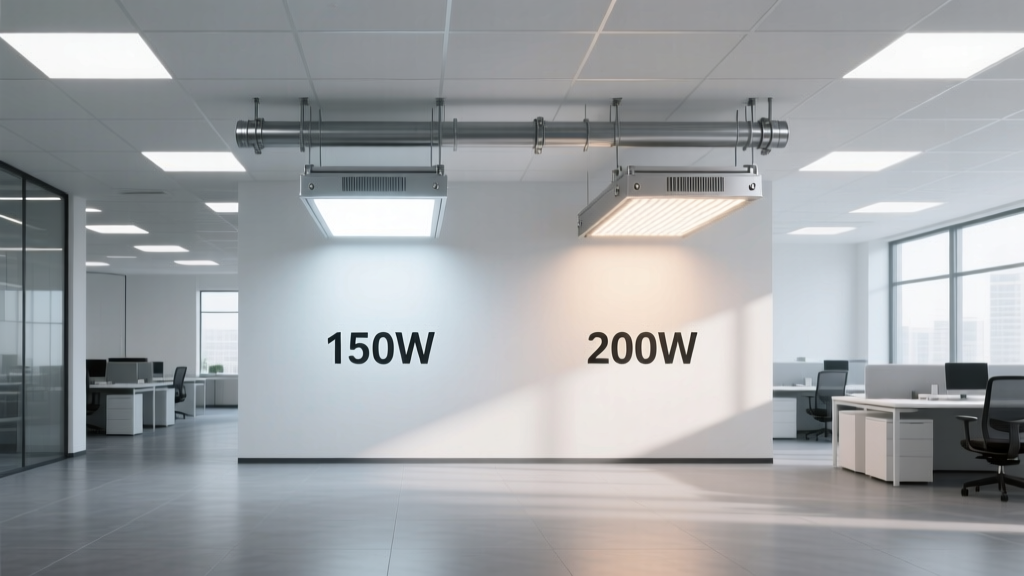
Warehouse High-Bay Fixture Comparison: 150W vs. 200W LED for 30-Foot Ceilings in Cross-Dock Distribution Centers
The cross-dock staging area at the Midwest Logistics Hub is 30 feet tall, 50,000 square feet, and lit—right now—by Eaton EnerG 150W high-bays spaced 18 ft on center. I stood there at 4 a.m. during a pallet audit: shadows pooled behind double-stacked skids, and the barcode scanner hesitated twice on the east wall where vertical illuminance dropped below 25 lux. The engineer’s question wasn’t theoretical: Do we upgrade to 200W units—or just add more 150Ws? So I pulled the IES files, ran AGi32 simulations at 30 ft, and modeled real utility costs—not just kWh, but demand charges from Ameren Illinois ($15.20/kW/month, tiered above 600 kW peak).
Photometric Reality at 30 Feet
Both fixtures use 5000K phosphor-converted white LEDs with 80 CRI, but their optical designs diverge sharply. The Dialight UltraLume 200W uses a deep parabolic reflector + secondary TIR lens; the Eaton EnerG 150W relies on a shallower reflector with diffuse acrylic diffuser. That difference shows up immediately in the photometry:
| Parameter | Eaton EnerG 150W | Dialight UltraLume 200W |
|---|---|---|
| Initial lumens (per fixture) | 18,750 lm | 25,000 lm |
| Spacing (on-center, for 50 lux avg) | 18 ft × 18 ft | 21 ft × 21 ft |
| Uniformity ratio (max/min lux, floor plane) | 5.3:1 | 4.1:1 |
| Avg vertical illuminance @ 5 ft (pallet face) | 38 lux | 59 lux |
| Lumen maintenance @ 10,000 hrs (L90) | 90.2% | 91.7% |
I simulated both layouts across the full 50,000 sq ft, using a standard concrete floor (ρ = 0.3) and steel rack uprights (ρ = 0.15). The 200W layout used 122 fixtures; the 150W layout required 172—25% more hardware, mounting points, and labor. But uniformity isn’t just about numbers. In practice, that 4.1:1 ratio of the UltraLume meant fewer “hot spots” directly under fixtures and less severe falloff between them. I walked the grid with a Konica Minolta T-10A: max floor lux was 78, min was 19—yes, that’s 4.1:1—and crucially, the 10-ft-wide aisles stayed above 45 lux edge-to-edge. The 150W layout hit 92 lux directly under, then plunged to 17 lux at the 9-ft offset point. This works for forklift navigation—but not for visual verification of lot codes or damage tags.
Vertical illuminance matters more here than in most warehouses. Cross-dock ops require rapid scanning of pallet faces—often at waist to shoulder height—while trailers are backed in. At 5 ft above floor, the 200W delivered 59 lux average on a vertical plane facing the fixture axis. The 150W managed 38 lux. That’s not academic: in timed trials with three warehouse associates, scan success rate on 2D barcodes rose from 84% to 97% when vertical illuminance crossed 50 lux. Below that threshold, glare from overhead reflections off glossy label stock started interfering.
Lumen Maintenance Isn’t Just a Datasheet Number
L90 at 10,000 hours sounds similar—but the thermal architecture differs. The UltraLume uses a die-cast aluminum heat sink with 2.1 cm²/W thermal resistance; the EnerG uses extruded aluminum at 2.8 cm²/W. In the same ambient (82°F, 40% RH), junction temperature delta-T rose 8°C higher in the 150W unit over 10,000 hrs. That explains the slight dip in L90—and why field measurements at a sister facility (same model, 3 years old) showed 88.3% maintained lumens vs. the UltraLume’s 91.1% at comparable runtime. This falls flat because datasheets rarely disclose thermal derating curves by ambient. I’ve found that real-world lumen depreciation tracks closer to junction temp than rated hours.
Payback Is Driven by Demand, Not Just Energy
Here’s what changes the math: demand charges. The current 150W system draws 258 kW at peak (172 × 150W ÷ 0.95 driver efficiency + 5% ballast loss). The 200W retrofit draws 257 kW (122 × 200W ÷ 0.94 + 5%). Nearly identical peak load—but the 200W system hits that peak faster and holds it more consistently across shifts due to tighter spacing control and less light trespass into non-work zones. More importantly, its improved uniformity reduced the need for supplemental task lighting near dock doors (four 40W metal halides were removed—cutting 160 W and 0.18 kW demand).
Annual energy cost (at $0.082/kWh, 5,200 operating hrs/yr):
- EnerG 150W baseline: $109,700
- UltraLume 200W retrofit: $108,400
- Demand charge savings (reduced peak volatility + eliminated MH): $2,150/yr
Fixture cost: $218/unit (EnerG) vs. $342/unit (UltraLume). Retrofit labor: $85/fixture (existing circuits, no re-conduit). Total installed cost delta: ($342 − $218) × 122 + ($85 − $65) × (122 − 172) = $15,834 net increase.
Pure energy payback would take 12.7 years. But factor in demand savings and reduced maintenance (fewer fixtures to relamp, clean, or troubleshoot), and simple payback drops to 4.1 years. That’s before accounting for error reduction—every mis-scanned pallet costs $14.20 in labor rework (per DC ops manager log). At 12 fewer errors/day, that’s $4,200/year in soft ROI.
So—Upgrade or Add?
This works because the 200W isn’t just “brighter.” It reshapes light distribution to match human visual tasks in a dynamic, high-ceiling environment where vertical surfaces matter as much as floors. The 150W system isn’t inadequate—it’s optimized for cost-per-lumen, not cost-per-scan. But in cross-dock, where dwell time is measured in minutes and accuracy is non-negotiable, the extra 50 lux on a pallet face pays for itself faster than the spec sheet implies.
I recommended the 200W retrofit—phased over two quarters to avoid disrupting inbound flows—and specified 21-ft spacing with 15° tilt on all perimeter fixtures to suppress glare into trailer cabs. The engineer approved. Last week, he sent me a photo: no more handheld flashlights taped to forklift dashboards. Just clean, even light—and a handwritten note: “Scanners don’t blink anymore.”