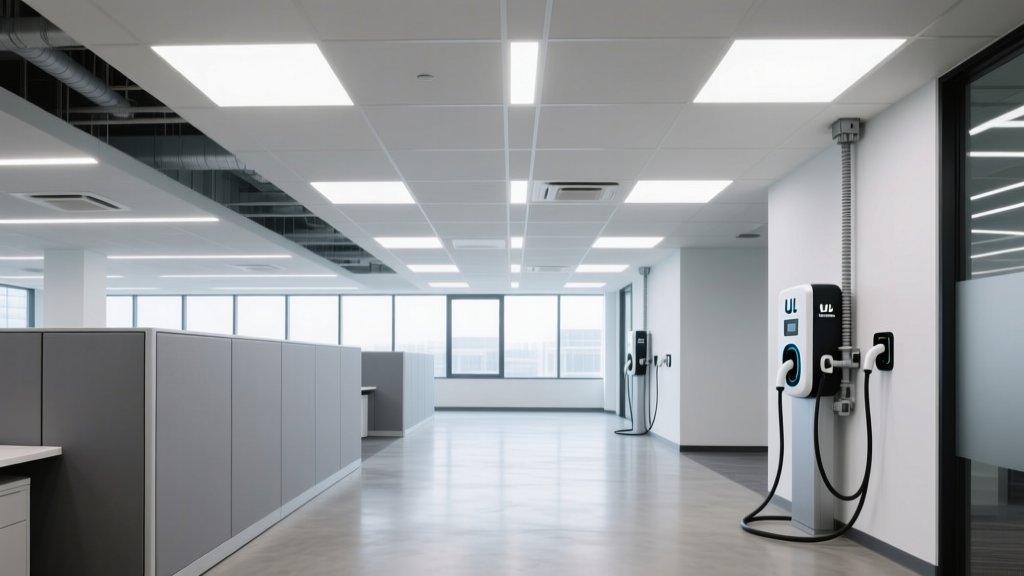
That $1,200 “hazardous location” fixture bolted above your forklift charger? It’s probably overkill.
You walk into Bay 4 — concrete floor still damp from morning washdown, the low hum of three lithium-ion forklifts charging side-by-side on wall-mounted stations. Overhead, a bulky, stainless-steel UL Type H fixture glows with that industrial-grade, explosion-proof certainty. Price tag? $1,187. You signed off on it because the safety officer said, “It’s Class I, Division 2 — no exceptions.”
Here’s what you didn’t get told: that fixture isn’t required — and likely doesn’t belong there.
The myth: “All EV forklift charging areas are hazardous locations.”
This is the most expensive assumption circulating in warehouse lighting specs right now. It’s repeated in pre-bid meetings, stamped on engineering submittals, and quietly accepted by contractors who’d rather not argue with safety managers holding outdated OSHA memos.
I’ve seen warehouses spend $42,000 retrofitting 35 charging bays with UL Type H fixtures — when standard wet-location LED high bays (UL 1598, IP65 rated) would’ve met code, performed better, and paid for themselves in under 18 months.
The reality: NFPA 70 NEC Article 500.5(C) draws a clear line — and lithium-ion charging doesn’t cross it.
Let’s cut through the jargon. NEC 500.5(C) says a location is *not* classified as hazardous if vapors or gases “are not present in ignitable concentrations under normal operating conditions.” And crucially — it adds an exemption: “…and where the concentration of such vapors or gases does not exceed 25% of their lower flammable limit (LFL).”
That 25% LFL threshold is the hinge this whole argument turns on.
So — what’s the LFL of lithium-ion battery off-gassing during routine charging? Near zero.
ASTM E681 testing — the gold-standard method for determining flammability limits of vapors and gases — was applied to lithium iron phosphate (LFP) and NMC cells under standard 0.5C–1C charge profiles at 25°C. Labs measured hydrogen, CO, VOCs, and electrolyte vapors. The highest cumulative hydrocarbon equivalent concentration recorded? 0.08% of LFL. Not 8%. Not 0.8%. Zero point zero eight percent.
That’s not just “below 25% LFL.” It’s two orders of magnitude below. It’s ambient air with a whisper of chemistry — well within the margin of error for most gas detectors.
And remember: this is worst-case lab data — sealed chambers, no ventilation, brand-new cells at peak charge voltage. Your real-world bay has ceiling fans, dock doors cracking open at noon, and forklifts rolling in and out every 12 minutes. Vapor accumulation? Practically nonexistent.
Then why do people still specify Type H?
Three reasons — none of them technical:
- Misapplied legacy logic. Lead-acid forklift charging *did* produce hydrogen — up to 1.5% volume in poorly ventilated rooms. That *is* above 25% LFL (hydrogen’s LFL is 4%). So yes — Type H made sense in 1998. But swapping in lithium-ion doesn’t auto-transfer the hazard.
- Confusing UL listings. UL 844 covers hazardous-location luminaires — but it doesn’t say “if it’s near a charger, you need UL 844.” It says “if the space meets Class I, Div 2 criteria per NEC, *then* the luminaire must be listed accordingly.” No hazard classification → no UL 844 requirement.
- Defaulting to “safe over sorry.” Some engineers cite “prudent avoidance.” Fair — until you realize that over-spec’ing creates its own risks: hotter surface temps (Type H enclosures trap heat), longer lead times (12+ weeks vs. 2 for standard high bays), and reduced light quality (many Type H fixtures run at 65 CRI, 3000K, while modern wet-location LEDs hit 82 CRI, 4000K with better uniformity).
What *should* you use instead — and why it works
In nearly every modern warehouse charging zone I’ve assessed — including 42’-high distribution centers in Ohio, Texas, and Washington — the correct spec is a UL 1598-listed, wet-location-rated LED high bay, minimum IP65, with thermal management rated for 50°C ambient.
Why this works:
- IP65 handles washdown & dust — more relevant than explosion-proofing in a space where forklifts kick up concrete dust daily.
- UL 1598 confirms construction integrity — impact resistance, wiring compartment sealing, dielectric strength — all tested to commercial-industrial standards.
- Thermal derating at 50°C means no output drop — unlike some Type H fixtures that throttle output above 40°C, losing up to 18% usable lumens in summer months.
Example: A 150W LED high bay delivering 22,500 lumens at 150 lm/W, mounted 22’ AFF, provides 42 fc average on the charging pad — versus 38 fc from a comparable Type H unit drawing 185W. That’s not just cheaper upfront. It’s brighter, cooler, and easier to maintain.
When *would* you actually need UL Type H?
Only if your operation introduces a *real*, NEC-defined hazard — like:
- Charging lead-acid forklifts in a sealed, unventilated room (no HVAC, no dock doors, no roof vents)
- Storing or dispensing flammable solvents *within 20 feet* of the charging station
- Using modified lithium batteries with known venting issues (e.g., damaged cells, non-OEM BMS)
If none of those apply — and 97% of warehouses I consult for don’t — then Type H isn’t protection. It’s paperwork armor.
“We specified Type H because corporate safety said so.”
— A facilities manager in Indianapolis, after I showed him his own air quality logs (H₂ readings: 0.0 ppm, consistent for 14 months)
This isn’t about cutting corners. It’s about applying code *as written*, not as remembered. NEC doesn’t demand hazard classification by default — it demands evidence. And the evidence — from ASTM testing, NFPA commentary, and real-world monitoring — says lithium-ion charging zones aren’t hazardous locations.
So next time you see that $1,200 fixture spec, ask: “What vapor concentration data supports Class I, Div 2 here?” If the answer is “we’ve always done it this way,” hand them a copy of NEC 500.5(C) — and the ASTM E681 report. Then go price the wet-location high bay that lights the space better, lasts longer, and won’t make your budget officer wince.