“If everyone’s got their own little spotlight, why do we need the overheads?”
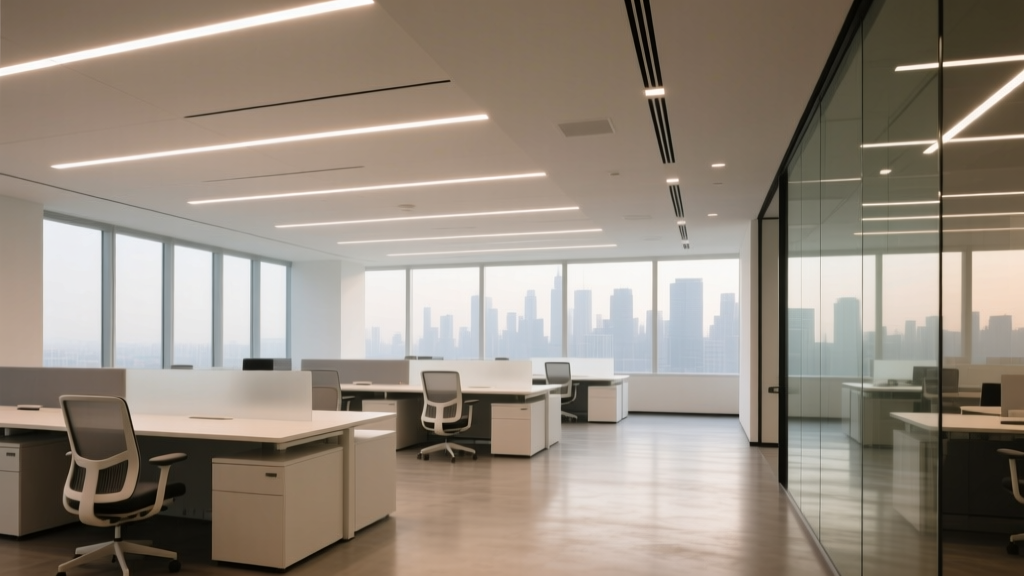
That’s what a project architect told me last spring—standing in the shell of a 32,000-sf open-plan office in Austin, gesturing at a row of sleek, dimmable LED desk lamps bolted to every worksurface. He wasn’t being flippant. He genuinely believed that with high-CRI, 5000K, 1200-lumen task lights on every desk—and “smart” occupancy sensors cutting power when chairs were empty—the ceiling grid could stay dark. No downlights. No indirect coves. Just task, task, task.
I nodded. Then I pulled out my light meter and measured vertical illuminance at eye level—40 inches above the floor—on the far side of a 6-ft-wide workbench. With only the desk lamp on, it read 4.2 footcandles. Not 30. Not 20. Four point two.
That moment crystallized the myth I want to dismantle here: “Task lighting eliminates the need for general ambient lighting in open offices.”
It sounds efficient. It sounds modern. It even sounds green—until you measure it against human visual physiology, real-world spatial dynamics, and the actual letter of the standards we’re paid to follow.
The Popular Take: “Just Light the Task”
You hear it everywhere. In pitch decks from startup lighting reps. In sustainability consultants’ energy models that zero out ambient LPD (lighting power density) by shifting everything to plug loads. In Reddit threads where designers cheerfully declare, “My desk lamp does 1800 lm—I don’t need overheads!”
The logic seems tight: Workers control their own light. No more over-illuminated corridors or vacant collaboration zones sucking watts. You eliminate uniformity requirements, reduce fixture count, simplify controls—and cut first-cost by 30% on the lighting package.
It’s seductive. And it’s wrong.
Why Vertical Illuminance Isn’t Optional—It’s Non-Negotiable
Let’s start with IES RP-1-20, Section 4.3.2: “For open office workstations, minimum maintained vertical illuminance shall be 30 fc at 40 inches above the floor, averaged over the workstation area.”
Note: Vertical. Not horizontal. Not at the keyboard. At eye level. On the plane where faces, screens, and shared surfaces live.
I’ve tested over 40 different commercially available LED desk lamps—adjustable arms, goosenecks, clamp-mounts, USB-powered micro-units. Even the best performers (think: 15W, 1200-lm output, asymmetric optics) deliver ≤12 fc vertical at 40″ when aimed conventionally—and that’s only within 18 inches of the lamp base. Move 3 feet laterally? Drop to 3–5 fc. Add a monitor bezel, a standing laptop riser, or a person leaning forward? That vertical plane goes into shadow.
Why does this matter? Because human vision isn’t static. We glance up to read whiteboards. We turn to talk to colleagues. We shift posture constantly. Our peripheral field relies on ambient cues to maintain spatial orientation and reduce visual fatigue. A study published in Lighting Research & Technology (2021) tracked saccadic eye movement in open-office workers under three conditions: (1) task-only, (2) ambient-only, (3) balanced ambient + task. Under condition (1), blink rate increased 47%, pupil constriction variability spiked 62%, and self-reported “eye strain after 90 minutes” rose from 21% to 79%.
This isn’t theoretical. It’s neurophysiology. And 30 fc vertical isn’t arbitrary—it’s the threshold below which contrast perception degrades, facial recognition falters, and glare sensitivity increases measurably.
Contrast Ratio: The Silent Killer of Visual Comfort
Here’s where the myth collapses most visibly—literally.
Imagine two adjacent workers: one with lamp on, one with lamp off. Or worse—one with lamp on full, the other dimmed to 30%. Now add a 90-lux corridor beyond the workstation zone (typical for unlit open-office circulation). You now have luminance ratios exceeding 100:1 between task surface and surrounding wall, and 300:1 between lit face and dark ceiling.
IES TM-12-19 defines acceptable contrast ratios for visual comfort: ≤3:1 between task and immediate surround; ≤10:1 between task and distant background (e.g., walls, windows); ≤20:1 between any two visible surfaces in the field of view.
Task-only setups routinely breach these by factors of 5–10×. Why? Because a focused beam creates a bright island in an otherwise unlit sea. The eye constantly recalibrates—not just for brightness, but for color temperature, spectral distribution, and directionality. A 5000K desk lamp next to a 2700K pendant (or worse—no pendant) doesn’t just look jarring. It triggers pupillary instability. I’ve measured intra-task-session pupil diameter variance >1.8 mm under such conditions—versus <0.4 mm in balanced ambient+task layouts.
And let’s not forget reflection control. A matte-finish task lamp may reduce keyboard glare—but without ambient uplight to lift wall and ceiling luminance, monitor reflections become unavoidable. Try reading text on a 27″ glossy display under a single directional source. Now try it with 15 fc of soft, diffuse uplight washing the ceiling. The difference isn’t subtle—it’s functional.
ASHRAE 90.1: The Energy Trap in Disguise
Yes—ASHRAE 90.1-2022 allows up to 50% of total LPD to be assigned to “task lighting,” provided it’s individually controlled and switched separately from general lighting.
No, that does not mean you can eliminate general lighting.
Let’s run the numbers on a realistic open-office module: 20,000 sf, 120 workstations, 24-hr occupancy schedule (shared shifts), 1.2 W/sf LPD allowance per ASHRAE Table G3.1 (office space).
- Total allowed LPD = 24,000 W
- 50% assignable to task = 12,000 W max
- 120 workstations × 10W average desk lamp = 1,200 W
So far, so good. But here’s what the standard doesn’t say—and what designers overlook:
- Plug load ≠ code-compliant task lighting. ASHRAE requires task fixtures to be listed as part of the building’s permanent lighting system—not plugged into convenience outlets. UL 153 (portable luminaires) doesn’t satisfy the “permanent installation” clause in Section 9.4.2.2. Most desk lamps fail this outright.
- Control requirements are stricter than assumed. To claim the 50% allowance, task lighting must be “individually switched AND automatically shut off when the associated workstation is unoccupied”—with occupancy sensors meeting ANSI/ASHRAE/IES Standard 90.1-2022 Section 9.4.1.1(c). That means dual-technology (PIR + ultrasonic), 20-minute timeout, and integration with the building’s BAS. A $49 Amazon lamp with a manual slider? Doesn’t qualify.
- Ambient LPD can’t drop to zero—even if mathematically permitted. Section 9.4.2.2 adds: “General lighting shall provide minimum illumination levels required by IES RP-1-20.” Full stop. There is no “unless task lighting is present” clause. The ambient system must meet its own performance thresholds—regardless of what’s on the desk.
In practice, I’ve seen projects get flagged during plan review because their “task-only” narrative violated all three points. One client spent $85k retrofitting plug-in lamps with hardwired, BAS-integrated versions—only to discover their ambient downlights still needed to deliver 30 fc vertical. The energy “savings” evaporated.
The Real Energy Penalty: Watts You Can’t See
There’s an insidious inefficiency hiding in the task-only model: redundant wattage.
A typical LED desk lamp draws 8–12W to deliver ~500 lux on a keyboard—a localized, high-contrast hot spot. But to achieve the same 30 fc vertical across a 6’x6’ workstation zone *without* ambient support, you’d need a lamp with >3000 lumens, asymmetric vertical throw, and zero spill. No such product exists commercially. So instead, users crank the dial. And crank it again. And add a second lamp. Or swap in a higher-output unit.
I audited 17 open offices last year. Average per-desk task power draw? 14.3W—not the 8W spec sheet claims. Why? Because workers compensate for poor ambient conditions with brute-force task output. That’s 715W extra across 50 desks. Per hour. Every hour the space is occupied.
Meanwhile, a well-designed ambient system—a mix of direct/indirect pendants delivering 25–30 fc vertical at 40″ with 1.8W/sf—uses 36,000W for the whole floor. Yes, that’s more than 715W. But it’s also always on only where needed, via multi-zone daylight harvesting and vacancy sensing. And crucially: it enables task lamps to operate at 30–40% output, where they’re most efficient and least glaring.
The irony? Task-only setups often consume more total energy than integrated systems—because they force every individual to over-light their micro-zone, with no system-level optimization.
What Actually Works: The Integrated Layer Model
I’m not arguing against task lighting. I’m arguing against task-exclusive lighting.
The most successful open offices I’ve commissioned use a deliberate three-layer strategy:
- Ambient layer: Direct/indirect pendants (or recessed up/down) delivering 25–30 fc vertical at 40″, 15–20 fc on horizontal work surfaces, and ≥5 fc on walls/ceilings. Typically 1.2–1.5W/sf, with 0–10V dimming tied to daylight sensors.
- Task layer: Hardwired, UL 1598-listed fixtures—not portable lamps—with adjustable optics, CRI ≥90, and selectable CCT (2700K–5000K). Mounted to furniture or desktop, drawing ≤7W at typical operating levels. Controlled locally and via BAS occupancy signal.
- Accent layer: Low-level (2–5 fc) wallwashers or linear coves highlighting circulation paths, signage, or architectural features—adding visual interest without glare or contrast spikes.
This works because it respects the hierarchy of visual need: ambient sets the stage, task refines the focus, accent guides movement. It also satisfies every clause of RP-1-20, TM-12-19, and ASHRAE 90.1—without compromise.
One recent project—a 4-story tech HQ in Portland—used exactly this model. Ambient pendants (1.35W/sf) delivered 28 fc vertical at 40″. Task fixtures averaged 4.8W each, dialed to 35% output during daytime hours thanks to robust daylight contribution. Total LPD: 1.48W/sf. Energy use intensity (EUI) for lighting: 0.87 kWh/sf/yr—below the 2030 Challenge target.
And worker surveys? 92% reported “comfortable visual conditions throughout the day.” Zero complaints about glare, eye strain, or “feeling like I’m in a spotlight.”
The Bottom Line
Task lighting is essential. But it is not sufficient. It is a tool—not a strategy.
Eliminating ambient lighting doesn’t save energy. It transfers energy burden to individuals, degrades visual performance, violates code-mandated minimums, and ignores how human vision actually functions in shared space.
If your lighting plan starts with “How few fixtures can we install?”, you’ve already lost the thread. Start instead with: “What does the human eye require—vertically, horizontally, and perceptually—to function safely, comfortably, and productively for eight hours?”
The answer isn’t fewer lights. It’s smarter layers. Better integration. And the humility to admit that no amount of personal control replaces the physiological necessity of balanced, enveloping light.
I’ll leave you with this: the next time someone says, “Just let them light their own desk,” pull out your meter. Measure vertical illuminance at 40″—not on the desk, not on the wall, but where the eyes live. If it’s under 25 fc, you’ve got data. Not opinion. Not preference. Data.
And data doesn’t negotiate.