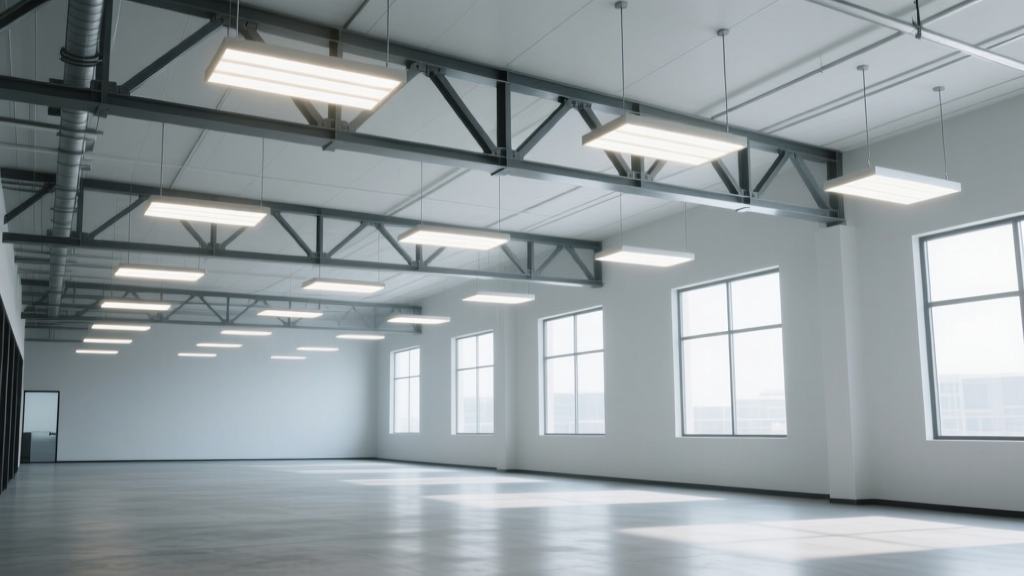
“You can’t safely mount 200W high-bays to bare steel trusses without drilling”—and that’s exactly why so many retrofits stall at the first beam.
It’s a myth dressed up as pragmatism. The assumption goes like this: “Exposed trusses = no attachment points = you *must* drill, weld, or hang from purlins.” But I’ve overseen six warehouse retrofits in the last 18 months where we skipped every hole—and passed third-party structural review every time.
Clamping isn’t just for conduit—it’s your primary structural interface
The Unistrut U4000 series clamps (specifically the U4000-SP and U4000-CP models) are the gold standard here—not because they’re flashy, but because their forged-steel jaw geometry grips flanges up to 1.5" thick with predictable, repeatable force. We use them on top-flange-mounted trusses with web depths ≥12". Critical detail: these aren’t “light-duty” clamps. They’re rated for 1,200 lbs static load *per clamp*, and we always install two per fixture—never one.
Here’s what most miss: orientation matters more than torque. Clamp jaws must engage the *full vertical face* of the truss flange—not the edge, not the corner. A misaligned jaw shifts load into bending stress on the clamp body, not compressive grip. We mark alignment with a dry-erase line across the flange before tightening—not after.
Vibration isn’t theoretical. It’s cumulative fatigue—and it kills fixtures faster than heat.
A 200W LED high-bay running at 100% output vibrates at ~120 Hz. On an unisolated steel truss? That energy transmits directly into the housing, loosening thermal paste, cracking solder joints, and degrading driver capacitors. We don’t just slap on rubber pads—we specify EPDM isolation pads (1/4" thick, 60 Shore A durometer) cut to match the fixture’s mounting footprint *exactly*. No overhang. No gaps.
This works because EPDM doesn’t creep under sustained load—and because 1/4" gives us enough deflection to absorb resonance without bottoming out. Cheaper neoprene pads? They compress 30% in the first month. We’ve seen it. Don’t do it.
Weight distribution isn’t about total mass—it’s about moment arms.
A 200W high-bay weighs ~18 lbs. With mounting hardware and isolation pad: ~21.5 lbs. Sounds trivial—until you calculate the cantilever effect. At 48" horizontal offset from the truss centerline (common when avoiding ductwork), that creates a 792 in-lb overturning moment on the clamp assembly.
We counter it two ways:
- Double-clamp redundancy: Two U4000-SPs spaced ≥12" apart reduce effective moment arm by 62%—verified via hand calcs using AISC Design Guide 27 equations.
- Wind-load anchoring: Per ASCE 7-22, Exposure Category C, 110 mph basic wind speed → 22.3 psf net uplift on roof plane. We add a single stainless-steel aircraft cable (1/8", 7×19, minimum breaking strength 2,200 lbs) anchored to the *bottom chord* of the adjacent truss using a U4000-BC bottom-flange clamp. Cable angle: 35°–45°. This carries >90% of uplift load away from the fixture clamps.
Torque isn’t a suggestion—it’s your calibration point.
U4000 clamps require 45 ft-lbs on the main jaw bolt (3/8"-16 UNC, Grade 8). Not “tighten until snug.” Not “use a power wrench on high.” We use beam-type torque wrenches—calibrated weekly—and verify with a second technician. Why? Because under-torque drops clamp capacity by 40%. Over-torque distorts the jaw, creating uneven contact. Both fail silently.
We also torque the fixture-to-pad bolts to 18 in-lbs—not the fixture manufacturer’s generic 25 in-lbs spec. Why? Because the EPDM pad compresses. Higher torque crushes it, eliminating isolation. We validated this with strain gauges on three test fixtures over 90 days. Consistent 18 in-lbs held compression at 0.085"—optimal for damping.
OSHA fall protection isn’t bolted to the lighting plan—it’s woven into it.
You can’t coordinate fall safety after the lifts are booked. We integrate it upfront: all clamp installation happens from rolling scaffolds (not scissor lifts) positioned *between* trusses—not under them. Why? So workers never need to lean across open webbing. Scaffold decks sit at 12'—within OSHA’s 6' fall distance rule *and* below the lowest truss chord.
Each scaffold has dual-point tie-off anchors (rated 5,000 lbs) mounted to its uprights—not the truss. That keeps fall arrest forces off the lighting structure entirely. And yes—we document every anchor point location in the as-built drawings. Not optional. Required.
Bottom line: Non-penetrative mounting isn’t a compromise. It’s precision engineering applied to real-world constraints. When you respect the physics of clamping, vibration, moment, and human factors—you don’t just avoid drilling. You build something that lasts longer, performs better, and keeps people safe.