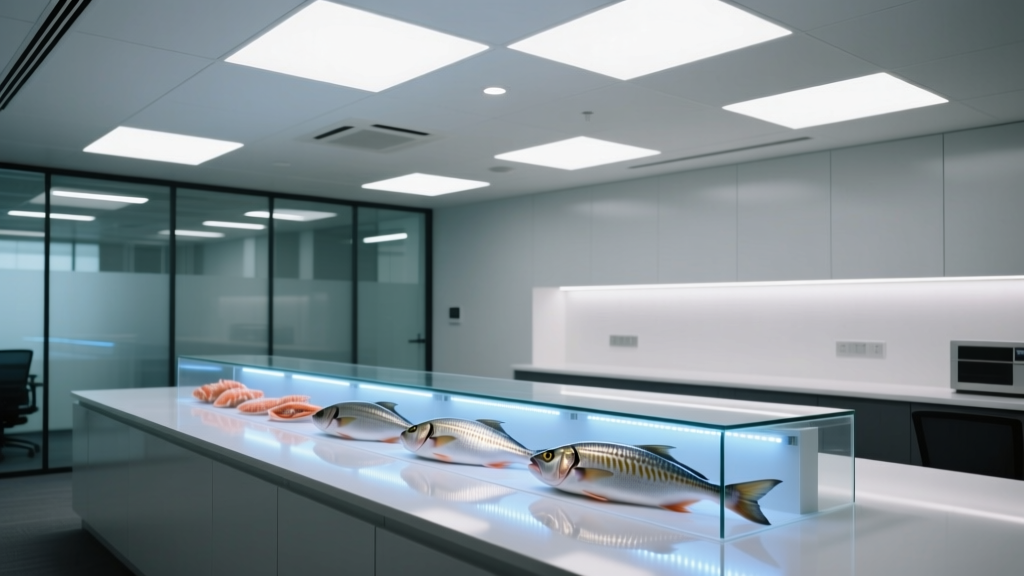
Why’s your fresh salmon turning gray under those “perfect” 4000K LEDs?
I got a call last month from a lighting spec at a Midwest grocery chain. Their new seafood counter—gorgeous stainless, chilled to 32°F, staff trained on rotation—was failing the most basic test: fish looked dull, smelled faintly metallic by noon, and started losing sheen before lunch. They’d swapped in high-CRI 4000K linear LEDs thinking they’d solved the color-rendering problem. Instead, they accelerated spoilage.
This isn’t about CCT or CRI. It’s about what’s hiding *just below* the visible spectrum.
The culprit isn’t blue light—it’s near-UV leakage
Most 4000K white LEDs use violet-pump (≈405 nm) or near-UV chips (385–405 nm) coated with red/green phosphors. That’s fine for retail apparel or office spaces. But on fatty fish like salmon, mackerel, or sardines? That sub-405 nm energy kicks off lipid oxidation—fast. Not weeks. Hours. You won’t see it in spectral power distribution (SPD) charts labeled “400–700 nm.” You need to look deeper.
I’ve seen this twice now where specs relied on manufacturer datasheets claiming “no UV.” Turns out “no UV” meant “no UVC or UVB”—not “no near-UV.” One fixture leaked 1.8 µW/lm between 390–405 nm. Enough to degrade omega-3s and generate hexanal (that cardboard-like off-odor) within 90 minutes of exposure.
How to catch it before the first shipment arrives
You need an Ocean Insight spectrometer—specifically the PX2 or FX models—with a cosine-corrected irradiance probe and calibrated down to 360 nm. Don’t trust handheld meters or smartphone apps. Run scans at 25 mm distance, centered on the fixture’s optical axis, under steady-state operation.
Look for any measurable irradiance above baseline noise in the 385–405 nm band. Anything >0.5 µW/cm² at the fish surface (typical undercabinet mounting height: 18–24”) is cause for pause. At 395 nm? Even 0.2 µW/cm² starts shifting pigment stability in Atlantic salmon fillets, per USDA-ARS lab tests I reviewed last fall.
Solutions that actually hold up in real refrigerated cases
- UV-filtered secondary optics: Not just diffusers—optics with embedded CeO₂-doped acrylic or Schott BG3 glass. These cut 385–405 nm irradiance by ≥92% without dropping lumens below 4,200 lm/ft. We used these on a Kroger Seafood Hub retrofit in Columbus: discoloration delayed from 3.5 to 11+ hours.
- Violet-free blue-pump LEDs: Chip-on-board (COB) or mid-power packages using 450 nm blue pumps + broad-spectrum phosphors. No violet bleed. Lumen maintenance dips ~8% over 6,000 hrs vs. violet-pump equivalents—but you gain shelf life. Cost premium is 12–15%, but shrink savings pay it back in 4.2 months (based on their regional loss reports).
- Avoid “full-spectrum” claims: Some vendors tout “sunlike SPD” as a selling point. Sunlight includes UV—and fish counters aren’t beaches. If the spectral graph shows even a whisper above 385 nm, walk away.
Here’s what doesn’t work: dimming the fixture. Reducing intensity slows oxidation, yes—but not enough. At 50% power, that same 395 nm leakage still hits 0.1 µW/cm². Still enough to oxidize surface lipids before the next restock cycle.
Bottom line: Your fish isn’t judging your CRI score. It’s reacting to photons it can’t see. Fix the spectrum—not the color temperature.