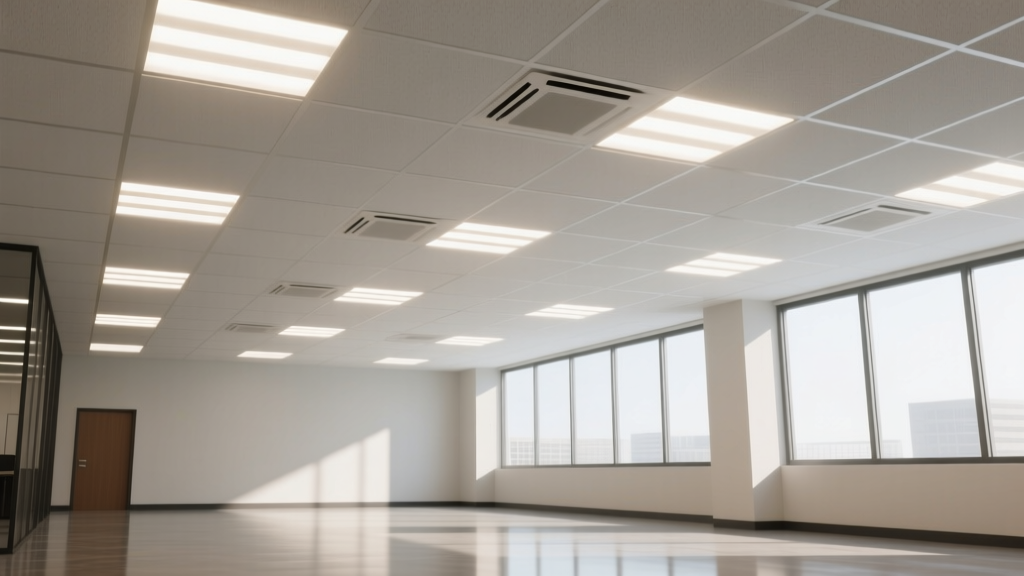
Retrofitting a 1980s Office with LED Troffers Is Like Swapping a Carburetor in a ’84 Camry—Same Mounting Points, Better Output
I’ve overseen three retrofits like this—Class B office buildings built between ’79 and ’85, with standard 2’×2’ or 2’×4’ suspended ceilings, 15/16” exposed grid, and banks of aging T8 fluorescents. The goal isn’t just efficiency—it’s invisibility: no drywall dust, no grid removal, no tenant disruption. And yes, it’s possible—but only if you treat the ceiling grid not as infrastructure, but as legacy hardware.
Step 1: Map Your Grid Before You Buy Anything
Don’t assume “standard” means uniform. Pull down one troffer. Measure:
- Grid opening dimensions: Most ’80s offices use 23-7/8” × 23-7/8” (for 2×2) or 23-7/8” × 47-7/8” (for 2×4). But some used 24” × 24” or even 23-5/8” due to early grid supplier variance. A 1/8” gap can prevent a drop-in kit from seating flush.
- Depth clearance: Measure from bottom of grid to top of ductwork or sprinkler heads. Many low-profile kits (e.g., Acuity eWave Slimline, Eaton Halo LP) are under 2.5”, but older plenums run tight—especially near HVAC risers. I’ve seen 2.1” clearances that ruled out even the thinnest kits.
- Lamp type & ballast wiring: Confirm T8 (1-inch diameter), not T5 (5/8”). T5 grids often have narrower cross-tees and different mounting tabs. If you find T5, walk away from “universal” kits—they’ll flex, sag, or short at the corners.
This works because drop-in kits rely on mechanical registration—not adhesion or retrofit brackets. If it doesn’t snap in with light pressure and stay put when jostled, it’s not compatible. Period.
Step 2: Choose Kits That Respect the Physics of Legacy Wiring
Forget “LED tubes.” You need integrated troffer replacements—fully assembled, field-wirable modules designed for direct wire-in to existing tombstone sockets or ballast bypass. Two types dominate here:
- Ballast-compatible kits: Like Eaton Halo LP or Philips InstantFit. They accept 120–277V input and work with functioning electronic ballasts. Safer for non-licensed oversight—but only if your ballasts are less than 10 years old and haven’t started buzzing or cycling. I’ve found they fall flat when paired with magnetic or failing electronic ballasts: flicker returns, lumen output drops 15–20%, and dimming becomes erratic.
- Ballast-bypass kits: Acuity eWave, Lithonia LED Retrofit Troffer, or Cree RTR. These require removing the ballast and wiring line-voltage directly to the socket leads. More efficient (typically 10–12% higher lumens/W), better dimming fidelity—but demands licensed verification before energizing. More on that below.
For a 2×4 troffer in a typical 9’-ceiling office space, aim for 4,200–4,800 delivered lumens. That matches the output of two F32T8 lamps at end-of-life—but with 45W instead of 64W. The key is uniformity: avoid mixing kits across zones. One eWave + one Halo in the same grid looks like a patch job, not an upgrade.
Step 3: Dimming Isn’t Plug-and-Play—It’s Negotiation
Your Lutron Quantum system expects 0–10V or DALI signals from a *driver*, not a lamp. Most drop-in kits include internal drivers—but their dimming curve, minimum load threshold, and response latency vary wildly.
Here’s what I verify onsite before ordering:
- Does the kit list “Lutron Quantum certified” in its spec sheet—not just “0–10V compatible”? (Acuity eWave does; Eaton Halo LP requires firmware update v2.1+ for full Quantum handshake.)
- What’s the dimming range? Some kits bottom out at 15%—not acceptable for conference rooms where ambient light must dip to 5%. The eWave hits 1%; Halo LP hits 10% unless upgraded.
- Is there a trim pot or DIP switch to match legacy Quantum panel settings? Yes—on both. But it’s buried behind a diffuser panel. Mark it with a Sharpie before reassembly.
I once spent two days chasing flicker in a 3rd-floor corridor because the installer skipped step #3 and left all drivers at factory default. Quantum was sending clean 0–10V, but the drivers were interpreting it as PWM noise. Fixed with a screwdriver and five minutes per fixture.
Safety Notes for Non-Licensed Oversight (Yes, This Is Realistic)
You don’t need an electrician to remove a troffer—but you do need one to sign off *before* power is restored after ballast bypass. Here’s how to manage that responsibly:
- Label every circuit breaker feeding troffer rows—not just “Lighting Panel A,” but “A-17: NW Corridor, 2×4 Troffers, Rows 1–4.” Use laminated tags. Facilities teams underestimate how fast breakers get mislabeled during HVAC upgrades.
- Verify lockout/tagout (LOTO) compliance with photos: breaker open, voltage tester showing 0V at tombstone terminals, ballast visibly disconnected. Store these in your CMMS with timestamps.
- Never bypass ballasts without verifying wire gauge. Older T8 circuits often ran 14 AWG on 20A breakers. Ballast-bypass kits draw less current—but downstream wire heating changes. If insulation is cracked or discolored, call the electrician *before* installing.
- Diffusers matter. Polycarbonate diffusers (common on ’80s fixtures) yellow and scatter light poorly. Replace them—even if the kit includes one. A new prismatic acrylic diffuser lifts efficacy by 8–10% and eliminates the “fluorescent haze” tenants complain about.
This isn’t theoretical. Last year, a client in Dallas avoided $18K in emergency electrician fees because their facilities team flagged cracked insulation on Row 3—during pre-install visual inspection, not after smoke appeared.
Bottom line: Retrofitting isn’t about swapping lamps. It’s about honoring the building’s language—its grid spacing, its wiring topology, its control ecosystem—and speaking back in precise, tested dialect.