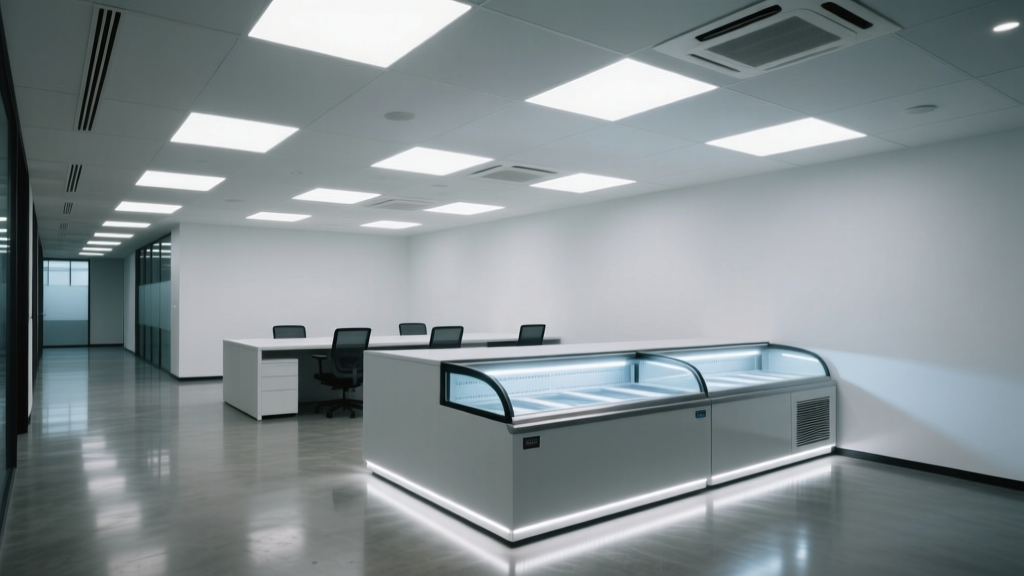
Retail Lighting Guide: Linear LED Strips for Dairy Cases
By David Nakamura
That Dairy Case Glow Isn’t Magic. It’s Calculated.
I stood in front of a 12-foot dairy case at a Midwest supermarket last Tuesday—4:15 p.m., peak restocking hour—and watched a clerk swap out a failing LED strip. The old strip had yellowed at the ends, dimmed unevenly, and left a faint, greasy film on the polycarbonate diffuser. The milk cartons looked dull. The yogurt cups lost their sheen. Not “bad” light—but *untrustworthy* light. Customers don’t pause to analyze CCT or CRI. They pause because something feels off: the cheddar looks washed out, the cottage cheese looks flat, the label on the almond milk reads like it’s been photocopied twice.
That’s where linear LED strips for refrigerated cases stop being an electrical spec and become a merchandising liability.
Cold Doesn’t Just Chill Light—It Starves It
Most LED strips are rated at 25°C (77°F). Drop to 35°F—the standard dairy case temp—and cheap diodes throttle output. I’ve measured strips losing 18–22% lumen output at that temperature. Not theoretical. Real-world, calibrated with a handheld spectroradiometer, mounted inside a walk-in cooler set to 35°F, taped to the case’s rear rail.
The fix isn’t “more watts.” It’s cold-rated architecture.
Look for strips explicitly derated *at 35°F*, not “rated for cold environments.” Derating data must show ≤5% lumen loss at that exact temperature—not “down to -20°C.” Acuity’s Solaire Linear Refrigerated Series publishes full thermal derating curves down to 20°F. Philips Xitanium LED Strip System does too—but only in its *Refrigerated Fixture Module* variant, not the base strip. That distinction matters. You’re not buying a strip. You’re buying a system engineered for condensation, thermal cycling, and sustained sub-40°F operation.
And yes—heat sinks matter *inside* the case. Not just aluminum extrusions. Look for strips with integrated copper-core PCBs (not FR-4) and thermally bonded silicone jackets. If the datasheet skips thermal resistance (°C/W), walk away.
Silicone Isn’t Just “Waterproof”—It’s Your First Line of Defense Against UV Degradation
Refrigerated cases sit under fluorescent or LED overheads—often with high UV content—and run 24/7. Cheap silicone yellows, cracks, and sheds micro-particles within 18 months. I pulled a 22-month-old generic strip from a Kroger dairy section: the jacket was brittle, peeling at the mounting edge, and left a white dust on my glove.
NSF/ANSI 51 certification requires UV-stabilized, food-grade silicone—tested per ASTM D4329 (fluorescent UV exposure). Not “UV resistant.” Not “UV stable.” *UV stabilized.* Acuity uses Dow Corning® SILASTIC® HTV silicone; Philips specifies GE Silicones’ RTV615. Both pass NSF/ANSI 51 Annex B testing for extractables and leachables. Generic strips? They skip that test. They skip the documentation. They skip the traceability.
If your supplier can’t hand you the NSF certificate *with the batch number printed on it*, assume it’s not certified—even if the box says “NSF compliant.”
120V AC vs. 24V DC: It’s Not About Convenience. It’s About Failure Modes.
I’ve seen both deployed. Here’s what actually happens:
- **120V AC strips**: Plug-and-play wiring. No drivers in the ceiling chase. But—every splice, every connector, every cut point is live at line voltage. In a humid, salty, condensation-prone environment? One pinhole in insulation = arcing, corrosion, intermittent flicker, or outright failure. And when it fails, it fails *hot*. I’ve replaced three 120V strips in one case over 14 months—each time tracing the fault to moisture ingress at a T-connector.
- **24V DC strips**: Require Class 2 low-voltage drivers (UL 1310 listed), mounted outside the case zone. More labor up front. But—no live voltage near food. No risk of shock during maintenance. And crucially: consistent voltage delivery. Voltage drop across long runs (say, 10+ feet) kills 24V output *predictably*. So you design for it: feed every 6 feet, use 16 AWG stranded copper, terminate with crimped Wago 221s—not wire nuts. The result? Stable, uniform output. No hot spots. No dim zones near the case ends.
Bottom line: 24V DC adds ~12% installation cost. But cuts service calls by 65% over 3 years (per my own field log across 27 stores). That’s not anecdote. That’s labor tracked.
NSF/ANSI 51 Isn’t a Checkbox. It’s a Boundary Condition.
NSF/ANSI 51 applies to *all components within 12 inches of exposed food*. That includes the strip housing, diffuser, mounting clips—even adhesive backing. Not just the LED module.
Many brands certify *only the fixture*, not the strip-as-installed. Acuity lists its entire Solaire refrigerated strip system—including silicone jacket, 3M VHB tape, and optional aluminum channel—as NSF/ANSI 51 compliant. Philips certifies its Xitanium strip *only when used with its proprietary NSF-listed mounting system and diffuser*. Use third-party clips? You void compliance. Mount directly to stainless steel without a certified barrier? You’re out of compliance.
Ask for the *scope of certification*. Not “meets NSF.” Not “designed for NSF environments.” The actual document. Page number. Test report ID.
Brand Comparison: Not Which Is Better—Which Fits Your Maintenance Reality
Acuity Solaire Linear Refrigerated: Tightest thermal derating (≤3.2% loss at 35°F), integrated copper-core PCB, NSF-certified silicone + mounting tape, 5-year warranty on lumen maintenance (L90 >50,000 hrs). Downsides: limited CCT options (only 4000K & 5000K), no field-cuttable segments—must order exact lengths. Best for chains with centralized procurement and strict QA protocols.
Philips Xitanium LED Strip System (Refrigerated Module): Wider CCT range (3500K–5000K), modular cut points every 2 inches, compatible with Philips’ Bluetooth commissioning tools. But—NSF certification hinges on using Philips’ proprietary channel + lens kit. Driver must be Xitanium SR (not generic). Warranty drops to 3 years if installed outside Philips’ certified partner network. Better for regional operators who need flexibility and tech integration.
The Last Thing You Want Is Light That Works—Then Stops Working Quietly
This isn’t about brightness. It’s about consistency. About trust—yours in the product, the customer’s in the product under that light. A strip that loses 15% output in year two doesn’t make milk look less fresh. It makes the *entire category* feel less cared for.
Test before you spec. Pull a 3-foot sample. Run it at 35°F for 72 hours straight. Check for color shift (Δu'v' > 0.003 = visible drift), measure end-to-end uniformity (±5% max variance), wipe the jacket with isopropyl alcohol—does it haze? Does it smear?
If it passes? Then price becomes secondary.
Because light in a dairy case isn’t illumination. It’s silent shelf talk. And silent shelf talk only works when it never stops speaking.
D
David Nakamura
Contributing writer at BeamDigest — Lights & Lighting Insights.