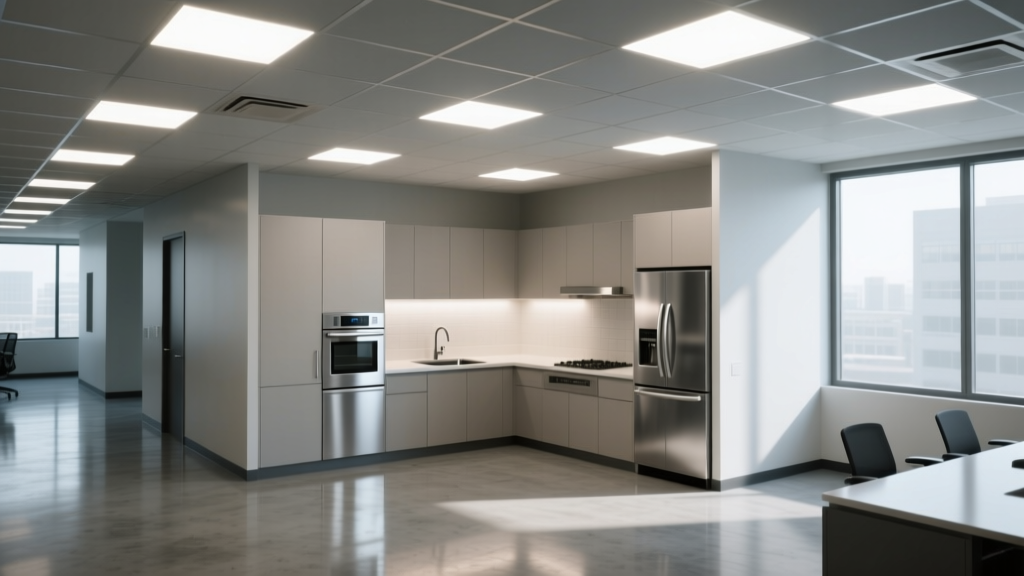
Code Compliance Deep Dive: When Does an Office Kitchenette Trigger ASHRAE 90.1-2022 ‘Food Service Area’ Lighting Rules?
Think of ASHRAE 90.1 like a jazz musician reading a lead sheet — the notes are there, but interpretation lives in the phrasing, the rests, the subtle weight you give each measure. That’s how I’ve come to understand Section 3.2.1 after reviewing dozens of tenant improvement drawings this year — especially when someone slides a sketch across the table saying, “It’s just a microwave and a sink. Do we *really* need to treat this like a cafeteria?”
I’ve seen it happen three times this quarter alone: a sleek, 60-sq-ft kitchenette tucked beside a conference center, clad in matte black tile and pendant lighting that costs more per fixture than my first car. The architect’s question is sharp and practical: Does this space trigger food service area lighting rules under ASHRAE 90.1-2022? Not because they’re avoiding compliance — but because misclassifying it triggers a cascade: tighter LPD limits, mandatory hood interlocks, potential daylighting controls, and, yes, a real budget hit.
What ASHRAE Actually Says (and What It Leaves Unspoken)
Let’s start with the text — not the rumors, not the “what the MEP guy told me at lunch,” but the actual language in Section 3.2.1 of ASHRAE 90.1-2022:
“Food Service Area” means a space where food is prepared, cooked, heated, or held for immediate consumption, including commercial kitchens, cafeterias, break rooms with cooking appliances, and similar spaces.
Note the phrase: “including commercial kitchens, cafeterias, break rooms with cooking appliances…” That “with cooking appliances” is doing heavy lifting. It’s not “with microwaves” — though microwaves are cooking appliances — nor “with sinks.” It’s not even “with refrigerators.” It’s about function, not fixture count.
This is where ASHRAE Interpretation #2022-004 becomes indispensable. Issued March 2022 and affirmed in the 2022 Errata Supplement, it clarifies:
“A break room or kitchenette containing only a microwave oven and/or refrigerator does not constitute a Food Service Area *unless* the microwave is rated above 1.5 kW output power, or the space is designed or intended for continuous food preparation activities beyond reheating single-serve items.”
That “1.5 kW output power” threshold matters — because most office microwaves sit between 0.7 kW and 1.2 kW. A countertop Panasonic NN-SN966S? 1.2 kW. A commercial-grade Sharp R-21LCFS? 1.5 kW. But here’s what trips people up: ASHRAE doesn’t care about the nameplate rating on the back of the unit — it cares about how the space is documented and intended to be used. If the construction documents say “for employee meal prep,” or if the tenant plans to install steam tables, warming drawers, or a convection toaster oven down the line, the intent shifts. And intent — confirmed by design narrative, equipment schedule, and even lease language — can override appliance specs.
The Lighting Power Density (LPD) Trap — 0.9 vs. 1.3 W/ft² Isn’t Just Math
Here’s where it gets visceral. In a standard office space — think open-plan workstations, private offices, corridors — ASHRAE 90.1-2022 sets the LPD limit at 0.9 W/ft² for interior lighting (Table 9.6.1). Tight, yes — but achievable with modern LED troffers, direct-indirect pendants, and good layout discipline.
Flip to Table 9.6.1 again, scroll down to “Food Service Areas,” and you’ll see 1.3 W/ft². Higher — but not generous. That extra 0.4 W/ft² sounds like breathing room. It isn’t.
Why? Because food service areas require task lighting over prep surfaces (300–500 lux minimum), accent on signage or branding elements, and often high-CRI lighting (≥90) for food appearance. You can’t get there with basic 4000K, 80-CRI troffers. You need dedicated under-cabinet LEDs (e.g., 24-inch linear strips at 1,200 lm each), recessed downlights over sink zones (15° beam, 90-CRI, 3,500K), maybe even color-tunable cove lighting near pantry shelves. All of that adds up — fast.
I recently audited a 60-sq-ft kitchenette in a Class-A Boston office tower. The original spec called for six 18W LED pendants (108W total = 1.8 W/ft²). Way over both allowances. The redesign? Four 8W integrated LED downlights (32W), two 6W under-cabinet strips (12W), and one 4W vanity light over the sink (4W). Total: 48W. That’s 0.8 W/ft² — compliant for office use, but only because we successfully argued the space wasn’t a food service area. Had it been classified as such, 1.3 W/ft² would have given us 78W — still tight, but enough to add that warm-dim under-cabinet strip I wanted.
This works because LPD isn’t just about watts — it’s about visual hierarchy. In true food service areas, you’re lighting action: chopping, plating, checking temps. In a kitchenette? You’re lighting pause — pouring coffee, grabbing yogurt, heating yesterday’s lasagna. The human rhythm is different. So the lighting should be too.
Hood Exhaust Interlocks: The Silent Trigger
Now, the part that makes architects quietly sweat: hood exhaust interlocks.
You’d think — no range, no fryer, no gas line — no hood required. And you’d be right. But ASHRAE 90.1-2022 Section 6.4.2.4.2 says:
“Where a commercial-type kitchen hood is installed in a Food Service Area, the lighting shall be interlocked with the hood exhaust fan so that lighting cannot operate unless the exhaust fan is running.”
Key phrase: “where a commercial-type kitchen hood is installed.” So if you don’t install one — problem solved? Not quite.
Interpretation #2022-004 digs deeper. It states that if the space is classified as a Food Service Area *and* includes ventilation designed to meet IMC or IECC requirements for grease-laden air (i.e., ducted to exterior, ≥150 CFM, Type I hood listed to UL 710), then the interlock applies — even if the hood is added later during fit-out or by a future tenant.
I saw this play out in Austin last fall. A 75-sq-ft kitchenette had a 200 CFM ducted exhaust tied to a wall-mounted inline fan — specified for “odor control,” not grease. But the duct was 8-inch rigid metal, terminated outdoors, and sized for 225 CFM. The AHJ flagged it: “This meets the functional definition of a Type I hood system per IMC Section 506.2.1. Interlock required.” They weren’t wrong.
This falls flat because nobody reads duct specs like poetry. We assume “exhaust fan” = bathroom fan. But ASHRAE and the IMC don’t. If your kitchenette’s exhaust moves >100 CFM, terminates outdoors, and handles anything more than ambient air — especially if it’s sized for future upgrade — you’re dancing close to that interlock line.
Room-by-Room Reality Check
Let’s ground this in real dimensions and decisions.
The 60-sq-ft Kitchenette (10′ x 6′)
- Typical build-out: 1 microwave (1.1 kW), 1 undercounter fridge, 1 farmhouse sink, quartz counter, open shelving.
- Lighting strategy: Two 4″ recessed downlights over sink (35W total), one 24″ under-cabinet strip (6W), one 15W vanity sconce — total 56W (0.93 W/ft²).
- Compliance call: Not a Food Service Area — provided microwave is ≤1.5 kW, no hot holding equipment, and no lease language indicating commercial food prep. LPD stays at 0.9 W/ft². No interlock needed.
The 120-sq-ft Break Room + Prep Zone (15′ x 8′)
- Typical build-out: Double-door commercial fridge, convection toaster oven (1.8 kW), induction hot plate (2.4 kW), prep island with backsplash, ducted 300 CFM hood.
- Lighting strategy: Task layer (under-cabinet strips, 48W), ambient layer (recessed 6″ downlights, 60W), accent (shelving LEDs, 12W) — total 120W (1.0 W/ft²). Still under 1.3 W/ft², but tight.
- Compliance call: Unequivocally a Food Service Area. LPD allowance jumps to 1.3 W/ft² (156W max). Hood interlock mandatory. Also triggers demand-controlled ventilation per Section 6.4.2.3 — another layer.
The “Gray Zone” Lounge-Kitchen Hybrid (20′ x 12′ = 240 sq ft)
- Typical build-out: Built-in microwave drawer (1.4 kW), wine cooler, induction cooktop (1.6 kW), sink with garbage disposal, open bar with glass shelving.
- Lighting strategy: This one’s messy. Is the cooktop for staff meals or catered events? Is the microwave drawer accessible only to facilities staff? The answer lives in the narrative — not the square footage.
- Compliance call: I’ve seen this go both ways. If the program memo says “for occasional team lunches, no daily cooking,” and the cooktop is locked behind a cabinet, it stays office LPD. But if the space appears in marketing materials as “collaborative culinary lounge,” or if the tenant’s operations manual lists “daily meal assembly,” it’s food service. Intent, again — written down, not whispered.
What to Do Before You Spec a Single Fixture
Before you drop a luminaire schedule into your TI package, do this:
- Document intent in writing. One paragraph in the design narrative: “This kitchenette serves exclusively as a break area for reheating pre-packaged meals using a single 1.2 kW microwave. No food preparation, cooking, or hot holding occurs. No future installation of cooking equipment is anticipated or permitted per lease terms.”
- Verify microwave specs — not model numbers. Get the manufacturer’s cut sheet. Look for “output power” (not input). Many “commercial” microwaves are 1.4 kW output — right at the edge. Push for 1.2 kW if possible.
- Review exhaust specs with your mechanical engineer. If CFM >100, ducted outdoors, and metal-lined — assume interlock applies unless you can prove it’s solely for odor control *and* sized accordingly (e.g., 80 CFM, flexible duct, terminated through roof curb).
- Flag it early with the AHJ. In cities like Seattle, Portland, and NYC, plan reviewers routinely request food service classification memos. Submit yours with the initial submittal — don’t wait for comments.
I think the biggest mistake I see isn’t misreading the code — it’s assuming the code is static. ASHRAE 90.1 evolves, interpretations stack, and local amendments shift the ground. Last month, Chicago added Appendix G language requiring all kitchenettes with microwaves >1.0 kW to comply with food service LPD — stricter than national ASHRAE. Always check the jurisdiction’s adopted version.
And remember: lighting isn’t just about watts and watts per square foot. It’s about how people move through space, what they do there, and whether the light supports — or undermines — that behavior. A 60-sq-ft kitchenette lit to 0.9 W/ft² with layered, warm-white, dimmable LEDs feels generous. Lit to 1.3 W/ft² with harsh, over-bright task lighting? It feels like a cafeteria at 3 p.m. — tired, transactional, slightly grim.
So yes — classify correctly. Read Interpretation #2022-004 twice. Cross-check with your AHJ. But also ask: what kind of experience do we want here? Because compliance without intention is just paperwork. And light, at its best, is never just paperwork.